.png) 1 month ago
49
1 month ago
49
There were plenty of reasons to believe the US hosting the World Cup would be a disaster.
In the year and a half leading up to the kick-off, Donald Trump had threatened to annex tournament co-host Canada, and to invade the other co-host, Mexico; he was at war with one of the tournament’s participants, Iran. Harsh travel restrictions were preventing fans from Senegal, Ivory Coast and Haiti from getting visas. Ticket prices were outrageous. Hotels weren’t filling up as promised. Fifa was introducing “hydration breaks” during games, allowing TV commercials in what appeared to be a shameless cash grab that threatened the flow of play.
Finally, in a country where the beautiful game has only ever flourished because of immigrants, the White House was overseeing brutal sweeps to forcibly expel millions from those very communities. America – where soccer has always trailed other sports in popularity – was poised to be the most unwelcoming host of a tournament that, Fifa boasts in its advertisements, “unites the world”.
Then the soccer started.
The world’s TV screens and social media feeds were filled with footage of American stadiums packed with rapturous, record-setting crowds. Through the first 78 matches, according to Sports Business Journal, an average of 64,511 fans were attending each game – 10,000 more than the 2022 tournament. Stadiums have averaged a 99.7% occupancy rate and Fifa says it has sold 6.5 million tickets. Those in attendance haven’t just been from overseas, or Americans with familial ties to other nations, but American fans in love, or falling in love, with the game.
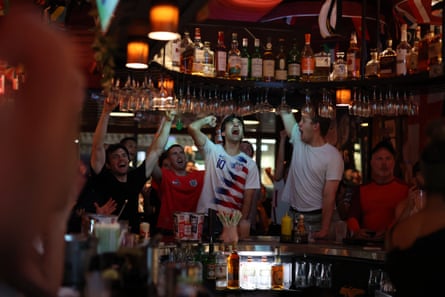
American TV viewership is breaking records too. According to Nielsen ratings, the US men’s national team’s (USMNT) round-of-16 loss last week to Belgium drew an average of 33 million viewers to Fox’s English-language broadcast, peaking at 41 million viewers in the final 15 minutes of the match. Per the Wall Street Journal, that’s a higher number than the tally of those who watched the 2025 World Series and Game 5 of last month’s NBA finals.
It was, per the Athletic, “the most-watched soccer telecast on one network in US history”, breaking the record set days prior, when over 26 million people watched the USMNT beat Bosnia, again only breaking a record set days prior, during the USMNT’s 4-1 trouncing of Paraguay.
But viewers in the US aren’t just tuning into US games. Sunday’s thriller between England and Mexico drew a jaw-dropping 21.7 million viewers on Fox and another 23.2 million on Telemundo. Fox has seen a record-breaking average of 5 million viewers over the first 72 matches, with Telemundo averaging another 4.6 million. Mike Mulvhill, the president of insights and analytics for Fox Sports, noted that only two weeks into the tournament, the “average Fox/FS1 World Cup viewer” had already watched more matches than they did during the entire 2022 tournament.
Outside of those metrics, polling from Ipsos Sports shows that four in 10 US adults have actively followed the tournament on social media. One-quarter of Americans have watched a game at a restaurant or bar. One-fifth have gone to a World Cup watch party.
Alex Lawton, a 32-year-old watching the Spain-Belgium quarter-final on a TV screen outside Bar Tabac in Brooklyn, said he’d “lost track” of how many games he’d watched this World Cup but estimated in it was “dozens”. He noted that, although he speaks only a little Spanish, he’d watched a lot of the games on Telemundo, “because it’s one of the more accessible ways to stream it”. (Telemundo, hosted on Peacock, is half the price of subscribing to Fox One, which hosts the English-language broadcast.)
“It’s completely ubiquitous,” Lawton’s friend, 31-year-old Paul Revell, said of watching the tournament in New York City. “I mean, you can go on any block in New York and there’s going to be a vibe, with people cheering.” Even on the subway, he said, he’d ended up watching games on strangers’ phones. “Everyone was screaming on the train,” he remembered, calling it an “amazing moment”.
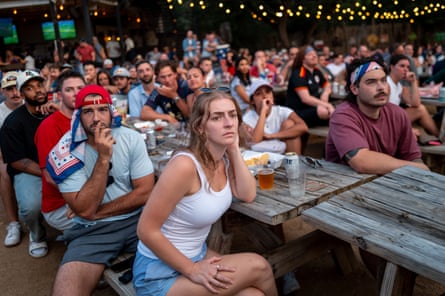
There are tangible reasons for this surge in American World Cup fandom. Soccer has long been growing in popularity here. After the US hosted the World Cup in 1994, some of the $100m in profits from the tournament were used to launch Major League Soccer, giving the country a men’s league of its own. In 1999, the Women’s World Cup was hosted in the US with the US women’s national team (USWNT) winning the tournament in dramatic fashion. The National Women’s Soccer League was launched in 2012; and in 2019, the USWNT won the World Cup again. US TV networks secured rights to broadcast the Premier League and La Liga, turning millions of Americans into diehard fans, piling into bars in the wee hours of the morning to watch the north London derby or El Clásico.
One in ten Americans identified soccer as their favorite sport in a January report in the Economist, edging out “America’s pastime” – baseball – to become the country’s third-most popular game.
Another obvious reason for the 2026 World Cup’s success in the US is that many of the games have been broadcast during primetime, meaning Americans don’t have to navigate work and sleep schedules to watch games being played in distant timezones.
Above all else, many Americans have likely tuned in because the soccer has been so damn good.
The tournament is averaging three goals per game – the most since the 1958 World Cup, and a welcome development in addressing the frequent American complaint that soccer doesn’t have enough scoring. The world’s superstars are on a tear, with France’s Kylian Mbappé and Argentina’s Lionel Messi tallying eight goals a piece; Norway’s Erling Haaland netting seven; and England’s Harry Kane putting home six. Many games have been decided with dramatic, stoppage-time goals.
The tournament’s expanded format, which included 16 more teams than previous World Cups, has allowed remarkable Cinderella stories. Americans cried with joy when Curaçao, the tiny Caribbean nation of only 150,000 residents, and the smallest country to ever qualify for the tournament, scored its first ever World Cup goal against perennial powerhouse Germany (who went on to win 7-1). Cape Verde, another island country with only half a million people, went on a miraculous run, tying all of its opponents in the group stage and advancing to the knockout round, where they scored twice against Argentina, the 2022 tournament champions.
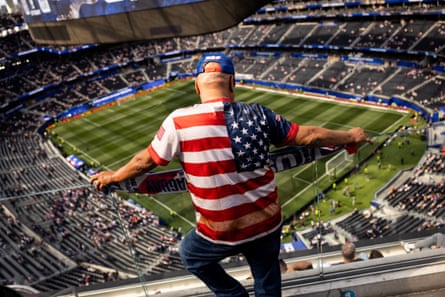
There’s also a harder-to-measure, more intangible reason for why Americans might be loving this World Cup. The tournament’s inherent internationalism has given Americans an outlet for a joyous multiculturalism under attack by this administration’s nationalism and isolationism. It has provided a stage for Americans to show the world: we are not our government.
Lawton, watching Spain-Belgium in Brooklyn, called the World Cup a “brilliant reprieve and a unifying force that has just brought people from different walks of life and backgrounds together in a super beautiful way”.
And arguably, the most “beautiful” and now-viral moments of this World Cup have taken place off the field.
Residents of Lawrence, Kansas, were so touched that the Algerian team chose to train in their city that they could be seen chanting “One, two, three, viva l’Algérie!” The University of Kansas marching band played the Algerian national anthem when they took the field. In Texas, a viral video showed a Japanese fan being ushered on stage at a nightclub to dance with some rappers from Houston. Scotland fans, nicknamed the Tartan Army, took over Boston to residents’ delight, nearly drinking the city out of beer.
Across the country, from Mexican fans in LA’s Koreatown to Ecuadorian fans in Astoria, Queens, photos and videos showed thousands of people packing the streets to watch the games on projectors, or through bar windows, or in the back of bodegas.
“It was such a vibe! They made history and gave us hope. ‘Si se pudo!’ we chanted when the final whistle blew,” recalled Steven Guevara, an Ecuadorian American who lives in the Bronx, who watched Ecuador play Germany at Pig Beach in Astoria with hundreds of other fans. “Beer was thrown in the air in celebration, and complete strangers were hugging and jumping up and down together, and some even crying tears of joy. It was such a beautiful moment.”
The scenes were the furthest cry from Trump’s Great American State Fair, the Washington DC event organized by the president for America’s 250th birthday on the Fourth of July. One video shot by TMZ shows Dr Mehmet Oz, a Trump administration official, speaking from a stage to just a handful of attendees. “There’s a ton of people here,” Oz claims, only for the reporter to pan the camera around, showing no crowd at all, the nearly empty National Mall stretching into the distance.