.png) 3 months ago
49
3 months ago
49
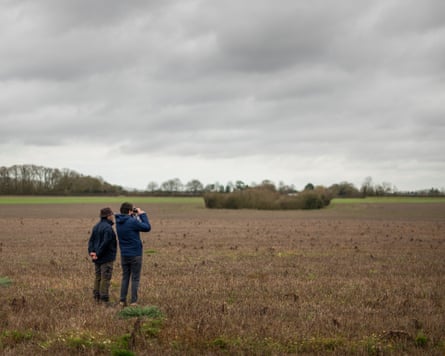
The place where Norton Wood once stood is now a vast field of decaying wheat stubble. The ancient wood was grubbed up during the second world war. No trace of it remains – on the surface, at least. This ghost in the landscape lives on only in the name of the local village: Wood Norton.
But trees will soon be bursting upwards again and the wood will regrow after Norfolk Wildlife Trust celebrated its 100th birthday by buying a swath of farmland to revive for nature.
The first of the Wildlife Trusts, a national coalition of 47 independent charities with nearly a million members and 2,600 nature reserves, marks its centenary on Friday.
A Norwich doctor, Sydney Long, began the county trusts movement when he assembled a group of 12 “subscribers” in the George and Dragon pub at Cley in north Norfolk. They snapped up the nearby marshes for £5,160 at auction, turning 407 acres into “a bird sanctuary for all time”.
Today, rare birds still thrive at Cley, one of more than 60 wild places cared for by Norfolk Wildlife Trust.
But its £4.6m purchase of 136-hectare (336-acre) Wood Norton reflects a transformation in how nature conservation charities are saving wildlife: rather than just protecting isolated fragments of species-rich land, they are seeking to restore lost habitats and boost bioabundance.
Eliot Lyne, the chief executive of Norfolk Wildlife Trust, describes Wood Norton as “one of the most significant habitat creation projects in our 100-year history”.
Giving the Guardian a tour of Wood Norton’s pretty vale of peaceful fields, Steve Collin, a nature conservation manager at Norfolk Wildlife Trust, said: “Traditionally conservation has been about just protecting the rare. It needed to be done but there’s a growing realisation that many of our more common species are suffering, too. Biodiversity and bioabundance are two sides of the same coin. We can’t wait until something is really rare to start looking after it.”
Wildlife looks poised to spring back at Wood Norton. The air is full of singing skylarks that this year will nest on the arable fields without disturbance from the plough. Roe deer gaze at us from a distance and a Chinese water deer bursts from a sallow thicket beside an old pond. There are kestrels, badger tracks, fox scents and soon the fields will be full of arable weeds offering a banquet of nectar for insects.
Wildlife restoration on neglected land or relatively unproductive fields is essential to reverse the disastrous national decline in wildlife, according to conservation scientists and nature-conscious farmers. As Collin puts it: “This wildlife that we are depleting is what looks after us as well.”
The Wildlife Trusts are also finding that restoration inspires strong support, particularly from younger generations, although turning farmland into wilder land is not universally welcomed. Critics say a country that already imports 48% of its food should not abandon food-producing land.
“We’re not into taking land out of production where we need it,” said Collin. Wood Norton’s soils were grade three agricultural land (grades one and two are the best food-producing soils). “These soils are very reliant on artificial fertilisers and chemicals, and the heavy clay requires a lot of diesel to cultivate.”
Collin also argues that the trust is supporting neighbouring farmers by what will unfold at Wood Norton: newly nature-rich land will provide pollinators for crops and natural pest control in the form of predatory beetles, while the retention of more water on Wood Norton land will lessen both floods and droughts downstream.
It will also improve water quality, with Wood Norton’s purchase enabled by £3.8m from Natural England’s “nutrient mitigation scheme”, which funds the removal of land from intensive farming close to sensitive river catchments, reducing the flow of nitrates and phosphates into polluted waterways.
Under the government scheme, the new nature reserve will cut nutrient pollution in the River Wensum and the Norfolk Broads over a 125-year period, enabling developers to build a certain number of houses in the wider catchment.
“We’ll create a bigger, better home for nature,” said Lyne. “But it will be fantastic for people too. We’re creating a wild place that will capture carbon, allow the land to once again act as a natural floodplain, and one in which residents and visitors can explore, learn and feel connected to nature. This land purchase has also helped unlock local housing development – so as well as creating new homes for wildlife, we’re helping in the effort to provide homes for our communities too.”
The big first task for the trust is to rewiggle the canalised Wood Norton beck, which runs into the Wensum, an internationally important chalk stream. The beck may turn out to be a chalk stream, too.
A pair of beavers have been found living wild in the Wensum 4 miles upstream, but the animals are still controversial in arable landscapes and the trust may have to rely on diggers to create new meanders and “leaky dams” in the beck, which will boost water quality and rapidly increase the wetlands and a suite of species from snipe and egrets to fish, amphibians and dragonflies.
What happens after that at Wood Norton reflects another big change in a century of conservation: the belief that the land should decide its destiny.
“We don’t want to go from a human-created arable landscape to a human-created wildlife landscape,” said Collin. “If you do that you risk trying to force the wrong thing into the wrong place. We’ve got to be agile, and adapt to what the landscape wants to do.”
The desire to restore “natural processes” has been popularised by the success of the rewilded dairy farm at Knepp, West Sussex. In time, herbivores such as cattle and ponies may be returned to Wood Norton to ensure there is a mosaic of open grassland alongside revived woodland around Norton Wood.
Collin, who spent two years searching for suitable land for restoration, is excited by Wood Norton’s potential. “The farming family who owned this land had a respect for it,” he said. “They kept trees and hedges that many would’ve grubbed out but it was a hard job to make a living out of it. We need places like this and nature-friendly farming – or we’re going to live in a world without wildlife.”
An antidote to gloom
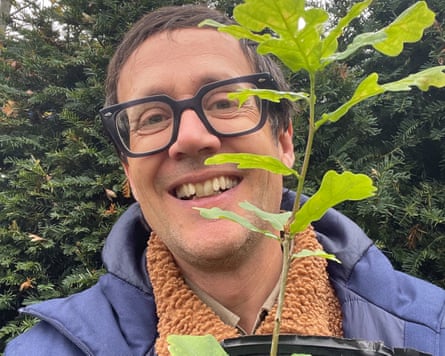
The county Wildlife Trusts began with 12 “subscribers” in a pub. Nationally, they now have more than 945,000 members. I’m one of their growing band of 33,000 volunteers because, like many, I’ve found an antidote to global doom and gloom in taking modest action to restore nature in my local neighbourhood.
Over the past year, my voluntary efforts to help Norfolk Wildlife Trust bring back wildlife have focused on growing oak trees from local acorns, and helping schoolchildren do the same. The trees that I’ve raised will be returned to Wood Norton and another new woodland springing up next to Norfolk’s largest ancient woodland, just 2 miles from Wood Norton.
This year, I’m raising funds for Norfolk Wildlife Trust to undertake further local nature restoration by running the London Marathon with a big handicap: I’ll be dressed as a badger, the national symbol of the Wildlife Trusts.
My Guardian stories may become tomorrow’s fish and chip paper but one of the oaks I’ve raised could still be standing in a thousand years’ time. In the meantime, watching wildlife bounce back and take over land where it’s been banished for decades is intrinsically joyful and hopeful.
-
Patrick Barkham is (voluntary) president of Norfolk Wildlife Trust