.png) 1 month ago
39
1 month ago
39
The commemorative Queen Elizabeth II centenary teddy bear stands 30cm tall, is made from finest mohair and retails for £289, payable in three interest-free instalments. It comes dressed in the queen’s classic lime-green ensemble with a white handbag draped over its left paw, which, according to Nicolas Metz, the managing director at the collectibles retailer Galerista, “is how we all remember her”.
And once you get over the basic category absurdity of seeing a toy bear dressed up to look like a nonagenarian constitutional monarch, you realise he’s right. What better way to commemorate our late queen than with a piece of premium souvenir anthropomorphism: cuddly, relatable and yet entirely inanimate, a vessel for our unthinking veneration and overactive imagination?
At the very least, we still underestimate the extent to which – for the millions of humble subjects who neither knew nor met her – the queen was an effortless source of content, a blank canvas upon which to project our rolling national psychodrama. In a sense, she was our original parasocial relationship, a relationship that expressed itself in death as richly as it did in life.
You only had to watch the stream of Instagram posts from people who queued for hours to watch her coffin lying in state, the many weeping on-camera testimonies from mourners for whom she was basically a human keepsake, our very own £289 stuffed bear. The more reverent spoke of her as if she were a cherished member of the family. Even the more instinctively republican of us were careful to question the institution rather than the 96-year-old great-grandmother: an entire nation essentially in thrall to the idea of the infallible monarch.
For sure, Queen derangement syndrome remains a highly lucrative business, at least if Sunday night’s BBC documentary titled Her Story, Our Century was any guide. A roll-call of celebrities – Barack Obama, Tom Jones, David Attenborough, Gyles Brandreth – was wheeled out to burnish the mythology. Two recently published biographies, by Robert Hardman and Hugo Vickers, attempt to squeeze a few last drops of capital out of a life that has already been venerated and picked over long beyond the point of usefulness.
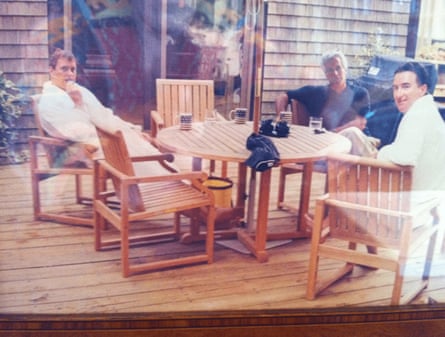
Time and again, these rambling hagiographies return to a sense of “duty”, a concept frequently evoked but rarely defined. Duty to her country, duty to her office, duty to her people, duty to the monarchical institution. How about duty to the traumatised victims of Jeffrey Epstein – considering her disgraced son maintained a close personal acquaintance with the sex offender, and that the late queen eventually helped Andrew pay a multimillion-pound settlement to the woman who accused Andrew and Epstein of sexual assault? It’s never made entirely clear, an elision you have to assume is partly intentional: a hallmark of a more censorious era, a society that has gradually grown more and not less deferential towards the powerful.
“It feels too early to be mean about our late queen,” runs a recent comment piece in the Telegraph. Meanwhile, it’s now almost two decades since the comedian Frankie Boyle made a tasteless gynaecological joke about the Queen on BBC2’s Mock the Week, which prompted only six complaints in the first two years after it was broadcast. Is it remotely conceivable that such a joke would even be allowed to air today?
For all this, in the 43 months since her passing, the legacies of the late queen and the institution she embodied have taken subtly different paths. While Elizabeth II remains wildly popular in death, affection for the monarchy itself has rarely been more volatile. Last September, the National Centre for Social Research found that support for it had dropped to its lowest level since records began. A Savanta poll in February, around the time of Andrew Mountbatten-Windsor’s arrest (he has denied any wrongdoing), found that just 45% of Britons preferred to have a monarch over an elected head of state.
Perhaps this helps to explain why, in the post-Andrew age, the late queen’s centenary feels so weirdly low-key, given the ample opportunities for pomp and pageantry it provides. This is, we are consistently told, an institution in skinny mode, trying to keep a lower profile amid the juddering waves of Andrew-flavoured scandal. Numerous media reports have emerged of Prince William demanding a smaller and more efficient monarchy when he becomes king, with all the apocryphal energy of a disciplinarian manager taking over a struggling football club and symbolically banning ketchup from the training-ground canteen.
In a way, these debates strike at a more fundamental crisis of identity within the modern royal family. If Elizabeth II stood for constancy and dignity in a world of flux, then what shall be the hallmark of the current house of Windsor, with its effortless predilection for scandal? Once, the monarchy stood for power; then decorum and class; then relatable family entertainment; then dignity and virtue. None of these avenues remain open to it. And yet it must maintain the elaborate illusion, maintain its essential absurdity with a straight face, maintain the basic species mystique that compels a post-Enlightenment society to – as Thomas Paine once memorably put it – “promiscuously worship the ass and the lion”.
Over seven decades, for better and worse, through a combination of hard-nosed politicking, strategic pivots and Paddington Bear skits, the late queen kept the show on the road. Perhaps the years after her passing have exposed how narrow and treacherous was the path she wove. “We have to be seen to be believed,” she is believed to have once said. What happens when she can no longer be seen? We may be about to find out.
-
Jonathan Liew is a Guardian columnist