.png) 2 months ago
65
2 months ago
65
Since it was penned in 1973, Pakistan’s constitution has been dealt many blows. Originally a statement of democracy, it was just a matter of years before a pattern of endless constitutional amendments began, validating successive coups and military dictatorships.
Yet for the past 15 years, the constitution had – at least on the surface – returned Pakistan to some semblance of civilian rule. That was until last month.
As parliament rushed to pass the 27th amendment, critics and analysts widely decried it as a “constitutional coup” that would enshrine military dominance over Pakistan in perpetuity.
“There is no constitution in Pakistan now. No judiciary. No social contract. The amendment is an unforgivable crime against the country” said Mahmood Khan Achakzai, the chair of the opposition alliance known as Tehreek Tahafuz Ayeen-e-Pakistan. “They have made one man into a king above all.”
It was widely acknowledged that there was really just one beneficiary to the 27th amendment. General Asim Munir, Pakistan’s army chief, was already the most powerful man in the country. Now, however, he is set to become one of the most powerful generals in the country’s history, with privileges akin to those of past military dictators.
Munir will oversee not just the army but also the navy and air force. His five-year term will restart, and has the possibility to be extended again, raising the prospect of him remaining in his role for at least another decade – an unprecedented term. He has also been granted lifelong immunity from criminal prosecution.
The amendment has also been accused of being a direct attack on Pakistan’s already-beleaguered judiciary. A new constitutional court, where judges are picked by the government, will replace the supreme court. Several senior judges have resigned in protest, claiming that the only remaining check on executive and military power has been crushed.
“It’s military rule, martial law by any other name,” said Ayyaz Mallick, a lecturer in human geography, specialising in Pakistan, at the University of Liverpool. “During direct forms of military rule in Pakistan we saw exactly the same thing happen.”
The amendment also prompted criticism from UN high commissioner for human rights Volker Turk, who warned of “far-reaching consequences for the principles of democracy and rule of law”.
To many observers, this was Munir seizing his moment. After an election in 2024 that was marred by documented allegations of rigging and bias, Pakistan’s ruling coalition government is widely seen as weak, unpopular and illegitimate, solely dependent on the backing of Munir – what Mallick described as a “military ventilator” – to stay in power.
Meanwhile, Munir has been riding a wave of popularity after hostilities with neighbour and rival India broke out in May, which saw cross-border drone and missile strikes launched by both sides. After Pakistan claimed to have shot down several Indian jets, Munir claimed victory over India, prompting a wave of militaristic and jingoistic fervour to grip the country. The India clashes were nothing short of a “godsend” for Munir, said Mallick, with the army chief promoted to post of five-star general.
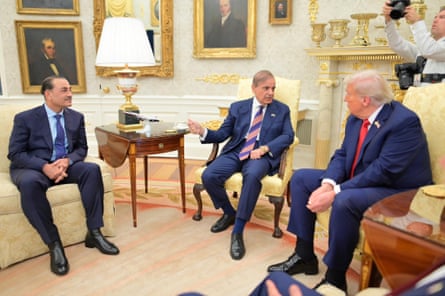
Munir began to position himself as something of a global statesman. After Pakistan nominated Donald Trump for the Nobel peace prize for his supposed role in bringing India and Pakistan back from the brink of war, Munir had an unprecedented two meetings with the US president in Washington.
For Pakistan, which has been shut out by the White House for a decade, Munir’s perceived success in bringing the country in from the cold – even earning the title of Trump’s “favourite field marshal” – elevated his position further. Munir was also at the forefront as Pakistan signed a significant defence pact with Saudi Arabia in September.
To many, the level of power that now rests in Munir’s hands was revealed by the speed at which the 27th constitutional amendment was approved. While previous amendments were discussed, revised and debated on for weeks by parliament, it took just a couple of hours for it to sail through both the senate and then the lower house with the necessary two-thirds majority, with only minor tweaks.
“What we have now is a political government whose legitimacy is so fragile that without the military’s backing, it would basically be nowhere,” said Farzana Shaikh, associate Fellow of the Asia-Pacific programme at Chatham House. “And Munir has seized this opportunity.”
While Shaikh emphasised that Pakistan’s history was one of political parties enabling the military for their own short-term political gain, she added, “it’s still extraordinary seeing two parties cave in the manner they have.”
The consequences, she added, were grave. “There’s no question that it is a significant – I would say the most significant – setback to any kind of transition towards an accountable government, let alone democracy,” said Shaikh. “This constitutional amendment allows Munir to act with complete impunity. It’s an extremely dangerous situation.”
Concerns have also been raised within the army at Munir’s newfound concentration of power over all three branches of the military, in particular its consequences for his authority over Pakistan’s nuclear arsenal.
Some raised concerns that Munir – whose reputation is one of a “reckless operator” and an ideologue, especially when it comes to his hardline approach to India – would now have unparalleled control over nuclear command.
One retired senior general, who spoke anonymously for fear of retribution, called the amendment “disastrous” and said resentment “has already begun among other forces, in the navy and air force. The proposed amendment does not benefit the defence structure; rather it benefits just one individual”.
Streamlining the nuclear command under singular army control – effectively removing all civilian government oversight – was also “deeply problematic”, he added.
Defence minister Khawaja Asif, among those who voted in favour of the amendment, refuted the criticism. “Pakistan’s armed forces are part of the state and if they do good work, we support them and stand by them,” he said. “Parliament bestowed immunity upon Field Marshall Munir because he won the war against India for the country. Saying he is all-powerful is just speculation.”
To some, the amendment simply codified a longstanding arrangement, that of the military de facto running the country and manoeuvring politics. Since he became army chief, it was Munir who was seen to have engineered the crackdown against popular former prime minister Imran Khan and his Pakistan Tehreek-e-Insaf (PTI) party. Khan and senior PTI leaders are all now behind bars, after they challenged military interference in Pakistani politics. Two serving cabinet ministers, finance and interior, are both recognised as Munir appointments.
Yet, as Walter Ladwig, senior associate professor in International Relations at King’s College London, emphasised, “the long-term implications of this are profound”.
“If there were ever an effort to try to reverse or rebalance power away from the military and back under civilian control, undoing this amendment will be significant feat,” he said. “Munir is now harder to remove than the prime minister or the president or any army chief who came before him.”
Nonetheless, analysts pointed out that Munir’s newfound power also came with challenges. Pakistan is grappling with two domestic terrorist insurgencies as well as hostilities with neighbours India and Afghanistan, and the country is also in the midst of a severe economic crisis that he has been unable to fix.
Munir was not the first Pakistan general to come up with a plan to retain power for years, Mallick noted; the country’s last military dictator Pervez Musharraf had one that spanned decades, before widespread dissatisfaction toppled him. “As history also shows, these long-term plans by generals never really work in Pakistan,” he said. “If money doesn’t flow in, the whole thing falls apart.”