.png) 5 hours ago
5
5 hours ago
5
While fewer of us are eating meat regularly – I refer you to the rise of “beef days” – if you’re going to cook it, it needs to be done properly. Overcooked beef with the texture of shoe leather, or undercooked poultry with a side of food poisoning, will put off even the most devoted carnivore.
A reliable meat thermometer solves both problems. It takes the guesswork out of cooking, helping you achieve melt-in-the-mouth steak and the best of any cut, with no special skills required.
As a bonus, it can even help you make modest energy-use savings by preventing overcooking. Buying one of the best meat thermometers isn’t about adding to a pile of gadgets – it’s about making the most of the meat you choose to eat. Personally, I’d choose a cheaper piece of meat cooked perfectly over a pricey one that’s dry and chewy.
At a glance
Best meat thermometer overall
£89.99 at SharkNinja
Ninja ProChef wireless thermometer WP100EUBest budget meat thermometer
£17.99 at Amazon
Salter Heston Blumenthal Precision indoor/outdoor meat thermometerBest wireless smart meat thermometer
£199.99 at Amazon
Typhur Sync Gold dual two-probe wireless meat thermometerBest wireless Bluetooth meat thermometer
£129 at John Lewis
Meater ProBest leave-in meat thermometer
£32.50 at ETI
ETI Dot digital oven thermometer
Why you should trust me
I grew up believing that I didn’t like meat – I was vegetarian through my teens. Turns out, I just didn’t like how it was cooked. As an adult, I’ve always kept a meat thermometer at hand and have been testing them since I bought my first Meater wireless probe nine years ago. Since then, I’ve upgraded as the tech has improved. I test a lot of air fryers, multicookers and ovens, so for me a meat thermometer isn’t just a nice-to-have – it’s an essential tool for assessing how well an appliance cooks.
How I tested
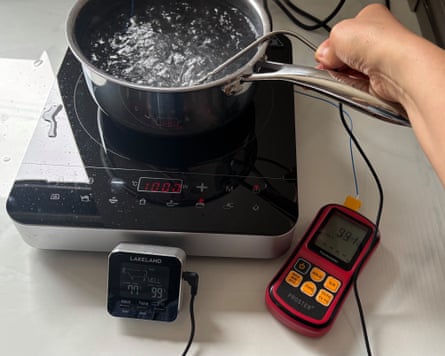
There are unexpected side effects to testing meat thermometers. One is cooking so much meat that a slightly greasy fug lingers in the house for days. Another is temporarily altering my App Store algorithm, after downloading five meat thermometer apps in succession. That’s a lot of cooking, says the store. Would I enjoy these 10 grocery shopping apps? Or how about some hiking and cycling apps to balance out your burger binge?
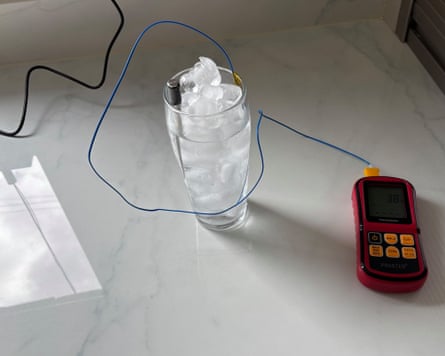
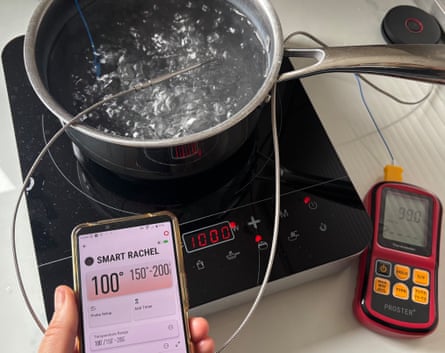
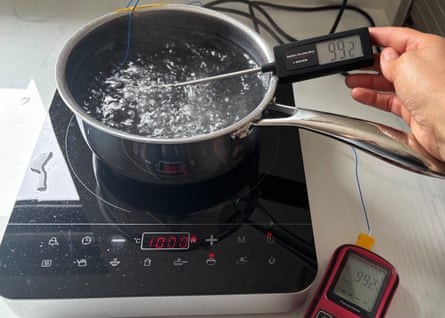
I tested 12 thermometers, but only nine made the cut. The first two tests used hot and cold calibration methods. I took the temperature of boiling water in a pan and ice water in a glass, alongside a thermocouple thermometer, and compared the readings. This was repeated three times for each. Since meat thermometers are designed for solids, liquid readings may not be degree-perfect, but they provided a guide to accuracy at the upper and lower limits of the scale.
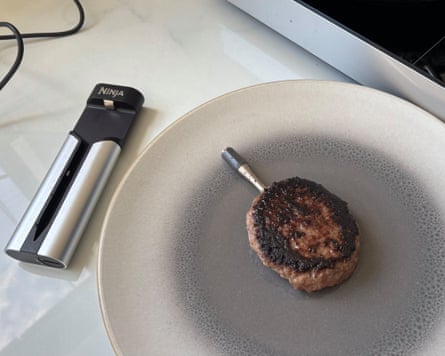
I started the cooking part of the tests by pan-frying thick beef burgers on a medium-to-high heat, noting when each thermometer said they were done, when I was advised to flip (if applicable), and if the burgers were still pink in the middle. Burgers were placed in a preheated pan straight out of the fridge, with just a small amount of oil. They were then fried for about six to seven minutes on each side with a three-minute rest, until cooked through and measuring a peak of 70-72C in the centre.
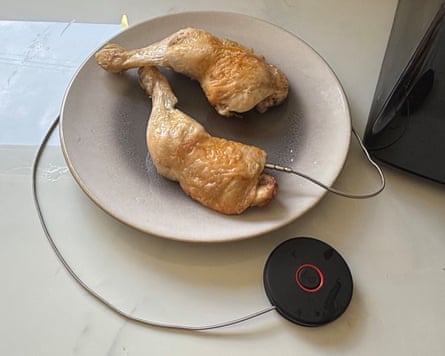
This was followed by roasting chicken legs in a preheated air fryer at 190C. It normally takes about 25-28 minutes for the chicken to reach an internal temperature of 75-78C, with a three-minute rest. For each thermometer, I noted when it read that the chicken was done, then checked it by slicing open the leg to see if there was any pink remaining. I also noted whether the juices were running clear and whether the meat remained moist.
Finally, I evaluated how easy each thermometer was to set up, use and maintain, and its battery life. All samples have been returned to their supplier or donated to charity.
The best meat thermometers, tested
Best meat thermometer overall:
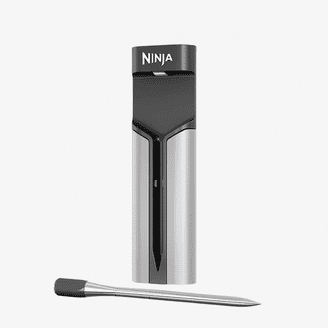
Ninja ProChef wireless thermometer WP100EU
Ninja
ProChef wireless thermometer WP100EU
from £89.99
What we love
It can handle high-heat flare-ups on a grill
What we don’t love
The connection can drop out briefly sometimes
Compared with other wireless thermometers, this Ninja unit has plenty going for it. First, if you’re looking for a brand you recognise, then price-wise, only Meater’s entry-level SE and the Plus are in the same ballpark. Its app is easy to use – particularly for smart meat thermometer newbies – even providing guidance on when to flip food. But where it stands out is its integration with Ninja’s other appliances. The app includes cooking charts and appliance-specific guidance, making it especially useful if you already own a Ninja air fryer, grill or outdoor oven.
Why we love it
The probe connected to the app first time – not always a given with connected devices – and was easy to navigate. It can handle temperatures up to 370C, so it was no surprise that it did well in the hot-water test, reading only a degree lower than the thermocouple, but it was out by a few more degrees with ice water.
It’s a thicker probe than the Meater Pro, so it can be tricky to insert, but it handled cooking well. Although there was a slight fluctuation in the estimated cooking time (dropping from 15 to 10 minutes in only two minutes), barbecue cooks that get easily distracted will welcome its alert to flip and that it factors in rest time, which resulted in a thoroughly cooked burger. Placement in chicken was problematic, playing havoc with the estimated cooking time and alerting me that it was cooked before it actually was – but reinserting solved the issue.
It’s a shame that … it’s better for bigger items than small pieces of food.
Water resistance? Yes
Probe length: 8.5cm (6.5cm from tip to insertion line)
Battery life: up to 30 hours (AAA battery supplied for charging case)
Recycling and longevity: the Ninja ProChef comes with a two-year warranty, and the brand advises that all its electrical products should be recycled at dedicated recycling points. It doesn’t offer a repair service
Ninja
ProChef wireless thermometer WP100EU
from £89.99
What we love
It can handle high-heat flare-ups on a grill
What we don’t love
The connection can drop out briefly sometimes
Best budget meat thermometer:
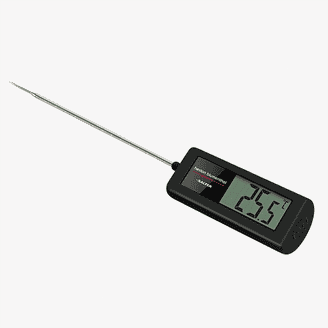
Heston Blumenthal Precision by Salter Indoor/Outdoor meat thermometer
Salter
Heston Blumenthal Precision indoor/outdoor meat thermometer
from £17.99
What we love
Gave a faster reading than others on test
What we don’t love
Tricky to manoeuvre it in an air fryer drawer
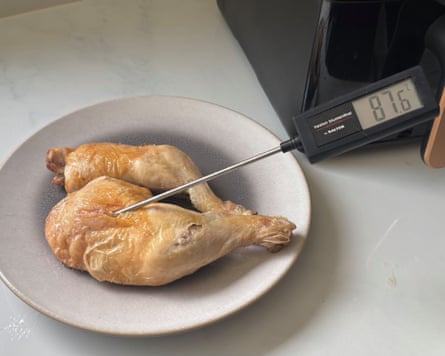
Equally at home in the kitchen as it is by the barbecue, this versatile instant-read thermometer can withstand temperatures from -45C to 200C. Unlike others, it’s also suitable for making jam and caramel and checking the temperature of deep-frying oil, while its silicone casing and probe cover keep it protected from the elements. It’s the long probe you’ll love most, though, letting you check bangers on the barbecue without reaching for the oven gloves.
Why we love it
In testing, the Heston Precision was fantastically accurate, matching up with the thermocouple in the boiling- and ice-water tests most of the time. The probe was easy to use and insert, too. Salter’s Precision meat thermometer is practically identical in spec and similar in price, and put in a similar performance in my testing – but the Heston made the list because of its extra cooking guidance.
The slim probe made it easy to check multiple spots in burgers and chicken, ensuring they were cooked through with no pink remaining.
It’s a shame that … at 30cm long with the cover on, it’s awkward to fit in a cutlery drawer – a hanging hook would be a useful addition.
Water resistance? Yes, to IPX5
Probe length: 18cm
Battery life: approximately one year (2xAAA batteries supplied)
Recycling and longevity: the Heston Blumenthal thermometer comes with a one-year guarantee that can be extended to two if registered within 30 days of buying. It can be recycled at a local e-waste collection point or household recycling centre in the small WEEE container once the battery is removed
Salter
Heston Blumenthal Precision indoor/outdoor meat thermometer
from £17.99
What we love
Gave a faster reading than others on test
What we don’t love
Tricky to manoeuvre it in an air fryer drawer
Best wireless smart meat thermometer:
Typhur Sync Gold dual-probe wireless meat thermometer
Typhur
Sync Gold dual two-probe wireless meat thermometer
£199.99
What we love
You can pop the probes in the dishwasher when you’re done
What we don’t love
The app and base beep, which could be annoying
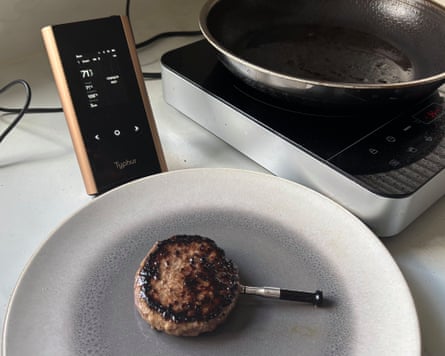
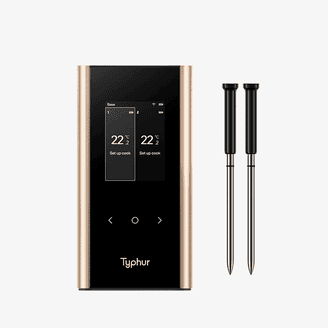
Typhur is in the process of making a humanoid kitchen robot, Athena, so I was expecting great things from its Sync Gold Dual meat thermometer. And for the most part, it lived up to expectations. Its two probes live in a sleek base that not only charges them but also acts as a monitor and control hub, so you can track cooking without reaching for your phone.
It also uses a stronger, longer-range signal (sub-1GHz for those radio frequency aficionados out there) – making it ideal if thick walls or a robust barbecue disrupt smart probe connections.
Why we love it
The Sync Gold can withstand up to 500C and is waterproof, too, making it suitable for almost any type of cooking, including sous vide. Having said that, I was surprised to find it struggled during the boiling-water test, coming in 3C lower than the thermocouple, and read 0C in the ice-water test, when the thermocouple read 4C. Fortunately, its cooking performance was excellent.
The app was easy to set up and use, while the base took more getting used to, although it’s useful if you’re avoiding your phone. I liked the cooking graph and frequent alerts, although it doesn’t remind you to turn the food. Both the burger and chicken were perfectly cooked without drying or overcooking. Great performance, then – as you’d expect at this price.
It’s a shame that … the base is set with arrows to scroll through and a button to select, rather than being a touchscreen.
Water resistance? Yes, probes to IPX8; base to IPX2
Probe length: 8.5cm (7.5cm from tip to insertion line)
Battery life: 24+ hours on a single charge/rechargeable base
Recycling and longevity: the thermometer’s sealed design means it’s not intended to be repaired, although it is covered by a two-year warranty. Typhur doesn’t offer a take-back or recycling scheme
Typhur
Sync Gold dual two-probe wireless meat thermometer
£199.99
What we love
You can pop the probes in the dishwasher when you’re done
What we don’t love
The app and base beep, which could be annoying
Best wireless Bluetooth meat thermometer:
Meater Pro
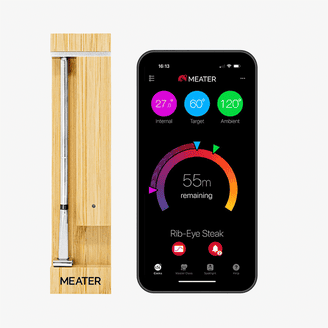
What we love
A compact, stylish base that isn’t plastic
What we don’t love
Pricey for a single probe
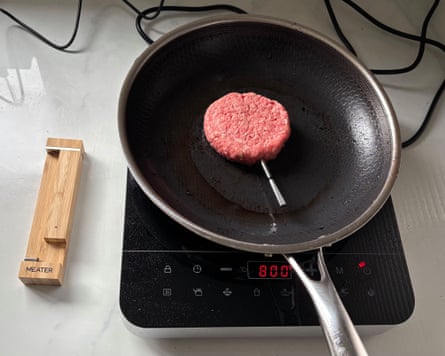
My fridge sits behind my kitchen door – but if yours is in a more visible location, you’ll appreciate that the Meater Pro’s magnetic bamboo base can be affixed to the fridge door for storing the thermometer, so it’s within easy reach when you’re next cooking steak. There’s plenty more to like, too.
The probe is waterproof, dishwasher-safe for cleaning, and suitable for deep-frying or sous vide. It’s also heatproof up to 550C, and slimmer than most at just 0.5cm in diameter – making it easier to use with smaller cuts of meat. Meater claims its app is so friendly, you can leave it to your kids. While they’d probably rather be playing Pokémon Go, I did find it genuinely easy to use.
Why we love it
I use a Meater Plus in my kitchen, but it’s not as whizzy as the Pro, which charges rapidly and lasts a long time (a 15-minute charge will buy you about 12 hours of cooking), making it perfect for spur-of-the-moment meat feasts. In testing, I appreciated the ability to specify not only the meat being cooked and the level of cooking, but also how you’re cooking it – there’s an option for air fryers, for example.
It didn’t perform so well in the water tests – fluctuating between 92C and 97C when the thermocouple read 99C, and 1.3C when the thermocouple was at 3C – although it did offer guidance for frozen meat. Cooking performance was better, although the burger was drier as a result of the preset being 2C higher than what I’d normally choose, and the chicken was a little pink. This could have been down to probe placement or the leg being thicker.
It’s a shame that … estimated cooking time takes a while to appear. I was over halfway through cooking the burger by the time this popped up.
Water resistance? Yes
Probe length: 9.8cm (6.7cm from tip to insertion line)
Battery life: 24+ hours from a 30-minute charge, estimated two years of charging based on one steak a week (AAA battery supplied for charging case)
Recycling and longevity: the Meater Pro isn’t recyclable at the end of its life, but it does come with a two-year warranty should it need to be replaced or repaired
Meater
Pro
from £129
What we love
A compact, stylish base that isn’t plastic
What we don’t love
Pricey for a single probe
Best leave-in meat thermometer:
ETI Dot digital oven thermometer
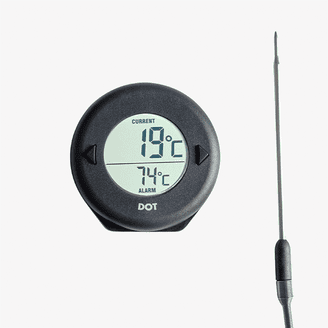
ETI
Dot digital oven thermometer
from £32.50
What we love
Large display for keeping an eye on progress
What we don’t love
No cooking guidance, so you’re on your own
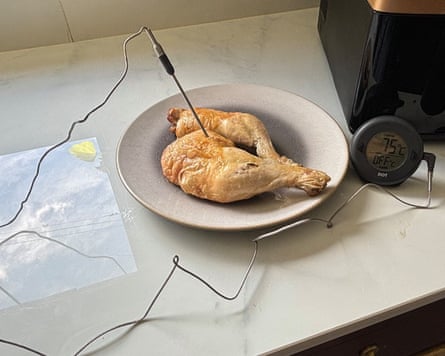
I enjoy the name of the Dot – both short for digital oven thermometer and a nod to its round shape – but it’s more than an appealing moniker that made me like this thermometer. Equipped with a wired probe, magnets for convenient placement on an oven door, and a light to brighten the LCD screen, this is a simple bit of kit, executed well.
The stainless-steel braided lead is a generous 1.2m, and the probe will measure temperatures from as low as -50C up to 300C. There’s no ignoring its 70dB alarm for when it hits temperature – great for easily distracted cooks who have wandered off to another room.
Why we love it
If you dislike apps or fiddly setup routines, the Dot will appeal. It has just three buttons: one on the back for power and adjusting screen brightness, and two on the front to set the target temperature. And that’s it.
It did well in the water tests, only usually a degree out from the thermocouple, but pan cooking and air frying proved more awkward. Positioning the probe in smaller items was tricky, and the cable often got in the way, meaning I had to reinsert it for an accurate reading. Eventually, I got a juicy well-done burger and thoroughly cooked chicken, but it took some effort. That said, for its intended use in the oven, it’s better designed, more robust, and slimmer than Lakeland’s in-oven model below.
It’s a shame that … its fold-up stand is flimsy and popped off in my hand. It didn’t break, but a more substantial structure would be an improvement.
Water resistance? Yes, to IP65
Probe length: 11.4cm
Battery life: 5,000 hours (2xAAA batteries supplied)
Recycling and longevity: it comes with only a one-year guarantee, but ETI offers a repair service and will recycle returned products
ETI
Dot digital oven thermometer
from £32.50
What we love
Large display for keeping an eye on progress
What we don’t love
No cooking guidance, so you’re on your own
The best of the rest
Weber Connect smart probe and grate sensor
Weber
Connect smart probe and grate sensor
£39.99
What we love
It’s compact and winds up for easy storage
What we don’t love
Battery type is less common (but it is included)
Best for: barbecuing
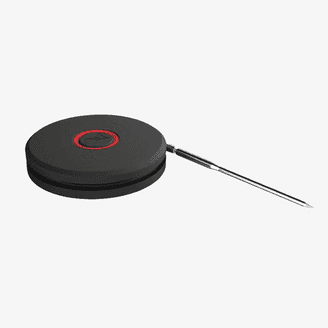
Designed to work either as a probe or a grate sensor with any barbecue, the Weber Connect smart probe is one for the alfresco cooks. It’ll withstand temperatures of up to 420C, attaches to your barbecue via magnets, has a 0.91m cable, and comes with a clip so it can measure ambient temperature. If you want to dip your toe into app-monitored cooking, the Smart Probe could be one of the most affordable ways to do it.
Its performance in the water tests was mixed, coming in at 99C when the thermocouple read 100C, and 1C when the thermocouple read 3.7C. Indoors, it’s tricky to use, but not impossible. For example, the ambient heat of the pan tended to skew the reading when cooking the burger, registering it as cooked before it actually was, while the cable was too thick for the air fryer drawer to close properly. I had to reposition the probe a couple of times in the chicken, but once it was in the right spot, the readings were what I’d expect. Used in an oven or, as it’s intended, on a barbecue, it worked well for larger cuts, but it’s far from being an all-purpose meat thermometer.
It didn’t make the final cut because … the choice for app-assisted cooking is limited – for example, chicken leg wasn’t listed.
Water resistance? Weather resistant, but not waterproof; probe length: 8.89cm; battery life: one year (1xCR2032 battery supplied); recycling and longevity: two-year limited warranty; no recycling or repair programme. The stainless steel probe is recyclable, while the electronic components and battery should be processed through suitable recycling facilities
Weber
Connect smart probe and grate sensor
£39.99
What we love
It’s compact and winds up for easy storage
What we don’t love
Battery type is less common (but it is included)
For more, read our guide to the best BBQs
after newsletter promotion
Oxo Chef’s Precision digital instant read thermometer
Oxo
Good Grips Chef’s Precision digital instant read thermometer
from £17
What we love
Turns off automatically to conserve battery life
What we don’t love
You’ll be cleaning the screen more frequently
Best for: beginners
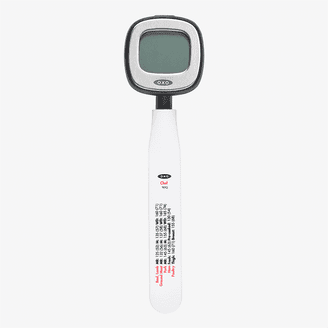
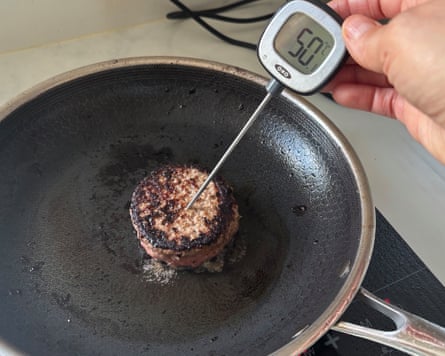
Lightweight, compact and easy to use, the Oxo Chef’s Precision is brilliant for those new to using a meat thermometer. It has a big, clear digital display, a button on the back flicks between celsius and fahrenheit readings, and the probe protector offers suggested temperatures for different meats and levels of doneness, along with resting advice. The display pivots 90 degrees so you can read it from any angle.
It’s less versatile than some, though. While it has a temperature range of -40 to 150C, it was confused by the ice-water test, reading 1C when the water was actually at 4C. It was spot on for the boiling water, though. During cooking, it was slower to climb up to temperature than other units on test, although it got there in the end. Both the burger and chicken were well cooked, but not before the screen had become splashed with fat – a combination of waiting time and a short probe.
It didn’t make the final cut because … it’s powered by a button battery, which you’re less likely to have to hand for replacement – and the one supplied was almost flat.
Water resistance? No; probe length: 11.5cm; battery life: two years of moderate use (1xCR2032 battery supplied); recycling and longevity: the probe cover and battery can potentially be recycled, but the thermometer can’t, and Oxo doesn’t have a policy in place for recycling its products. However, it does offer a “better guarantee”, a lifetime warranty that promises to replace or refund products with material or manufacturing defects
Oxo
Good Grips Chef’s Precision digital instant read thermometer
from £17
What we love
Turns off automatically to conserve battery life
What we don’t love
You’ll be cleaning the screen more frequently
ProCook meat thermometer
ProCook
Meat thermometer grey fork
£11
What we love
A hanging hook saves drawer space
What we don’t love
AAA batteries not included
Best for: an easy-to-read display
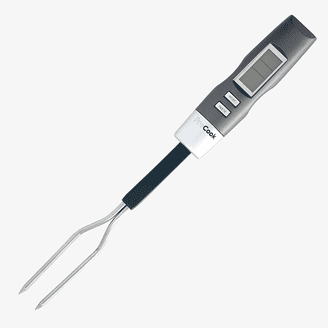
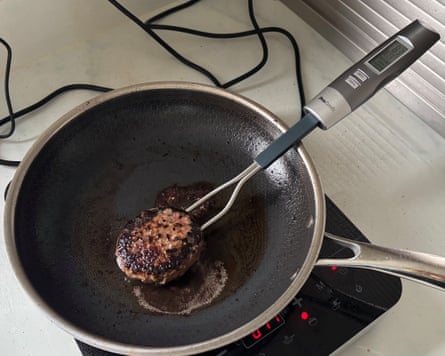
It’s unwieldy and won’t be for everyone, but I liked the simplicity of this affordable meat thermometer. There are just two buttons for scrolling through what you want to cook – meat and taste – plus you have the option to easily switch temperature readings between celsius and fahrenheit under the battery cover. An anti-slip handle, easy-to-read backlit LCD panel, safety caps for its menacing prongs, one-year guarantee, and presets for six meats complete the package.
Its temperature range goes from -5 to 250C – although, like many others I tested, it did better with boiling water than cold. It was only one degree off for boiling water, but for ice water, this increased to two or three degrees. It worked well for the chicken leg in the air fryer, but I had issues with the burger. Not only did it leave a pair of large holes in the meat, but it also tended to hit the base of the pan when inserted from the top, throwing off the reading. I had more success piercing the burger from the side – awkward, but accurate. As such, it’s probably better for use with larger cuts of meat and joints.
It didn’t make the final cut because … there are no real instructions for getting started or guidance on how far the probes need to be inserted.
Water resistance? Yes, to IPX3; probe length: 8cm; battery life: one to three years depending on batteries bought and frequency of use (2xAAA batteries, not included); recycling and longevity: one-year guarantee. At the end of its lifespan, ProCook will recycle it for free when you buy a new electrical item from it via its trade-in/WEEE scheme
ProCook
Meat thermometer grey fork
£11
What we love
A hanging hook saves drawer space
What we don’t love
AAA batteries not included
Lakeland digital in-oven kitchen thermometer
Lakeland
Digital in-oven kitchen thermometer
£27.99
What we love
A loud alarm will definitely get your attention
What we don’t love
Batteries not included
Best for: multifunctionality
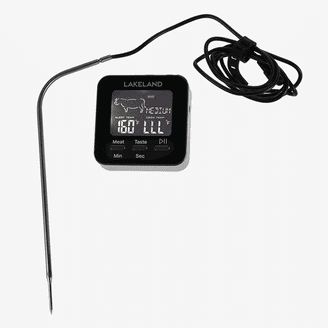
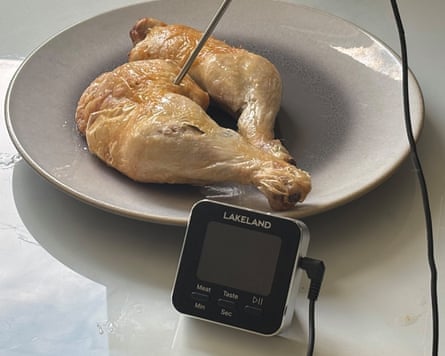
If you like your kitchen gadgets to do more than one thing, Lakeland’s digital in-oven kitchen thermometer should please you. When it’s not working as a thermometer, it doubles as a kitchen timer – just change it using the switch on the back. It also comes with a decent three-year guarantee, a handy leaflet of cooking guidance, a temperature range from -20C to 250C, and presets for different meats and doneness. It even has a fold-out stand on its rear, plus a small notch so you can hang it. However, the screen is hard to read – on a bright day, I found myself having to tilt it to see the display.
Performance was mixed: it did well with boiling water, reading the same temperature as the thermocouple, although it was several degrees out with ice water. I struggled to position it in the chicken, and it shifted during cooking and needed reinsertion to get an accurate reading. The cable was too thick to use easily in the air fryer, too. It was awkward in a pan and slipped out of the burger when I flipped it, so it’s definitely one that’s just for the oven.
It didn’t make the final cut because … a dim screen, even on full brightness, makes it almost impossible to read unless positioned at just the right angle.
Water resistance? No; probe length: 15cm; battery life: should last past the three-year guarantee depending on the batteries bought and frequency used (2xAAA batteries, not included); recycling and longevity: three-year guarantee. Lakeland doesn’t offer a repair service, and advises that the thermometer is thrown away in line with local waste disposal guidelines
Lakeland
Digital in-oven kitchen thermometer
£27.99
What we love
A loud alarm will definitely get your attention
What we don’t love
Batteries not included
The rest of the test
Those that didn’t make the cut in my testing include the Salter analogue meat thermometer (doesn’t require batteries or charging, but its dial didn’t offer as much information as others here, and it briefly malfunctioned in my test); plus Salter’s Precision meat thermometer, which performed brilliantly, but is identical in price and similar in spec to the Heston Blumenthal Precision meat thermometer above. The Heston put in a similar performance but came with more guidance.
Also missing is the ETI RFX wireless. On a positive note, it uses radio frequency rather than wifi for a more stable connection, but it’s lacking in features compared with other wireless meat thermometers. The app is basic – there are no guided cooks, for example – and I didn’t find it especially user-friendly. It also requires exact placement in small items, or else it can give misleading data – I had to reinsert it mid-cook. I have included ETI’s Dot digital oven thermometer, though, and would always recommend its Thermapen, which is the thermometer I use for general cooking at home.
What you need to know
What kind of meat thermometer do I need?
The type of meat thermometer you choose will depend on what you might cook with it and how.
Analogue or traditional meat thermometers will be fine for infrequent users, or those who mainly cook joints of meat in the oven or on the barbecue. They’re durable, affordable, and don’t need to be recharged or have their batteries replaced. That said, they’re less precise than others and can be slow to respond to changes, which can lead to overcooking, plus the dial can get in the way under a grill or in a pan. They’re better than no meat thermometer at all, but could prove frustrating for a keen cook.
Digital meat thermometers are more accurate than analogue, quick to respond to temperature changes, and may also come with extra features, such as a timer, alarm, or presets for different meats and levels of cooking. They’re available either as a stand-alone, instant-read probe or wired to a base, so that the probe can stay in an oven, pan, grill or barbecue – just always check the maximum temperature, particularly with wired models. Most cost less than £40 and are a good choice if you don’t need all the bells and whistles – and extra cost – of a smart wireless probe.
Smart, wireless meat probes are designed to be used with a companion app for checking the temperature remotely. There may also be a separate base for monitoring, so you don’t always need to have your device to hand. They’re often pricey, but if you cook meat frequently, you’ll love the convenience of not being confined to the kitchen or grill. They’re the most versatile of the lot: many fit in smaller food items more easily; they work well in pans, grills and ovens; and apps will usually offer guidance for achieving the best results. Great for beginners and more confident cooks aiming to up their game.
How to use a meat thermometer
Correct placement of a meat thermometer will return the most accurate reading, but this depends on what you’re cooking and the type of thermometer you’re using. Smart probes usually need to be inserted fully into the meat, up to a marked insertion line, while instant-read probes often only need the thin tip inserted so it reaches the centre of the food. Analogue meat thermometers typically need to be inserted deeper than instant-read models. Check the insertion guide for your particular model.
The aim with most meats is to insert the probe into the thickest part, avoiding bone or gristle. For example, for a whole chicken, this would be through the thigh into the centre of the breast. While multiple insertion holes allow juices to leak out, don’t be afraid to take the meat thermometer out mid-cook and reinsert if the temperature looks too high too soon.
How to clean a meat thermometer
It’s important to clean your meat thermometer when switching between pieces of meat to avoid cross-contamination. Wipe the probe with a hot, soapy cloth (don’t submerge), then rinse and dry with a kitchen towel to prevent bacteria growth. An alcohol wipe will do in a pinch.
For stuck-on mess, soak the probe tip in hot soapy water to soften the residue before cleaning. Resist the temptation to scrub with harsh cleaners or pads – scratches on a probe create more places for bacteria to grow and can affect sensory accuracy.
It’s advisable to clean a probe after every session: dip it in diluted bleach or distilled white vinegar (avoiding any electronic parts), then rinse under hot running water. Don’t forget to clean protective sheaths or covers since these can harbour bacteria, too.
Can you use a meat thermometer for other foods?
Yes, but not all foods. If you don’t have the budget for a cooking thermometer and a meat thermometer, the latter can be used for foods such as quiche, casseroles and desserts.
However, they’re not usually suitable for liquids. Meat thermometer probes tend to be thicker and slower to react, which can lead to imprecise readings in liquids. In addition, they may not cover the temperature range.
It’s also best to opt for a specialised thermometer for high-heat cooking, such as jam or caramel, or deep-frying. A meat thermometer may not have the upper range, plus high heat can damage sensors.
Rachel Ogden has worked as a consumer journalist for decades, becoming an expert unboxer before it was a thing, although she is less successful at repacking. Her home has hosted hundreds of small appliances, from air fryers and slow cookers to meat thermometers, while outside, you’ll find her messing about with barbecues and pizza ovens. It takes a lot to impress her – many appliances have tried and failed