.png) 2 months ago
50
2 months ago
50
The controversy over flags has faded from the national agenda – but street by street, late at night and with ingenious equipment, their raising and removal is the subject of a roiling dispute over local identity
The Christmas lights have gone up in Stirchley. A multifaith mix of stars and swirls add a festive air to the lamp-posts along the main street of this south Birmingham suburb. Stirchley is a modest kind of place, sandwiched between better known (and better off) areas such as Bourneville and Moseley, but there is plenty of evidence here of the lively community spirit that last year resulted in the area being named the best place to live in the Midlands.
Posters in shop windows along Pershore Road advertise a knitting group, a neighbourhood winter fair and the local food bank, while in the former swimming baths, now a community hub, friendly flyers for coffee mornings and choirs are stacked.
Scratch just below the surface, however, and there are signs of something much less harmonious going on. Outside the farm foods shop, someone has pasted photos of a number of Stirchley residents, whose faces have since been scraped away. “I AM THE PERSON TAKING DOWN THE FLAGS,” reads one image that has been stuck on a bin. Another picture, since torn off the post box, was tagged: “I HATE THE UNION FLAG”.
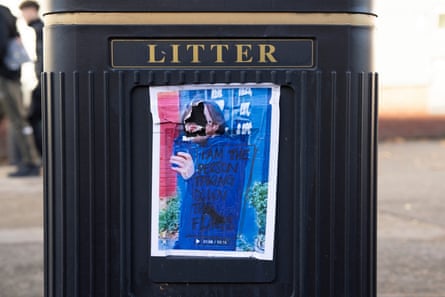
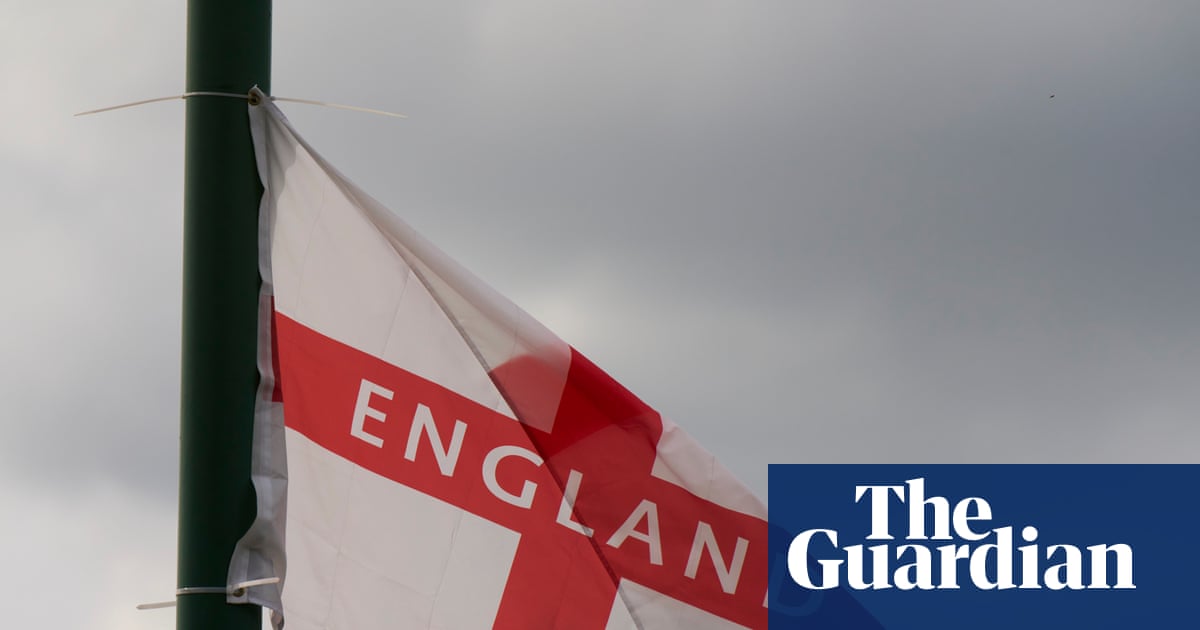
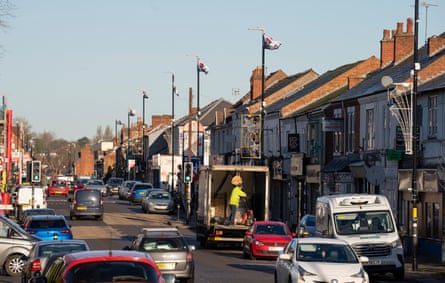
For months, this small collection of Victorian streets has found itself the scene of a fractious and at times very ugly dispute over the flying of flags. On at least four occasions since September, members of a Birmingham-based group called Raise The Colours (RTC), wearing branded hard hats and hi-vis vests and using a cherrypicker, have hung hundreds of Saint George and union flags from Stirchley’s lamp-posts, as part of a widespread campaign they say is intended to “fill the skyline with unity and patriotism”.
On each occasion a group of local residents, objecting to what they describe as territory-marking as part of an anti-immigrant movement, have taken the flags down, but say they have been subject to harassment and intimidation when they have tried to protest.
Those objecting to the flags are routinely filmed, with the clips later posted on social media. Two independent Stirchley businesses whose owners challenged people erecting flags outside were vandalised with flour and eggs the next day. After RTC posted on X about a third dissenting small business, later reposted by the far-right activist Tommy Robinson, the business was hit with hundreds of negative Google reviews.
RTC, which says its members are acting out of a “patriotism” it describes as “positive and inclusive”, has characterised the confrontations on social media as “the Battle of Stirchley”. But David, a 65-year-old management consultant who brought up his family in Stirchley and is one of about 150 local people who have joined a loose grouping opposed to the flags, said: “We don’t want a battle here. We want to go on with our lives, our work and bringing up our families.
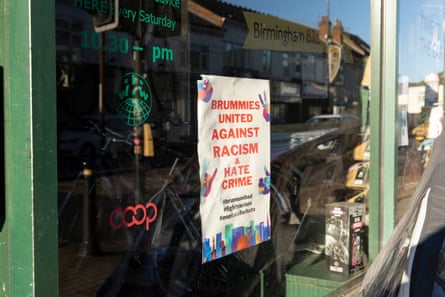
“We don’t want to spend our time battling with some guys from out of town who have a political agenda and want to use us as their battleground. But equally, we won’t retreat from our streets and be intimidated by these people. We will continue to make our case as a welcoming, caring community of people.”
Like most of those interviewed for this article, he asked not to be fully identified, fearing doxing or other retaliation.
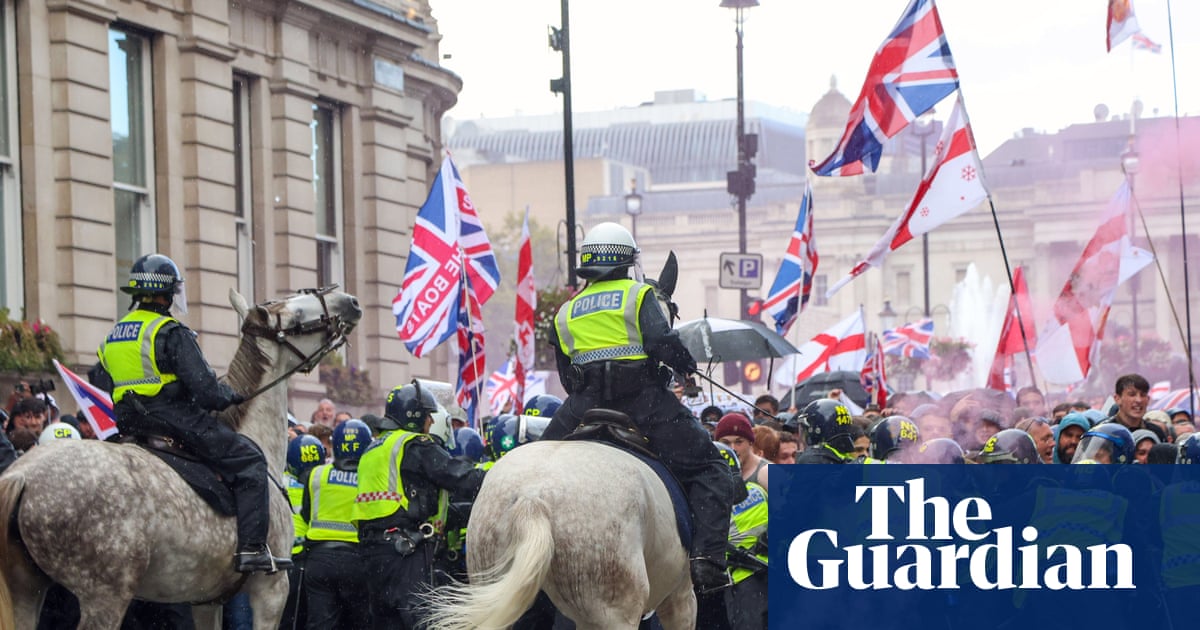
Flag-flying has faded from the political agenda in England since the febrile summer months, when tensions over migration and an emboldening of the far right were accompanied by a wave of flags being erected in streets across the country, with the vocal approval of some residents and despite the often silenced objections of others.
But in many communities, including some where flags are no longer so visible, this has remained a fraught and highly divisive issue, even if strikingly few politicians are willing to speak about it. In the absence of political leadership, some neighbourhood groups say it has been left to them to push back against an organised and well funded movement that, while certainly galvanising support among many individuals, has been driven and encouraged by figures with links to the far right.
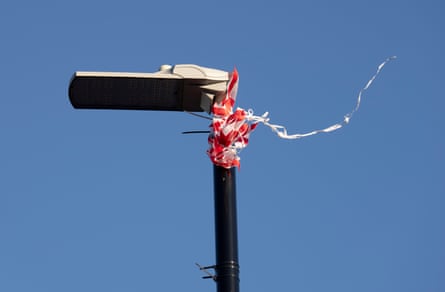
Some local authorities have removed flags that have been attached to civic infrastructure – technically an offence if done without permission – though there have been widespread reports of workers being abused while doing so, including in Knowsley, Trafford, Hertfordshire and London. In Salford, a subcontractor working on camera equipment was pulled from a ladder in September by a man who mistakenly believed he was removing flags.
Elsewhere, however, councils refuse to intervene, or residents have decided to take matters into their own hands, sometimes leading to angry confrontations or worse.

One Norwich man, Ian, 68, said he was assaulted last month while attempting to remove a flag from a lamp-post in the early hours of the morning. After he was spotted from inside a house, he said, a car pulled up, he was surrounded and had his face smashed into the pavement. He believes someone stamped on his head. Officers from Norfolk police were called, but told Ian they could not investigate as there was no CCTV evidence. The case has now been closed.
James Harvey, a Green councillor on Broadland district council in south Norfolk, said in some places, groups of people opposed to flag-flying were now organising to take direct action against it. He said: “There are teams that go out late at night to remove the flags. They don’t want any fuss or any publicity. They just want to take them down because they see them as the far right marking territory. They see them as divisive and hate-filled, not patriotic.
“My fear is it just escalating. If the authorities are seen to do nothing, then it just carries on. My fear is that it’s only a matter of time before there is a larger or more serious confrontation and somebody could get very seriously hurt.”
One man who is part of a group of anti-flaggers in the area said they work in small teams of about six “for safety”, organised via the secure messaging app Signal, and go out in the early hours of the morning to targeted areas. “We have contacts in other places who have requested flags to be taken down and have given us maps of where they are before we go,” he said.
The group have developed a device with an extendable pole and brush that allows them to remove flags even where they have been placed with cherrypickers at the top of very high lamp-posts. “It always feels a bit scary,” the man said. “We are aware of the possibility of being infiltrated, which could mean that the flaggers might be waiting for us in an organised group when we arrive somewhere to deflag. This means we need to be careful about recruiting. Or perhaps we are being paranoid, it is hard to tell.”
Anne, 66, from Walkley in Sheffield, said the disputes over flags near her home have felt like “a mini Battle of Cable Street” – referencing the 1936 clashes in London’s East End when neighbours united to resist a march by fascists.
Walkley has been the scene of angry standoffs between a group identifying itself on Facebook as Reform Sheffield East, which erected many flags in the area, and a group of local residents who did not want them. “We really do feel that it is designed to intimidate, and it is intimidating,” said Anne, who has lived in the neighbourhood for more than 20 years. “A lot of us feel – and I think the evidence bears this out – that when these flags start going up, people then feel emboldened to say the sort of things that they haven’t felt able to say for 30 years.”
“It’s like there’s a very quiet and very English guerrilla war going on, in terms of different groups putting up and taking down flags,” said Andrew Scarsdale, spokesperson for a group called Sheffield Communities against Racism and Fascism (Scarf).
“One thing that’s definitely happened in Sheffield is people have been spontaneously taking them down. So the flags have had to go physically higher to stop them being ripped down by enraged passersby. There are fewer flags now, but they’re higher up and more difficult to get to.
“We know what these flags are. This is not like flags coming out for the football. This has been a deliberately toxified symbol. Everyone knows what it means, including the people who put the flags up.” A YouGov poll last month found the majority of ethnic minority adults now see the Saint George flag as a racist symbol.
Like many people in the area, Anne sees the flag-flying in Walkley as a carefully planned tactic. “They come into an area and they put up a load of flags. Some people will come out to support it and some people will come to take it down. But now they’ve found the people who support them, they’ve found their local support base.”
A spokesperson for Reform UK said Reform Sheffield East was not an officially affiliated Facebook page, but that the party supported the hanging of flags, which it saw as “symbols of unity and inclusion”. Sheffield city council said it regarded flags on lamp-posts as illegal but if they were not an immediate safety risk, it would remove them “in a timely manner”.
Back in Stirchley, the main strip of Pershore Road is still festooned with flags, although instead of the Saint George Cross and union flag, mostly since removed, they are now Remembrance-themed flags, which RTC erected across Birmingham last month at the top of the very high street lamps. While most people may support commemorating the war dead, local anti-flag residents still regard the banners, which are not supported by the Royal British Legion, as a provocation.
RTC says it has raised more than £115,000 to fund further flags, and for “community support” and “campaign outreach”. It did not respond to a request for comment.
Birmingham city council said it was engaging with communities but suggested it did not intend to remove flags, as previous efforts “have unfortunately been met with hostility and abuse and we must consider workers’ safety”.
“They are not going to do it. We have to do it ourselves,” said Allie, 30, a web designer who has been active in Stirchley’s anti-flag group. “Community is where change comes from. This is what true democracy looks like. It doesn’t look like coming in [to a neighbourhood] and putting up flags and not talking to anyone.
“It’s about all of us organising and doing shit ourselves, and not only taking down flags, but also trying to start migrant support networks, or create local community events, or volunteering at the food bank. And that’s what we’ve been doing.”
Some names have been changed