.png) 15 hours ago
4
15 hours ago
4
When Robert Solomon’s working hours were cut during the pandemic – he did building management and tech support for a nonprofit organisation – he got an extra job at a food cooperative, helping to stock the store. It was, he says, the most ordinary job, but that’s what made it special.
That job ended with the pandemic, but in 2022 he left the nonprofit and hunted for grocery positions. Now, at 71, he is assistant buyer in produce (ie fruit and vegetables) at an independent market in New York. “I love the opportunity to do physical, creative work with my body, hands and mind,” he says. “I’m working harder than I have since my 30s, and I love it.”
Solomon’s favourite time of day is the morning. He often starts at 5.30am or 6am. “I put the rugs back on the floor and the carts out in the yard. And then I start stocking.” Certain products make him particularly happy.
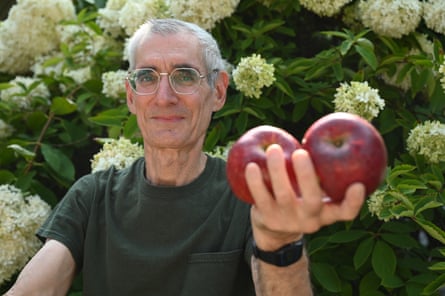
“I like fussing up the dandelion greens,” he says. (Though dandelions are often considered weeds, both leaves and roots are edible.) “I have a little bucket of water and I swish them around head first so they’re fresher again. We have to restock broccoli many times a day, and I like that.” When it’s in order, “it makes a sea of broccoli”. We are speaking on a video call, and Solomon lifts his phone to the camera to show waves of blue-green broccoli heads.
“The work requires good attention,” he says.
By “attention” he means his mind doesn’t wander too often. “One of the big attractions is that it’s a low-fantasy job. I spend most of my time working, not fantasising about what a wonderful job I’m doing and how I’ll get famous for it next year.
“My political belief is that all work is important,” he says.
Solomon grew up in Brooklyn, five miles from the shop. His mother was a musician turned director of a daycare centre, his father a professor of art history. “They were first-generation immigrants from Russia, and to them it was a step up to be doing something technical or managerial.” His father “probably” wanted Solomon to be a scientist.
Solomon left school at 17. He had stints at night school but got his degree at 46 “with independent study and life credits”. For most of his working life, he was “a house painter, handyman and cabinet maker”. After the degree he worked for a neighbour’s company that sold energy-efficient lighting solutions, and had two stints at the nonprofit.
Through it all, he says, “I kept trying to change my job to a better job, and it just didn’t work for me.” At various times he aspired to become a computer programmer, an interfaith minister and a nurse practitioner. “In each case things went terribly wrong.”
At an interview to be an emergency medical technician, having scored an A on the course, Solomon was asked if he would cross a picket line. “No way,” he said. “My mother would roll over in her grave.” He watched his application drop into the bin.
Sometimes Solomon has a feeling his late parents would disapprove of his grocery job. But recently he’s remembered one of his mother’s sayings when he’d pitch a tantrum: “Stop running around like a chicken with your head cut off!”
Solomon thought that impossible, but she explained that “when she was a girl, they had a little shop on the porch of their home. When my mother would get home, my grandfather would take a break, and if someone came in for a chicken, she would have to kill it.”
Solomon doesn’t handle poultry, but in his produce work “all these things I learned from her that she didn’t mean to teach me are coming back. … She knew how to clean lettuce and she knew how to pick a good apple. I’m like: ‘That’s how I know all of this.’”
Initially shop work was challenging. On the subway home, it was hard to stand up again. “But now it feels fine,” he says. “I feel quieter mentally. My knees hurt less. I feel stronger.
“There are no guarantees on how long I will be able to work. But I think this is the best employment I’ve had. It’s an appreciation of good things.”