.png) 2 months ago
67
2 months ago
67
Only four months ago, Copenhagen student Sven Li’s view of the prime minister, Mette Frederiksen, was, like many Danish voters, less than favourable. The 21-year-old, who was about to host an election event for Green Left (Socialistisk Folkeparti, known as SF) in his cramped but cosy halls-of-residence kitchen, said the woman who had led Denmark’s centrist coalition government for the past three and a half years had shown herself to be a “very cold, calculating figure”.
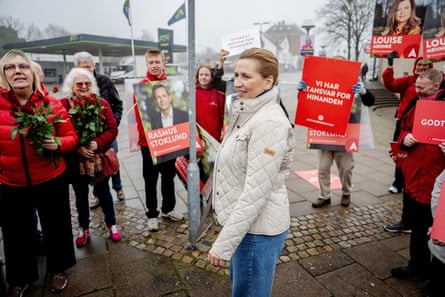
Her Social Democrats were suffering too, going down to sweeping defeats in municipal elections in November and losing control of Copenhagen for the first time in more than a century. But since then, and as Denmark prepares for an early general election on 24 March, Li’s view of the prime minister has transformed, first as a result of her handling of the geopolitical crisis with Donald Trump over Greenland, and second because of her recent shift to the left in some areas – including a 0.5% wealth tax to fund smaller class sizes in schools.
“I am very proud that Mette Frederiksen and [current coalition partner] Lars Løkke Rasmussen, as much as I think that they have undercut general welfare in Denmark, are very competent statesmen and are solid leaders in a time of crisis,” said Li, who had the words “socialist activist feminist” written across the back of his red hoodie.
According to the polls, which show Frederiksen to have benefited from a “Greenland bounce”, this sentiment could be widely shared.
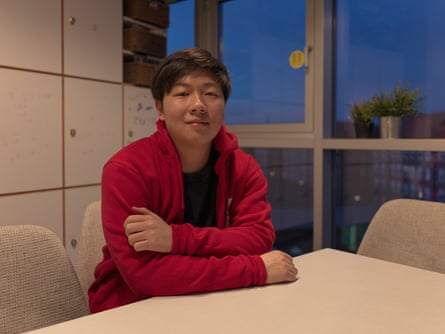
Like many on the left, Li is hoping for a “red” government formed of the Social Democrats, the Danish Social Liberal party (Radikale Venstre), the SF, the Red-Green Alliance (Enhedslisten) and the Alternative (Alternativet).
“I want to see something that would account for the fact that inflation and rising housing prices, especially in Copenhagen, have eroded people’s quality of living,” he says. “And I want to see a direct effort to combat child poverty, which we are seeing rise across Denmark.”
The wealth tax, which Frederiksen announced in the Danish parliament, the Folketinget, as she called the election, is a 0.5% tax on assets held by an individual worth more than 25m kroner (about £2m) that will, among other things, lower class sizes for six- to nine-year-olds from about 26 to 14.
According to the Danish Union of Teachers, such a tax would address “serious challenges” facing schools, including a teacher shortage and a failure to include children with special needs. “It’s a very classic Danish welfare approach,” said Niels Jørgen Jensen, the union’s vice-chair.
But the proposal has outraged Denmark’s super-rich. Henrik Andersen, the chief executive of wind turbine giant Vestas, declared “enough is enough” and suggested he may leave the country if it was introduced. Meanwhile, the shipping magnate Robert Mærsk Uggla, who is the chair of the board of directors of Maersk and the chief executive of AP Møller Holding, said it would be “harmful to Denmark”. The chief executive of Lego, the Danish company that is the world’s biggest toymaker, also told the Financial Times he believed it would “impact society pretty hard in the long run – less job creation, less tax generated from companies, less competitiveness for a broad range of Danish companies”.
On Sunday, the Danish confederation of business joined the criticism, branding the policy “effectively a tax on companies”.
Frederiksen’s shift left does not, however, include immigration. On top of Denmark’s already restrictive asylum laws, Frederiksen has proposed deporting foreign nationals sentenced to a year or more in jail for criminal offences and taking action to prevent future asylum seekers, including those from Iran. “We must avoid at all costs a repeat of the situation in 2015, when more than a million refugees and migrants, especially from Syria, came to Europe,” Frederiksen said last week.
Arriving at Li’s kitchen loaded with food shopping, Sadek Al-Amood, 26, a Copenhagen parliamentary candidate for SF, has held about a dozen similar “dürüm and debate” events, where voters are invited to come for free food and a chat about politics. The key issues among students, he said, before dozens piled in for the event, are affordability and climate justice.
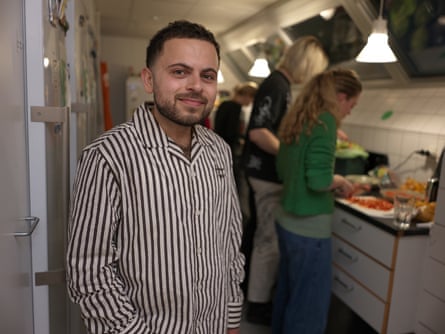
The current government – a coalition between the Social Democrats, the centre-right Venstre and Rasmussen’s centrist Moderates – had, he said “shown itself to be incapable of answering some of the biggest issues there are in society” but he said he had hope for a future coalition.
“Even though she doesn’t say it outright, it seems like Mette Frederiksen wants to do at least more left-leaning policies,” he said. “It feels like the pieces of the puzzle are there to get a really progressive government the next time around after the lacklustre centre government we’ve had.”
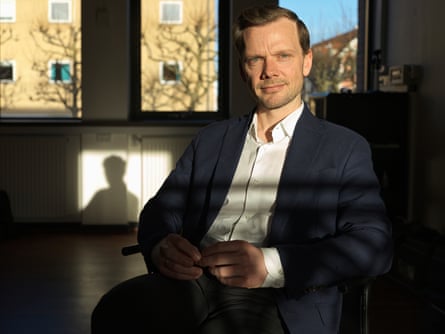
The justice minister, Peter Hummelgaard, widely seen in the Social Democrats as Frederiksen’s heir, told the Guardian after a campaign event in the Copenhagen suburb of Kastrup for workers at the city’s airport that the party was focused on inequality, which he said “creates the kind of gaps that those who want to divide, those who want to sow insecurity in society” can feed off.
“During the past three and a half years in a centrist government, we have actually made very large tax reductions on especially working incomes,” he said. “So there is also thinking that, while we lower the taxes on working income, we would like to balance it out with a little bit higher tax on wealth.”
Geopolitical turmoil was, however, a “constant backtune on everything”, Hummelgaard said, and he added the Greenland crisis is not over for Denmark. “We do not perceive that this dispute or crisis has been resolved,” he said. “Now it’s a working group format with the US, but we haven’t concluded that the desire for the American president to take control of either whole or parts of Greenland has gone away.”
His government’s handling of Greenland is only one element of why his party is seeing an increase in support, Hummelgaard said. But many voters say it is a key factor.
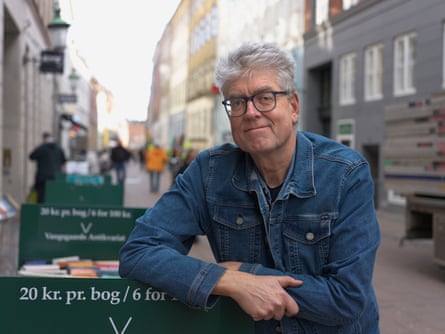
Christian Kaaber, 65, a deputy manager of an antique book store in central Copenhagen, said he leans conservative but that the blue opposition bloc is too “immature”. He is hoping for another centrist government, but fears the outcome will be more left-leaning.
“Personally I dislike Mette Frederiksen, but she is the most competent leader we have had for decades so I think I’ll just close my eyes and put my cross,” he said leaning on a bookshelf outside the shop.
“The outside world is more important than ever and I hope as many as possible will have that view – that we need competent people at the stern in this situation.”