.png) 2 hours ago
5
2 hours ago
5
On the face of it, South Africa have been beset by disruption before their most significant match since the successful defence of their World Cup title. Rassie Erasmus had sought to lean further on the Springboks’ set-piece strengths by selecting Handré Pollard at fly-half for the second Test against New Zealand in Cape Town, suggesting a narrow gameplan. A return to the tried and tested. A reliance on what he knows best. Then came news of the “niggle”.
Out goes Pollard, who, according to the Friday morning bulletin, suffered said niggle in training on Wednesday and failed a fitness test 24 hours before the match, and back comes the far more adventurous Sacha Feinberg-Mngomezulu into the No 10 jersey. Feinberg-Mngomezulu struggled in last week’s 33-16 defeat at Ellis Park, as he did on his comeback from injury against Argentina earlier this month, but the 24-year-old has a skill set that has marked him out as a future global star.
The upshot is that South Africa head to the Mother City for their must-win match against the All Blacks with a completely different type of fly-half. Pollard is experienced, reliable from the tee and, as Erasmus said this week, has delivered “under extreme pressure” time and again for the Springboks. His nerveless goal-kicking guided them to the 2023 World Cup title and, in what are forecast to be wet conditions, South Africa’s initial approach seemed clear. As Erasmus had said when reflecting on his side’s game management in the first Test, “we made a lot of stupid calls. Three points is two less than five [for a try]. Handré is a guy that has always done it for us.”
In turn, it is a fair conclusion to reach that the approach changes somewhat with the introduction of Feinberg-Mngomezulu, while the return of Cheslin Kolbe, who has also replaced Kurt-Lee Arendse in the starting XV as of Friday, is significant because he will assume goalkicking duties.
It does not take much looking on social media, however, to find the conspiracy theorists spouting what, truth be told, most of us are wondering – was this a classic piece of misdirection from Erasmus? Was it the plan all along? Erasmus’ previous further fuels that particular fire as does the convenience of recalling Kolbe to kick at goal, but Pollard’s selection did make a degree of sense.
In the 2023 World Cup semi-final against England, Erasmus hooked Manie Libbok after just half an hour, sending on Pollard to steer the Boks home. When the chips are down, Pollard is the Springboks’ go-to move. As the 1995 World Cup winning captain Joel Stransky says, “Handré brings maturity and stability, and an ability to close the game off. I think there’s a bit of a message in that saying we might just go back to what we used to do best and maybe not the running game.”
New Zealand have clearly been preparing to face Pollard, and the type of gameplan he would carry out, and as a result will have to adapt on the hoof. But to what extent can the same be said for the Springboks? Injuries, of course, happen and South Africa are not the first side to possess a variety of options at fly-half. But the significance here is that his particular selection speaks to the identity of the Springboks just a year out from their tilt at a third straight World Cup title.
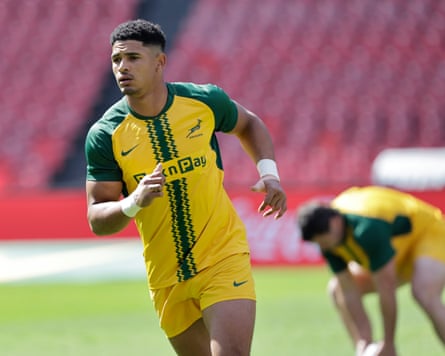
Do they intend to try to defend it with the set-piece-heavy gameplan that has served them so well or, with Feinberg-Mngomezulu running the show, to do so with more creativity and imagination? It is to South Africa’s credit that hitherto in the World Cup cycle, they have looked a side perfectly equipped to do both. But when the “extreme pressure” comes on, which way will they turn? Erasmus has been forced to change tack at the 11th hour. On the face of it.
after newsletter promotion
The All Blacks, for their part, will try to ignore the disruption. They are walking tall after ending South Africa’s run of 12 straight victories and the penny has dropped that, whoever is playing at fly-half for the Springboks, the scrum contest will be pivotal in Cape Town. Such was South Africa’s profligacy in the New Zealand 22 last week, the All Blacks ran out comfortable winners despite conceding six scrum penalties in a barrage by the Boks. That they were able to turn the tide, winning a crucial scrum penalty of their own near their own line, and achieve relative parity thereafter was key to their victory; Dave Rennie wasted little time in flagging concerns this week over South African tactics.
“Scrum-wise, we’ve spoken with World Rugby around a couple of issues from our point of view, and so we think – scrum-wise – we’ll be a lot better,” Rennie said. “That was massive for them last week. We think if they’re forced to scrum square and not allowed to step sidewards and walk around us, then we’ll be able to stay in front and we’ll be able to get the footie going off that.”
As pre-match comments go, they are about as predictable as a late Springboks team change but, with rain expected, the close-quarters battle is to be the most significant aspect of the match on Saturday. Having lost 43-10 in Wellington last year, a week after edging home in Auckland, the All Blacks know the Bok-lash is coming.