.png) 2 hours ago
5
2 hours ago
5
With the Bonneville salt flats in Utah echoing to the sound of a new land speed record achieved by a British team, the timing could not be more apposite. The historical legacy of the challenge of pushing the envelope of pace is being dusted down and made public in the form of an extraordinary archive from more than a century of record-breaking machines and their singularly driven pilots.
On Tuesday JCB’s Hydromax car took the hydrogen-powered International Automobile Federation (FIA) land speed record, reaching 406.320mph at Bonneville. Appropriately the car was driven by Andy Green, the former RAF wing commander who holds the current outright land speed record of 763.035mph, set in 1997 in the ThrustSSC car in which he also became the only person to have broken the sound barrier on land.
His efforts in the ThrustSSC and now the JCB Hydromax join a rich history of land speed records, the archive of which is being re-examined, much of it seeing the light of day for the first time.
The FIA is in the process of digitising for public viewing more than two million documents and pictures from its archive. Its collection relating to the land speed record, held in the FIA storage facility in Valleiry, France, is one of the first projects to be undertaken and will be made public shortly.
“This is the first time they’ve been available outside of the boxes that were stored in Valleiry,” said Roger Banowetz, the president of the FIA land speed records commission. “I was pushing to get the land speed record archive digitised, it’s really important to have that material available for everybody.”
Alongside the documents and pictures are hand-written notes, letters and official records, annotated by those witnessing or taking part in the record attempts, a distinct, human element reaching back through the years.
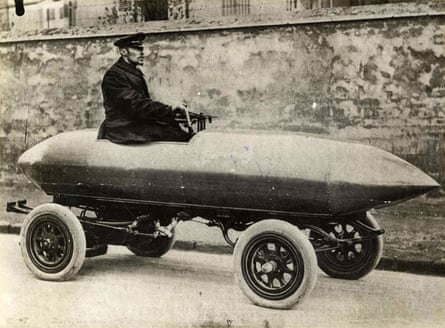
The battle to be the fastest had begun shortly after the invention of the motorcar at the end of the 19th century, but initially under electric combustion power. The Frenchman Count Gaston de Chasseloup-Laubat set the first mark in 1898 at 39.24mph in a Jeantaud car but the baton was swiftly taken up. Belgium’s Camille Jenatzy joined the fray and the pair swapped records for two years until Jenatzy broke the 100kmh mark in his car La Jamais Contente (“The Never Contented”), a striking, torpedo-shaped beast in which Jenatzy sat bolt upright from the knees upward.
What followed became a furious competition as men and women in machines from around the world vied to take the top spot and swiftly caught the public’s imagination. In what might be considered the competition’s golden age, the British were front and centre.
Kenelm Lee Guinness took the record in a Sunbeam 350HP after the first world war, followed by four more successes from Malcolm Campbell, the latter becoming a household name and a key player in a frenetic contest in the 1930s as he and his fellow Britons George Eyston and John Cobb went at it. When the decade began the record stood at 231mph. By its close it was 367mph.
The archive reflects a period when the exploits were front page news. Pictures of Cobb’s Railton Special being assembled speak evocatively of the time while the technical report of his records included understated remarks noting that the course was “unusually rough”.
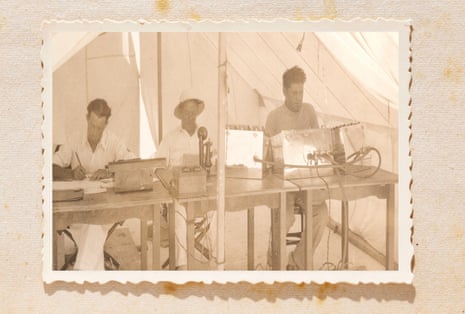
Photos of Campbell’s efforts in 1935 at Bonneville include a picture of the time scorer and calculator, with a handwritten note on the back reading “early morning – clothes not yet removed”, and of his Blue Bird car hurtling across the salt. That year in Utah Campbell broke the 300mph mark but it had been far from an easy ride, as he later recalled.
“Suddenly a film of oil started to cover the windscreen and deadly fumes from the engine commenced to enter the cockpit and I realised that at any moment I might fade out,” he said. “However, we were fast approaching the end of the mile when there was a terrific explosion. The near-side front tyre had burst. By now the screen was opaque. I had a feeling as though dozens of nails were being driven through the top of my head, this being caused through inhaling the exhaust fumes, and in consequence regaining full control of the car was not very easy.”
after newsletter promotion
In a sport where the speeds made the threat of death a constant possibility, it was a stark reminder of how dangerous it was and the bravery of those participating.
“You just don’t get in the thing and put it on cruise control and go down the course,” observed Banowetz in Utah. “We’re out here on the salt right now. Some of the other records have been done on mud, dry, land surfaces. All have very reduced traction compared to a tarmac surface. So it really increases the challenge exponentially.”
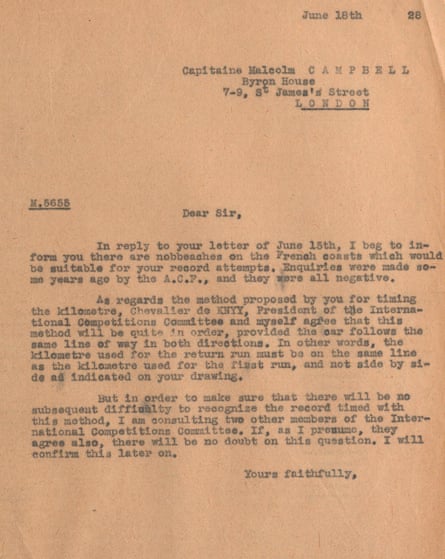
Included too is the correspondence between Campbell and Colonel CG Péron, who was the general secretary of the Association Internationale des Automobile Clubs Reconnus, which set the rules and ratified new records and would ultimately evolve into the FIA. As Campbell tried to find a suitable venue for his efforts between 1928 and 1931 Péron did his best to assist, including enlisting the help of the French military in Algeria. “Mon General … ” begins the letter of introduction he supplied to Campbell.
The competition continued in the postwar period, not just for outright speed but for timed endurance runs too. In 1959 the archive charts a record in the international class G by what might have considered the most unlikely contender, an aerodynamic-bodied Austin-Healey Sprite. The record was set over 12 hours across 1,665 miles at an average of speed of 138.75mph, the details of which were meticulously filled in by hand, including a laconic note recording when one of the drivers, Gus Ehrman, endured a huge spin when the engine cover came off at 135mph: “Car spun outside measured line in 5th lap – run continued”.
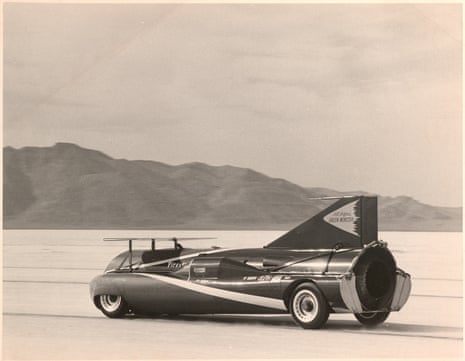
In the 60s the contest changed drastically as the cars ceased to be wheel-driven but rather propelled by jet and rocket engine power. Campbell’s son Duncan was the last to hold the wheel-driven record at 403.10 mph in 1964 before the FIA allowed the use of thrust power and ushered in a new era.
It was led by Craig Breedlove from California who had shown the future when he put a fighter jet engine on to a three-wheel chassis called Spirit of America and reached 407mph at Bonneville in 1963, a record that was not recognised at the time as it was not within regulations. When they were changed he and another young charger, Art Arfons, enjoyed an enthralling to and fro. Between 1963 and 1965 they exchanged the fastest time repeatedly, with Arfons’ wonderfully named Green Monster taking on Spirit of America as the record went from just over 400mph to Breedlove making it to 600.601mph in November 1965.
The FIA documents include a telegram Breedlove sent confirming the new record and noting that, this time, his car did have four wheels.
This week the competition continued with Green and JCB on the flats to set another record. The motto of the team, “never content”, has stood the test of time, as the archive aptly demonstrates. “The people that do this sport are admired because it’s unique in so much as if you can dream it, you can build it and you can race it,” said Banowetz.