.png) 2 months ago
58
2 months ago
58
In the expensive hush of a hotel bar over the road from the Royal Ballet and Opera in Covent Garden, London, Matthew Ball asks for a mint tea. I’m having a white wine; Ball’s body is clearly more of a temple than mine, although you don’t need to know our drinks orders to see that: he has an effortlessly straight-backed posture, muscular arms under a white T-shirt. On stage, ballet dancers can seem like mighty gods and goddesses, but often IRL they are petite. Not so Ball, whose tall stature is part of why he’s much in demand for princely roles and partnering. With the fine features and strong angles of his face, and those piercing eyes, there’s a bit of the Robert Pattinson about him. Is he as brooding and romantic in his roles on stage? Certainly. Tortured? We’ll come to that.
At 31, Ball is riding the crest of a career that seems to have gone pretty smoothly so far. Growing up in Liverpool, he didn’t get much stick for being into ballet as a kid (the worst comments came from another girl in his ballet class). Joining the Royal Ballet School at 11, he graduated straight into the Royal Ballet company and was promoted each year, making it to the top rank of principal in 2018. He has loved getting his teeth into meaty dramatic roles, especially the psychological turmoil of Kenneth MacMillan’s ballets: the suicidal Crown Prince Rudolf in Mayerling or the doomed poet Des Grieux in Manon. As a guest star he was smouldering as The Stranger in Matthew Bourne’s popular Swan Lake and made a virtuoso cameo, spinning in a Paul Smith suit, in the recent Quadrophenia ballet. Plus, he dances at galas all over the world, often with his Brazilian girlfriend and fellow Royal Ballet principal Mayara Magri. He would groan at me telling you that Tatler called them “The Posh’n’Becks of ballet”. “They really went to town on that,” he shakes his head bashfully, “Golden Balls!”
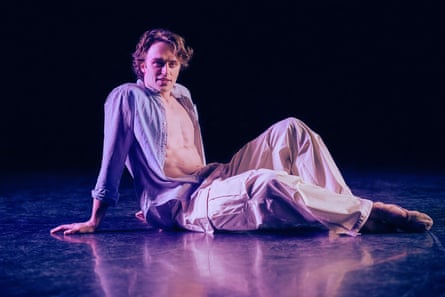
Ball’s next starring role is as himself, in an “Evening With …” event from producers Fundamentally Dance, a new live series aiming to give behind-the-scenes insights into the mysteries of a dancer’s craft. Ball will be giving a “walk and talk” through one of his roles, showing how his mind whirs as he’s performing, especially in the intense, emotionally complex roles he prefers. Against type, he recently made his debut as Colas in Frederick Ashton’s La Fille Mal Gardée, a sunny 1960 ballet romcom with a pantomime dame thrown in. Colas leaps about in bright yellow tights. “I was like: I’m so not used to this. Where’s my angst? What am I going to do with my eyebrows?” He furrows and unfurrows his brow.
But even the showboating ballets are a mental game, he says. Don Quixote is one of the toughest technically. “Your lungs are burning, your legs get heavy, but it’s really a neural fatigue.” The first entrance is explosive, nought to 60. “It’s like a lightning bolt’s come for you, and then you come off and you’re in the wings and … woah,” he looks stunned. But it’s a sprint start to a marathon. Often the biggest moment of a ballet is in the third act, the climax of the show, so you need to be hitting your peak around 10pm. “And your legs are like: ‘I’m not sure I can do that.’”
What about after a show, how does it feel when he’s pulled it off? “It feels pretty good,” he says. “But because I’m trying to squeeze all the juice out of it, and get lost in the character emotionally, quite often I do feel embarrassed afterwards. In the sense of: what did I show? After Mayerling I’m always like: God, what must people think? Wow, you went somewhere that maybe you don’t even reveal to yourself.”
In person, Ball is thoughtful, mild-mannered and quick to laugh at himself. But the choreographer Paul Lightfoot once said: “There’s a kind of suffering in him.” Is there? “I’m quite energetic in the studio, and in general, but I do have a dark side, and when I go there I’m quite internal and I just need to process things. I kind of enjoy negativity sometimes. I’ve always felt that negativity has been an instigator for positive change.”
As an example, he didn’t do well in competitions at school, he says, “and that made me really, like …” he searches for the word and pops with laughter as he finds it, “vengeful!” It was motivation to prove he could do it. That tenacity must have come from somewhere. “I don’t know. My parents weren’t pushy at all with these things,” says Ball, but they were encouraging: his mum taught dance in secondary schools, his dad did teacher training using drama. “My dad’s a massive showoff. He loves stealing a room from time to time.” Maybe there was a competitive streak, he says, as the youngest of four siblings. “My brother was three years older so I was clawing to try to catch up.”
By nine or 10 Ball was pursuing dance seriously. His mum would show him videos of Nureyev and he bought into the “mystique” of such legendary dancers. He remembers having a “weird moment” thinking what would happen if he didn’t get into ballet school. “I remember feeling that I wouldn’t be OK,” he says. But he did get there, the watershed was reading the book Mao’s Last Dancer, about the dancer Li Cunxin, who was chosen from his impoverished village in communist China for intensive training in Beijing. “It flipped a switch, it made me go a bit obsessive.”
In the book Li tells how he tied sandbags to his ankles and hopped up and down flights of stairs to improve his strength. “I was not going through any hardship,” Ball says, realising how easy his life has been compared to Li’s, “but people would laugh at me because I’d be running up and down the fire escape while everyone else was sitting on the floor.” There’s no growth without pushing yourself beyond what’s comfortable, he thinks, and he’s up for it. “I really enjoy flirting with that edge.”
The next challenge: making his own choreography. It’s common to hear choreographers say they want to push boundaries, reinvent the art form; the dance equivalent of “move fast and break things”. But for Ball, “there’s nothing wrong with organic movement”. “There’s a reason why it’s attractive, in the way nature’s attractive. There’s an inbuilt idea of beauty, and you can play with that. Breaking the rules is interesting, but just pretending that they’re not a thing any more and that we’re not human, I don’t know how far you can go with that.” At the same time, he’s not interested in “waving around making pretty shapes”. “There’s so much ballet like that, the wafting vibe,” he says.
He wants his work to be loaded with meaning, and looks to literature, music and painting for inspiration (current faves: Sibelius, Steinbeck). He is influenced by the contemporary choreographer Jiří Kylián, artistic director of the Nederlands Dans Theater, a company where Ball was offered an apprenticeship before choosing the Royal Ballet, in a small sliding doors moment. He would also like to present dance in smaller spaces, having danced for choreographer Kim Brandstrup at Bath’s Ustinov Studio (capacity 126, as opposed to the Royal Opera House’s 2,256).
“It was just really thrilling,” he says. “You’re so close to the audience. I felt as if they were thinking: ‘That’s a person, and they’re sweating,’” he inhales the imaginary scent. “‘I can see them breathing.’ There’s a lot of immediacy and it makes it very tangible.” He even mentions staging dance in churches. “I don’t practise a religion, but I find the theatre of religion really interesting. And that it’s a dedicated space for contemplation. Even the idea of raising ourselves to a higher plane, in whatever sense that might mean.”
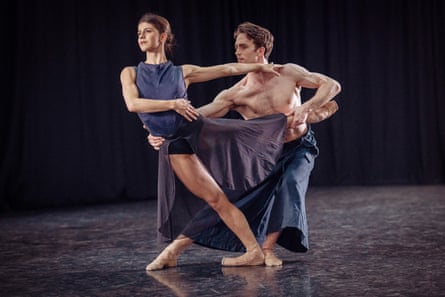
Ball has made duets for himself and Magri, and the level of trust they have in each other is clear. In To and Fro there’s a startling lift when Ball basically tosses Magri up into the air and over his head while she’s in sideways splits. “We tried it out on the beach first, in Bahia in Brazil,” he says. “It was like Dirty Dancing.” He and Magri aren’t usually matched as a couple at the Royal Ballet and perhaps it’s healthy not to be together 24/7 (the pair share a flat off the Holloway Road in north London). “It might be a bit much. We’re both quite strong-willed people, so it’s not always hunky dory. But I think we lend each other a lot of support. If she’s away and not in the wings or watching my show, I feel it a lot. That makes me sound so needy!” he laughs. “I feel like we’re each other’s favourite cheerleader,” he says, which sounds like the definition of a good relationship.
You can see them giving masterclasses together on Ball’s Instagram, along with clips from the dance films Ball makes, modelling shoots, and all the usual ballet dancer photos of beautifully sculpted bodies that elicit multiple fire emojis in the comments. Does he mind that what gets traction on social media can be a bit, shall we say, objectifying? Not really. “The body is just what we work with, so I don’t feel very precious about it.” He recalls being bowled over by Michelangelo’s David in Florence and all the different levels on which you could look at it: “It could be sexualised, but also idealised and pure at the same time. The sensitivity of the sculpture, the vein that feels like it’s literally pulsing, the most delicate skin.” It’s a stretch to compare Instagram with the Italian Renaissance but you get what he’s saying.
Ball describes himself when he was younger as being “desperate for success”. Has it lived up to his expectations? “I feel very aware of how life is a different reality to the dreams you made as a young person,” he says, quick to add, “I don’t feel disappointed or disenchanted, I enjoy a lot of what I do.” He probably has another decade of dancing, but where do you go after you’ve ticked all the boxes on your list? Ball can’t quite picture it. “I was iron-willed about this, when I was nine, and I feel as if I made it happen for myself,” he says.
“I suppose in the future, I want to be a bit more gentle with myself.”
An Evening With Matthew Ball is at Royal Academy of Music: Susie Sainsbury theatre, London, 14 December.