.png) 3 hours ago
2
3 hours ago
2
Barclays Bank is facing a formal complaint over its financial links to a coal-fired power station near the Sundarbans, the world’s largest mangrove forest and home to millions of people in Bangladesh and India.
Three complainants from the region have submitted a case to the UK government’s Office for Responsible Business Conduct, alleging that the British bank breached international guidelines by underwriting companies involved in the emission-heavy Maitree super thermal power project, also known as the Rampal power plant.
The coal-fired power station is situated near the Sundarbans, a Unesco world heritage site made up of more than 100 tiny islands across a river delta that supports hundreds of plant and animal species, including the Bengal tiger.
Sharif Jamil, an environmental campaigner based in the Bangladeshi capital, Dhaka, who is one of the complainants, said heavy-metal pollution from the plant and the industrial development surrounding it was entering the Sundarbans through its interconnected rivers and canals.
“The Rampal power plant is right on the bank of the Pasur River, which is the lifeline of the Sundarbans,” he said. “The health of the forest is in trouble.”
Last November, a study found elevated levels of mercury and arsenic in water samples taken from the Sundarbans, with the highest concentrations recorded in the Pasur River.
Researchers identified industrial discharge and port-related activities among the sources of heavy-metal contamination and said the Rampal power station posed “a significant environmental threat due to emissions from coal combustion and increased navigation traffic”.
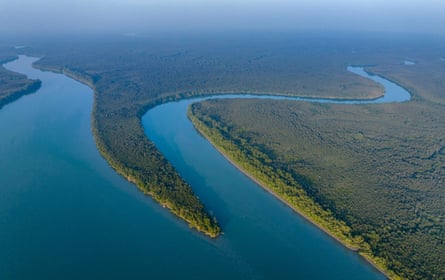
Millions of people live in the Sundarbans, and many depend on the river and forests for food and other resources.
The claimants allege that Barclays failed to conduct sufficient due diligence on the environmental and human rights risks before providing financial services to organisations connected to the project.
Barclays underwrote debt of India’s state-owned NTPC Ltd (formerly the National Thermal Power Corporation), one of the joint-venture partners behind the plant, according to King’s Legal Clinic, which is assisting the complainants. It also says Barclays underwrote bond issues for the Export-Import Bank of India between 2016 and 2019, which provided a loan for the Rampal project.
The complainants argue that emissions from the plant will contribute to global heating, rising sea levels and extreme weather in a region already highly vulnerable to the climate crisis. Mangroves act as a natural barrier against cyclones and other extreme weather.
The power station faced sustained opposition during its planning and construction, including concerns raised by Unesco in a report in 2016, which concluded that “air and water pollution have a high likelihood to irreversibly damage the … World Heritage property”. Some financial institutions, including banks in France, refused to support the project because of its potential environmental and social effects, the complaint says.
Jamil said Barclays’ international standing obliged it to consider the consequences of financing. “The greater your reputation, the greater your responsibility to behave responsibly towards the planet and its people,” he said. “Barclays is a reputed global organisation, and that is why it also has a responsibility.
“Other banks and financial institutions were divesting from, or declining to finance, this project,” he added. “Barclays and other financial organisations should change their policies and examine how their operations can protect the planet from climate catastrophe.”
Jamil also called on banks to direct more funding towards renewable energy rather than imported fossil fuels. “Bangladesh has sunlight throughout the year,” he said. “Why should we expand fossil fuels when there is enormous potential to produce electricity from renewable energy?”
The other complainants include Animesh Mandal, a farmer and politician, and the Dakshinbanga Matsyajibi Forum, a trade union representing fish workers in West Bengal.
They are being assisted by students and lawyers at King’s Human Rights and Environment Clinic, part of King’s College London’s law school.
Sue Willman, a solicitor at the clinic, said: “Rural communities in the Sundarbans are on the frontline of the climate and nature crisis. We hope to persuade banks and financial institutions to think again before financing oil and coal developments that are contributing to that crisis.”
The Office for Responsible Business Conduct, part of the Department for Business and Trade, will assess whether to consider the complaint.
Barclays Bank and BIFPCL (Bangladesh India Friendship Power Company Ltd), the holding company for the Maitree super thermal power project, declined to comment.