.png) 3 months ago
52
3 months ago
52
Friedrich Merz’s Christian Democrats (CDU) have stumbled into a busy election year with a defeat to the Greens in a key state poll, as his embattled party struggles to fend off a challenge in other pivotal races from the far right.
The German chancellor’s conservative CDU had enjoyed a double-digit lead in the south-western car production region of Baden-Württemberg just weeks ago but the Greens and their charismatic candidate Cem Özdemir eked out a half-point-margin win in Sunday’s poll with 30.2%.
Merz, who has travelled to Beijing and Washington in the past two weeks to defend German and European interests amid growing global turbulence, called it a “bitter result” and said the onus was on his government to win back voters.
“We will now have to make more substantial progress with the necessary reforms so that we in Germany can emerge from this difficult economic situation,” he told reporters on Monday.

The surprise Greens triumph is expected to make Özdemir, a former federal cabinet minister and party co-chair, Germany’s first state premier from the large Turkish diaspora community, more than half a century after the first “guest workers” arrived.
Özdemir, 60, whose parents moved to Germany in the 1960s, has said he wants to continue the decade-old Greens-CDU coalition government after a hard-fought campaign in the prosperous state of more than 11 million people.
He would succeed Germany’s first and so far only Green state leader, Winfried Kretschmann, who is retiring after 15 years in charge.

The far-right Alternative für Deutschland party zeroed in on deindustrialisation fears in the state’s automobile heartland, home to Mercedes-Benz and Porsche, and nearly doubled its score from the last election five years ago to almost 19% – its best ever in a western state.
That was below the party’s announced target of 20%, and the third-place finish proved something of a disappointment to the AfD, which had hoped to project its impact far beyond its traditional strongholds in the ex-communist east.
But the result still underlined its ability to expand beyond immigration as a mobilising issue, to capitalise on economic anxiety and win robust support deep in the wealthy west.
Merz’s CDU garnered 29.7%, while its junior coalition partners on the federal level, the Social Democrats, suffered a wipeout with 5.5%. The SPD co-leader Lars Klingbeil, who is also Germany’s vice-chancellor and finance minister, spoke of an “utterly bitter night”.
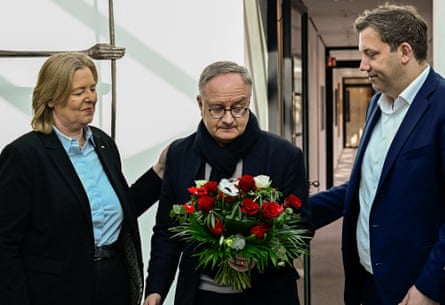
Merz, 70, has stumbled in efforts to jumpstart a recovery in Europe’s top economy, a prospect he said on Monday was increasingly under threat by a spike in energy prices from the Iran war.
His popularity ratings have also taken a hit from rhetoric often seen as divisive in a country that puts a premium on harmony and consensus in politics.
Sunday’s was the first of five state elections this year. The next, on 22 March in neighbouring Rhineland-Palatinate, pits the national governing parties against each other. It has been led since 1991 by the Social Democrats, who are running neck-and-neck with Merz’s CDU.
In September, there are elections in Berlin and two regions in the east, where the AfD hopes to win its first absolute majority and seat a state premier.
The political scientist Albrecht von Lucke called the Baden-Württemberg result a “catastrophe” for Merz’s government. “The defeat has had a devastating effect right at the start of the year,” he told the Frankfurter Rundschau newspaper, noting that the regional CDU “certainly received no tailwind from Berlin”.
“If Rhineland-Palatinate is now also lost … the party will be in a very poor position ahead of the extremely important [eastern] state election in Saxony-Anhalt” where the AfD could win outright.
He said Merz’s ruling coalition would struggle if state elections continued to show diminishing support.
“This will increase the fear, even panic, in both parties – and their efforts to distinguish themselves from each other,” he said. “This means that we will face even more difficult negotiations [on government policy] at the federal level, which in turn will benefit the AfD.”
Özdemir ran a pragmatic, centrist campaign for the Greens, who are polling at just 12% nationally. Analysts said that should serve as a wake-up call to the “Fundi” or hardliner wing of the party, whose influence has grown since it fell out of government in Berlin last year.
Climate campaigners pointed to the Greens’ win as proof that support for EVs, as highlighted by Özdemir, over CDU-backed combustion engines could be a vote winner, even in car country.