.png) 2 months ago
44
2 months ago
44
Oral sex in the kitchen. Weed-smoking and talk of temazepam. A full-frontal Andrew Lincoln shower scene. And that’s just in the first episode. Welcome to This Life. Pop on a Portishead CD and leave your inhibitions (and clothes) at the door.
This Wednesday marks 30 years since the landmark drama swaggered on to our screens in a fug of cigarette smoke and swearing. The BBC is celebrating the anniversary by rerunning the none-more-90s saga, with a new introduction by the actor Daniela Nardini, who played the breakout heroine Anna. It enables viewers to revisit a cult classic that not only captured the hedonistic spirit of the Cool Britannia era but left a lasting mark on TV.
Amy Jenkins, the show’s creator and chief writer, recalls how This Life came into being: “Michael Jackson – not that one, the BBC Two controller – wanted to be more like Channel 4, so decided to commission a cool drama for young people about trainee lawyers. When I told [executive producer] Tony Garnett that I’d briefly been a lawyer, his eyes lit up. But I didn’t want to write a show about lawyers! Fuck, so boring. That’s why I’d left to become a writer. I agreed on the condition that we never had courtroom scenes and it wasn’t actually about law at all. I had another idea for a script about the rave scene, so I brought that spirit into it.”
Her seminal series followed a gang of law graduates as they embarked on their adult lives while sharing a shabby house near London’s Southwark Bridge. Booze flowed. Quips flew. Debauchery followed. “I remember being in BBC meetings and people asking, ‘Why do we care about this bunch of idiots?’” says Jenkins. “By which they meant fairly privileged university graduates. It was oddly radical at the time to show middle-class young people who were drinking, swearing, taking drugs and having sex. It struck such a chord because that generation had never been represented on TV. No one had even tried.”
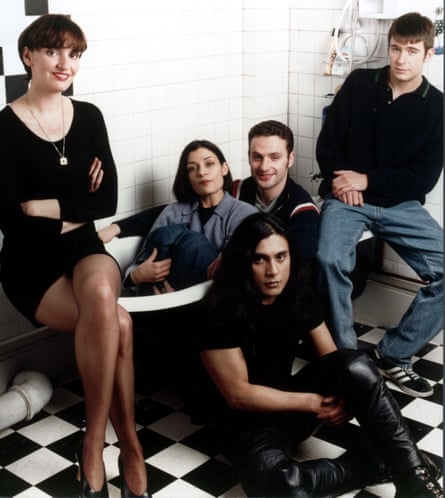
Viewers felt as if they truly knew the characters, learning to love, hate or fancy them. Daydreamer Edgar, AKA “Egg” (Lincoln), was in a long-term relationship with ambitious Milly (Amita Dhiri). At least, until contrasting approaches to their careers caused tension. Warren (Jason Hughes) was Welsh, gay and in therapy. Scenes of Warren’s counselling sessions with an unseen psychiatrist came years before HBO went there in The Sopranos, Big Little Lies and In Treatment. “Therapy wasn’t as ubiquitous as it is now but I was in therapy from age 20,” says Jenkins. “Most of my friends were too. And if they weren’t, they were talking about it. As a writer, you’re always looking to go places nobody has gone before. Besides, therapy makes for great scenes.”
The show’s killer weapon was the love-hate relationship between posh playboy Miles (Jack Davenport) and chippy, lippy Anna. For mid-90s viewers, the pair became a homegrown Ross and Rachel – two frenemies who’d had a fling at university and clearly belonged together. Viewers willed them to admit their feelings and sort it out. But because this was a sarky UK drama and not a schmaltzy US sitcom, they never quite did.
Like Nardini says in her introduction: “Our will-they-or-won’t-they relationship titillated and teased viewers. It was an important hook for the audience. People really bought into it and wanted them to get together.” “The characters were loosely based on me and my friends,” says Jenkins. “I lived in a house share and had a quite chaotic social life. Anna was kind of my alter ego, whereas Miles was the sort of handsome bloke I fancied but never got anywhere with. Well, sometimes a little bit!”
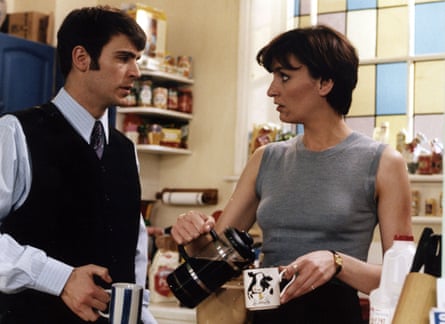
As a self-sabotaging but lovable hot mess, Anna was a proto-Fleabag – a chain-smoking whirlwind of charisma in a little black dress and leopardskin coat. Phoebe Waller-Bridge cites This Life as one of her formative shows. “Despite being this outspoken, cursing, hard-drinking tough nut who was good at her job, there was this real vulnerability about Anna,” says Nardini. She won a Bafta for her show-stealing performance.
With its bracingly bold portrayal of recreational drug-taking and casual sex, This Life spoke to a generation. “I hadn’t come across anything like it,” says Nardini. “It was fresh and youthful but didn’t feel like Hollyoaks. They drank and did drugs but there wouldn’t be any big consequences. Nobody dropped down dead or went into recovery. It was unapologetic.”
The Daily Mail pronounced itself “appalled”. “They used to ring up and say their readers were disgusted,” says Jenkins. “I should’ve replied: ‘Well, I’m disgusted by the Daily Mail.’ I’m glad if it moved things forward in terms of inclusivity, especially the gay sex scenes. One of my proudest moments was getting a letter from a young gay man who worked in the Post Office. He said: ‘I want to thank you because your show changed my life.’”
The BBC largely left them to it, except for F-bombs and fellatio. “They once cut three seconds off a blowjob,” says Jenkins. “We also had a limited number of ‘fucks’ that could be said per episode.” Nardini grins: “They gave them all to Anna because she swore the best.” The show almost featured a Saltburn moment: “I remember giving Jack Davenport a scene where Miles had a wank in the bath but he refused to do it.” Jenkins laughs. “I don’t blame him. It was probably a bit out of order on my part.”
Storylines tackled previously taboo subjects, from eating disorders to HIV scares – not to mention the theory that “the Beatles are boring”. Jenkins grabbed attention in a BBC meeting by voicing this deliberately provocative view. She subsequently put the line in Anna’s mouth during episode one.
Veteran producer Garnett was a longtime Ken Loach collaborator and wanted the action to feel grittily real, hence no studio sets or slick editing. This Life was shot almost entirely on location. Pioneering use of wobbly handheld cameras gave it a raw, voyeuristic, documentary-like feel. This technique would later be adopted by everything from The Cops to Succession. “Us actors felt very free,” says Nardini. “We were never given marks to hit; the camera just followed us”. “That fly-on-the-wall intimacy has become the norm now,” adds Jenkins.
When the show launched on late-night BBC Two in spring 1996, it slipped under many radars and was only a modest success. But a second series had already been commissioned and in the run-up to its broadcast the debut run was repeated to build buzz. This Life took off at last. The photogenic cast hit front pages and plot lines became talking points. Promoted to a prime time slot, it drew an impressive audience of 4 million and sold strongly on VHS.
“Tony was very clear that he wanted viewers to discover the show for themselves,” says Jenkins. “No billboards, no big campaign. He wanted people to stumble across it and feel like it belonged to them. Happily, that’s exactly what happened. We got a notoriously terrible review in Time Out for the first episode but they actually retracted it, which is unheard of. Seven episodes later, they wrote: ‘We’re going to admit we got this wrong.’ That never happens. Lots of people were rude about This Life. When it became a solid hit and, dare I say it, a bit of a classic, that was the best revenge.”
“The show exploded,” says Nardini. “I was on an escalator in Leicester Square tube with my brother and someone shouted: ‘Oh my God, there’s Anna from This Life!’ My brother went: ‘Are you some sort of rock star’?”
This Life became one of the first word-of-mouth, box set-style hits on British TV. It was also among the first to release a soundtrack album. Its zeitgeisty blend of Britpop and trip-hop was curated by an unknown named Ricky Gervais, partner of the show’s producer Jane Fallon, three years before his own on-screen career began. Credited as “music advisor”, Gervais commissioned the guitar-chiming theme tune by the Way Out.
Who did Jenkins most enjoy writing for? “Anna, because she had main character energy. I also loved Egg. He was kind of the ‘new lad’, having feelings and liking football. He worshipped Eric Cantona and wanted to become a novelist. I’m not sure we’d seen that on TV before. After all, the middle classes didn’t discover football until Euro 96 and Nick Hornby.”
As well as becoming a cultural touchstone, the show unearthed a generation of talent. Lincoln would zombie-slay his way to global fame in The Walking Dead. Davenport has been a regular presence in film (notably the Pirates of the Caribbean franchise) and TV (from Coupling to The Morning Show). So has Natasha Little, who played the troublemaker Rachel. Jason Hughes spent eight years as the detective sidekick in Midsomer Murders. A baby-faced Martin Freeman and Jodie Whittaker (she was in the 2007 reunion special) appeared in early roles.
Alongside the Gervais/Fallon proto power couple, behind the camera were the likes of Amelia Bullmore, Joe Ahearne and Matthew Graham (he later co-created Life on Mars). Jenkins would become a novelist and a writer on The Crown, while Garnett’s World Productions went on to make Line of Duty.
Groundbreaking in style and content, This Life reinvented TV drama, ushering in a wave of sexed-up soaps about urban professionals. “We inspired a whole swathe of brilliant shows that came after,” says Jenkins. “Cold Feet, Coupling, all the fantastic Russell T Davies stuff. This Life definitely moved the dial a bit. The current show that most reminds me of it is Industry. That’s got a strong This Life vibe.’”
Thirty years on, the lusty lawyers are back. “It’s become a bit like Dad’s Army,” says Jenkins. “When in doubt, the BBC repeat This Life! But it’s fantastic that it’s still being discovered. People often tell me that they begged their mum to let them stay up late to watch it. I’ve even met people who went into law because of This Life. I’m always slightly apologetic about that!”