.png) 2 months ago
65
2 months ago
65
The Australian-born broadcaster Brian Hayes, who has died aged 87, was a pioneer of phone-in programmes in Britain. Soon after the launch of his mid-morning show on LBC in 1976, he was labelled “the rudest man on radio”, with a reputation for being abrupt with listeners and challenging their views trenchantly. However, he insisted: “I’m not rude, but I might be assertive or even aggressive. I think I might be a bit arrogant – but that’s not a character defect.”
His abrasive manner, which included cutting off callers he thought were failing to back up their arguments, was part of the “game of verbal chess” he said he played with them. He was the ultimate devil’s advocate, in contrast to presenters such as James Whale who tried to emulate the American “shock jocks”, provoking listeners with their own opinions.
“There are two sides at least to everything,” Hayes explained to Iain Dale in a 2013 LBC interview marking the 40th anniversary of the launch of the country’s first commercial radio station, broadcasting news and information to London.
“I didn’t generally put my own point of view across. I said, ‘Here it is. You can either think that of it or you can think this of it. Let’s talk about it.’ And the first person who came on said, ‘I think that,’ and then I would argue that it wasn’t that – it was this. That, I thought, meant that I couldn’t be accused of taking a line and, what’s more, I didn’t want to. I didn’t want to be known by my opinions on politics or anything else.”
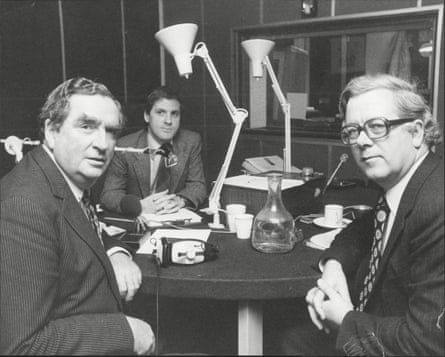
The show, which ran until 1990 and attracted up to 500,000 listeners, also featured Hayes’s interviews with politicians – over two turbulent decades of conflict in the Middle East, the winter of discontent, the Thatcher years and the Falklands war – although he said he was more invigorated by his chats with big names in the arts and literature such as Joseph Heller and Lawrence Durrell.
After 14 years, following a change of management at LBC, Hayes – nicknamed “Brian Bastard” by Private Eye – was moved off the morning show and offered an evening slot, which he turned down.
BBC Radio 2 gave him a national audience when he stood in for holidaying presenters during 1991, before he took over from Derek Jameson on the breakfast show – newly titled Good Morning UK! – the following year. He was less at home in this mainstream mix of music, news and sport, and after 12 months handed over to Terry Wogan, who returning to the station after almost a decade away.
More happily, he presented the weekly evening programme Hayes Over Britain (1993-98) for Radio 2, returning to his tried-and-trusted format. One edition, on euthanasia, won him the 1993 Gold Sony Radio award for best phone-in.
During the same period, he was back in the mornings taking calls for his show The Magazine (1994-97) on Radio 5 Live, where he also returned to breakfast time at weekends (1995-98), then hosted a late-night show (1998-2006). Another Sony Radio award came his way for anchoring the station’s coverage of the 1999 Soho nail bombing. He described Radio 5 Live as “the nearest thing to LBC”.
Hayes was born in Perth, Western Australia, and brought up in the mining town of Norseman, where his father was a gold miner, and then the city of Kalgoorlie. He said that even at school he enjoyed debate and was known as “a difficult little beggar”.
He left at 14 to take a typing course, then went through jobs at the Kalgoorlie Miner newspaper, the Chamber of Mines, and a mining company, before his radio break in 1955, aged 17, reading the news and presenting music shows on the Kalgoorlie station 6KG. Five years later, he moved to 6TZ-CI in the coastal city of Bunbury and rapidly on to 6IX in Perth to present phone-in shows and documentaries.
In 1971, Hayes emigrated to Britain. Radio work was slow coming, so he found jobs as an usher at the Dominion theatre in London, then as a copytaker for the Press Association.
Capital Radio, a new London commercial station that opened in 1973, a week after LBC, took him on as a producer of the phone-in show Open Line, and two years later he was presenting it. He joined LBC in 1976, with Margaret Thatcher, the new Conservative party opposition leader, as a guest on his first programme. He said she was as nervous as he was – and concerned that the headphones would ruin her hairdo. Later, he was named the Variety Club’s 1980 Independent Radio Personality of the Year.
On leaving LBC, he had his own show on the BBC London station GLR during 1991 and, while at Radio 2, interviewed guests on the Radio 4 programme Midweek, alongside Libby Purves, from 1991 to 1994. He also presented the London Newstalk breakfast show with Douglas Cameron (1994-95).
He later starred in the Radio 4 sitcom Not Today, Thank You (2006) as a washed-up radio presenter.
In 1965, Hayes married Rosie Galati; they divorced in 1998. He is survived by their son, Sean, and a granddaughter, Emily.