.png) 3 months ago
48
3 months ago
48
He’s got the whole Warwick Arts Centre in his hands. It’s Friday night and the 550-capacity venue is sold out. The theatre is full of adults singing the school assembly hymns you may remember from childhood. They are rising and shining, conducting gleeful hand actions of wiggly worms and fish in the sea. Just what is going on?
James B Partridge’s Primary School Bangers is the hit show that is storming UK arts centres, originally a viral video that has become a defiantly IRL phenomenon. “It just brings back memories of primary school, sitting in the hall,” enthuses Hayley, 40. She is one of many teachers attending tonight. “We don’t sing in primary schools much any more,” mourns Katie, 33. She is right: in the 2010s, funding cuts, Conservative policy and a crisis in teacher retention caused an ongoing fall in music at primary level. At her school, children sing just once every three weeks. Some of tonight’s pull is communal. “You go to a show and you have to sit and watch,” says Frank, 61, “but you’re actually participating in this, that’s the big difference.”
On a stage decked out with gym equipment and blackboard, Partridge – who, in Warwick, the crowd greet in unison with a cheery singsong “good evening Mr Partridge” – sings and plays the keyboard. He plays on their memories, too, with a tightly scripted show built on reflective interludes about school discos and Sunday night homework.
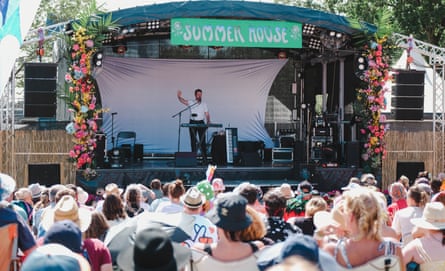
On a stage decked out with gym equipment and blackboard, Partridge – who, in Warwick, the crowd greet in unison with a cheery singsong “good evening Mr Partridge” – sings and plays the keyboard. He plays on their memories, too, with a tightly scripted show built on reflective interludes about school discos and Sunday night homework. Everyone agrees on how they found out about the show – on social media and often through the same video: Glastonbury 2025. When Partridge took to the Summer House stage at the Theatre and Circus fields, he had just pulled an all-nighter (disappointingly, from being kept awake by some dodgy on-site chicken). As with Kneecap, the festival had to restrict entry to the packed field during his set. Unlike with Kneecap, the sunburnt crowd swayed amiably to Shine Jesus Shine.
Partridge himself looked like a CBeebies presenter conducting a rave. “There was a group of laddish guys,” he remembers. “One who looked like Jason Statham, but he was in a school uniform and tie, with a Give Me Oil in My Lamp flag. He was crying, arm in arm with his mates.”
BBC News’s TikTok of the Glasto performance garnered 6.8m views (for comparison, their video announcing Andrew Mountbatten-Windsor’s arrest got 1.8m). Partridge is intrigued that below-the-line commenters were unable to place it on the political spectrum. Some, he says, damned it as “lefty woke nonsense. Others said it was all the Tories at Glastonbury. You can project whatever you want on to this, if you want to.”
Prior to his Warwick gig, I meet Partridge at the Barbican Centre, the London arts institution where he will cement his unlikely domination with an April show. He is cheery and self-effacing in a quarter-zip jumper. From the 1970s to the 1990s, he argues, “people had the same experience in primary schools”. His show is about “the last era where we grew up without constant access to the internet”.
Partridge’s own childhood was in Dorset; he was born in 1991 to teacher parents. Speak to him for five minutes and it’s obvious his passion for music is sincere and formative. The child who nerded out over the Bournemouth Symphony Orchestra became the music teacher who juggled four schools in five days with private tuition at the weekend. There was also Truly Medley Deeply, the mashup wedding band he co-formed (this was how he met his wife, proffering her a business card from the stage of London’s Winter Wonderland).
Covid hit, and he started “basically putting videos on YouTube for my pupils to sing along to”. A friend suggested they might do numbers on TikTok. A first video about music theory very much didn’t, but when an Easter 2021 video about hymns performed modestly, Partridge filmed a TikTok about his “top 10 British primary school assembly bangers”, editing it in a Costco car park while his wife shopped. And then, that very modern chorus: “I looked at my phone the next day and it had gone crazy.”
Partridge being Partridge, he “went away and rewrote it as an immersive theatre show”. When his London debut sold out in minutes, he put together an Excel spreadsheet of arts centres cribbed from comedians’ tour posters, and got cold calling.
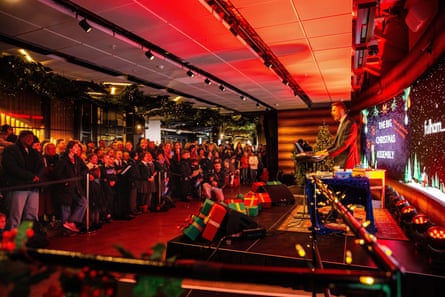
It’s an impressive story. But look: Primary School Bangers does not feel like a product of a vigorously progressive culture. Its rise is part of a wider love for online meme nostalgia, the eyeball-guzzling content that plays on a yearning for the banal markers of a simpler time such as “proper binmen”, playing out in the street and, in this case, cold school assembly halls. It is also part of an experience economy where novelty attractions such as adult ball pits and immersive Peaky Blinders drink and dine nights have surged in the last decade.
In Warwick, for all that the audience are loving it, the enthusiastic self-infantilisation feels depressing to me. Is Middle England so deprived of communal singing – the pub, the church, the local choir – it makes this appealing?
“People are going to church less,” observes Partridge, of a show that is “not religious, but has songs that tell religious stories”. He pitches Primary School Bangers as part of a lineage that includes the BBC’s long-running Singing Together – though that was aimed at children, not their mums and dads. In fact, Partridge’s show is straightforward nostalgia, with broad callbacks to Panda Pops or S Club 7. And despite the show’s professed nostalgia for the overhead projectors that displayed the lyrics (you can buy T-shirts of them), here they are found via QR code. A The glowing faces in the audience provide an easy metaphor for nostalgia mediated by phone use.
At the Barbican, Partridge sticks out on a music programme otherwise dedicated to more bold and boundary-pushing work, though he doesn’t see it like that. “I would say that the Barbican was created in the spirit of postwar communal rebuilding,” he says of the housing estate and arts centre that was built in the 1960s and 70s. His ideal punter, he says, might take in something “extremely avant garde” before catching Primary School Bangers. “There’s something to be said for channelling the idea of rebuilding, and bringing people back together in a large, multiuse space.” To paraphrase one of his bangers: perhaps it’s from the old that’s he’s travelling to the new?