.png) 1 month ago
47
1 month ago
47
I park my car near the trail head and leash up my labrador. Mist coils around the stringy trunks of the manna gums and I breathe in a lungful of cold, peppery air. With notebook in hand, I begin to walk.
I learn a lot by walking in the forest every day. It’s like catching up on the daily news, but with a focus more ecological than political. I see which trees have fallen, what flowers have burst into bloom, which animals have been busy overnight, what weather is coming in. Most of all, surrounded by growing, breathing things that aren’t human, I learn that I am not the main form of life on the planet, but just one note in a vibrant choir of living beings. Importantly, I learn this with my brain, but also my heart, lungs, muscles and skin.
It’s a well-trodden cliche to ask a writer where their ideas come from. Answers typically include other books, film, music, art, people and simply life itself. Generative AI aside, the source of a writer’s creativity is often considered something of a mystery, part of the glamour and mystique of the singular (usually male) author, toiling away in the turret of his solitude. Over the past few years, I have come to a different view. I think my ideas come from trees.
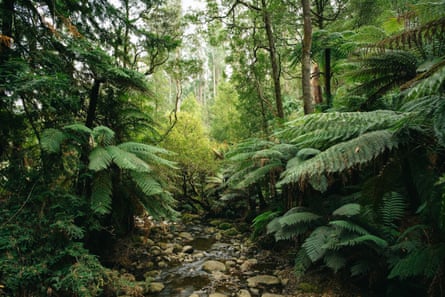
I am lucky enough to live near cool-climate eucalypt forests in central Victoria. During the early months of writing my last novel, I noticed that, walking in these forests, my mind worked differently. Ideas came quickly, thoughts roamed more freely, more associatively. As if these green beings had switched something on inside my brain. I started going to the forest with specific problems or gaps in the narrative, finding they would be solved by the end of the walk. The effect was so pronounced that I decided to commit to a year of daily walking to see how it might shape my novel. That year changed how I wrote for ever.
We already know that being in forests is good for us, lowering blood pressure, improving metabolic function, enhancing immunity, reducing anxiety and loneliness, boosting mood. Across almost every physiological and psychological measure, human function is improved by spending time among trees. But do they help us be more creative?
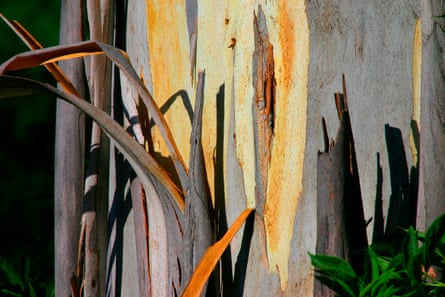
Researchers measure human creativity by testing the ability to think associatively. In a study measuring associative performance before and after a forest therapy experience, participants’ abilities had significantly increased. Qualitative studies also show that natural environments, such as forests, enhance creative thinking by increasing curiosity, ideas and flexible thinking. So what is it about forests that sets our imaginations in motion?
It seems obvious that walking somewhere pleasant will be conducive to creative thinking – after all, poets and artists have been inspired by natural beauty for centuries. But in terms of a deeper explanation, researchers don’t have a definitive answer. Psychologists suggest it is to do with the cognitive rest our brains get in soothing forest environments, leaving us refreshed for creative thinking. I believe it is much more than this.
My year of daily walking in the forest was one of getting to know a community of sentient, thoughtful beings. Contemporary science is just beginning to understand what many Indigenous cultures have always known: that far from being an inert, green backdrop to a human drama, plants are highly perceptive and responsive creatures that converse continuously with their environment and one another, and live their own full and complex lives.
Trees don’t have words, but they express themselves with a rich vocabulary of colour, scent, growth and a chemical lexicon far beyond human perception. Every bend in their branches, every new shoot, is a decision about light, water, kin and predators. They don’t have brains, but their bodies are their thoughts. Their patterns are their intelligence.

Plants are the dominant life form of our planet. They are continuously proliferating, burgeoning, branching, blossoming, dying and feeding new growth as their bodies rot. The forest is, in every sense, a place of creativity.
The novel I wrote during my year in the forest was different to anything I’d written before. Its narrative was fragmented, connected by the rhizomatic logic of memory and association. It was forest-like. Did it come from my head? Or is a novel just one instance of a human fleetingly humming along with the fundamentally generative nature of the living Earth?
-
Ilka Tampke is the author of How to Love the World, out now (Summit Books, $34.99)