.png) 1 month ago
49
1 month ago
49
Everybody knows fossil fuels cause climate breakdown, but until recently, mention of them was all but erased from the annual UN climate summits. Last year, two weeks of discussions ended without fossil fuels being mentioned in the final outcome.
Frustration with those talks led a small developing country with a large fossil fuel sector – Colombia, the largest coal and fourth biggest oil exporter in the Americas – to rewrite the rules. With co-convener the Netherlands, and support from more than 50 countries, Colombia will host a groundbreaking new global conference this month to begin the long-awaited “transition away from fossil fuels”.
Now, with nations embroiled in another oil-inflected war and fuel prices soaring worldwide as a consequence, the conference in Santa Marta on 28 and 29 April looks more prescient than ever.
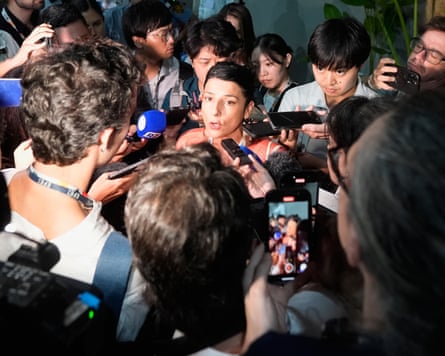
Irene Vélez Torres, Colombia’s minister of environment and sustainable development, speaks at the COP30 UN climate summit, 21 November 2025, in Belem, Brazil. Photograph: Fernando Llano/AP
Countries are paying the price for oil addiction, not just in their energy bills but in food prices, consumer inflation, shortages, and businesses threatened with collapse. “We, of course, didn’t know that war was going to break out, but we knew the challenges of a dependency on fossil fuels,” said Irene Vélez Torres, Colombia’s environment minister, who will preside over the talks. “This conference comes in the best possible moment.”
The oil crisis, sparked by the US-Israeli attack on Iran, is spotlighting the stark choice world leaders face between oil, gas and coal and the cleaner, safer renewable energy of the future. This is “the moment in which history is going to split,” said Vélez.
Spurred by soaring prices, some countries – and millions of individuals – are already making the switch. Record numbers of households in the UK are turning to solar panels, electric vehicles and heat pumps. Not counting China, global power generation from coal and gas has fallen, while renewables have surged ahead, with solar generation up 14% and wind by 8%. After the closure of the Hormuz strait, coal-fired power generation fell in the US, India, EU, Turkey and South Africa, according to the Centre for Research on Energy and Clean Air, despite fears that countries would return to coal.
For the first time, the countries that want to forge ahead with the energy transition cannot be held back by the naysayers, Vélez told the Guardian in an interview. With a “coalition of the willing”, Colombia and co-host the Netherlands hope to break the deadlock of the long-running UN climate talks that are frequently hijacked by the unwilling.
While 54 countries have confirmed their attendance at the conference, some of the world’s biggest economies and biggest polluters, including the US, China, India, Russia and the Gulf petro states, will be missing. “Whatever nations have not yet taken that decision, then this is not the space for them. We are not going to have boycotters or climate denialists at the table,” Vélez said.
The 54 countries confirmed represent about a fifth of global fossil fuel production and about a third of demand. They include the UK, the EU, Canada, and Australia and Turkey, which will jointly preside over the next UN climate summit, Cop31, this November. Among the dozens of developing countries confirmed are some of the most vulnerable to the impacts of the climate crisis, such as Pacific islands, but also major fossil fuel producers, such as Nigeria, Angola, Mexico and Brazil.
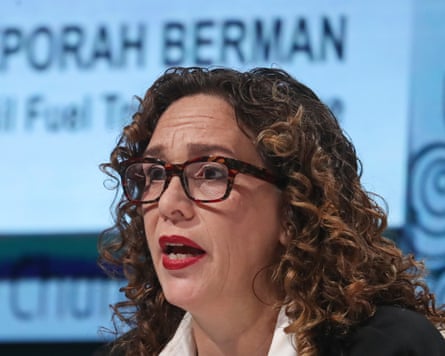
Tzeporah Berman, founder of the Fossil Fuel Non-Proliferation Treaty Initiative, said the Santa Marta conference, intended to be the first of a series, would complement rather than replace the annual UN summits. “The UN Framework Convention on Climate Change [UNFCCC] plays a vital role in climate governance, and will continue to do so,” she said. “However, it’s a consensus-based process and has become deadlocked on the core issue of fossil fuels. Year after year, we’ve seen this deadlock exploited to delay meaningful action on fossil fuel supply.”
Governments first agreed to “transition away from fossil fuels” at the Cop28 UN climate summit in Dubai in 2023, but have taken no further steps to decide what such a transition could look like or how to embark on it.
For Vélez, that failure comes down to an unwillingness to take the risk of change. But sticking with the status quo carries its own dangers, she said. “There is a lot of energy stress [owing to the Iran war], there is energy scarcity and it’s going to be very difficult for the energy market, and the oil market particularly, to recover any time soon,” she said.
Fossil fuel dependency also leads to war and global conflict, and countries must put themselves “on the right side of history” by moving to alternatives, said Vélez, a former minister of mines.
“[The Iran war] is making explicit what the difficulties of the fossil fuel model are,” she said. “There is a straight line of connection between the fossil fuel economy and armed conflicts at the global scale.”
Governments are at “un parte caminos” according to Vélez – a fork in the road.
Colombia has decided to stop licensing new coal, oil or gas exploration, and is aiming to develop other industries (including renewable energy), focus more on tourism and boost agriculture. “We want to invite people to be on the right side of history,” Vélez said. “The right side of history is to go greener, to go more sustainable, to go more interconnected. [These decisions can be] challenging in terms of energy provision, but are the best and maybe the only way for humanity to survive.”
Other countries could cooperate with and learn from Colombia, she added. “This country has made a very brave decision [to stop new licensing]. The reason is we should make economic decisions away from extractivism [reliance on the extraction of resources] into what we call economics for life.”
Photograph: André Penner/AP
Yet some of the participants, including Norway, Mexico and Nigeria, are planning to expand fossil fuel production in response to the Iran war. “The risks of fossil fuel dependency have literally exploded in front of us,” said Claudio Angelo, head of international policy at the Observatório do Clima thinktank in Brazil. But he warned the climate crisis was slipping down the lists of government priorities – a tendency that the conference “has to counteract”.
Finance to help developing countries make the switch to clean energy will be key for many. “[It’s important that] this conference focuses on the tangible, designing a financial mechanism that can actually reach out to our shores, securing technology transfer that doesn’t come with debt and building economic pathways that allow nations to choose their people over oil reserves,” said Maina Talia, from the government of Tuvalu, at a press conference organised by Climate Home News.
Carola Mejia, of the climate justice network Latindadd, said the wars in the Middle East and Ukraine had led to an alarming shift in government spending priorities. “International cooperation financing decreased 21% in one year due to the military budget increases prompted by war,” she said. “Santa Marta must be a milestone for a future based on peace and solidarity.”
This month’s conference will be just the start. The main tangible outcome will be a report by scientists – “some very rock star academics,” according to Vélez – on how countries can make the transition, and one from finance experts from the Global South on how funding can be made available to countries that need it. A second conference is already planned for next year, in Tuvalu.
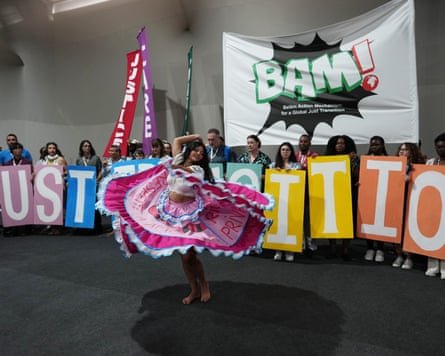
Colombia and the Netherlands are also convening a “people’s summit” within the conference to ensure Indigenous peoples and marginalised groups are heard. The organisers expect 2,800 representatives from Indigenous, African-descendant, youth, women and other social movements.
Oswaldo Muca Castizo, general coordinator of the National Organization of Indigenous Peoples of the Colombian Amazon, said, “Indigenous communities are demanding a strong voice at Santa Marta. Many stress the energy transition must be fair to prevent their lands from being exploited for critical minerals or carbon credits. Some want territories to be declared fossil-free zones with extra protections for isolated peoples.
“The mechanisms being used in transition are often not fair. Sometimes, the opposite. Indigenous people are at ground zero. We have to be a fundamental part of the conference.”