.png) 5 hours ago
7
5 hours ago
7
In 1949, Kazimierz Moczarski, a leading member of the Polish resistance, was in his fourth year of incarceration when he was moved into a cell with two Nazis at Warsaw’s Mokotów prison. One of them was Jürgen Stroop – a war criminal and SS general who had led the infamous destruction of the Warsaw ghetto and was responsible for the murder or capture of more than 56,000 Jews. They shared the same four walls for 255 consecutive days.
A celebrated figure in modern-day Poland, Moczarski was regarded as a threat to the power of the postwar communist regime in the country. Like other resistance members, he was accused of collaboration and arrested. But Moczarski, who spoke German, used his imprisonment with Stroop as an opportunity to investigate a question: what turned some Germans into mass murderers, seeking to impose their “Ordnung”, order, across the world? His book about the experience, Conversations with an Executioner, was published in 1977. An instant bestseller, it was performed as a play the same year, directed by Andrzej Wajda. It is finally being published in the UK this month, in its first uncensored translation into English by Sean Gasper Bye.
Publisher Clare Bullock heard about the book by chance nearly 10 years ago when she was studying Polish. “In one of my lessons, we were talking about books, Polish classics. And this wonderful teacher, he said, ‘Well, there’s this one book. I don’t understand why it’s never been published here. It’s absolutely extraordinary.’” It was not until she joined Duckworth Books as editorial director in 2024 that she had the opportunity to publish it. Next year is the 50th anniversary of the book’s publication and the 120th of Moczarski’s birth. There will be events to mark the occasion in Poland.
Stroop was an unrepentant fascist. He had been sentenced to death by the US military tribunal at Dachau and was awaiting trial in Poland. His cellmate Moczarski had been a member of the Home Army, the main resistance group, and had even taken part in plans to assassinate him. Yet Stroop told him his life story with little inhibition, from his rapid rise in the SS to the shocking details of the obliteration of the Warsaw ghetto in 1943.
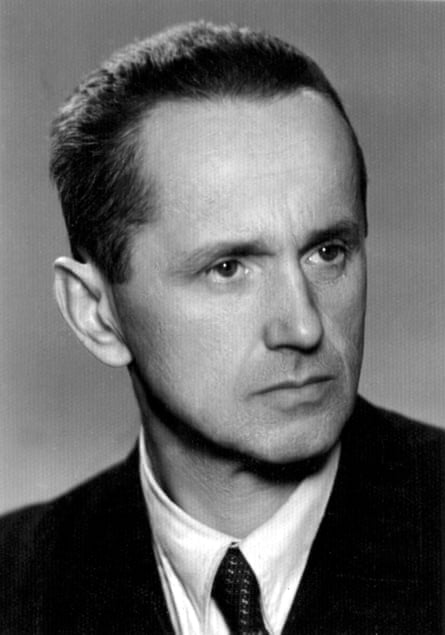
The memoir offers a remarkable insight into the genesis and mindset of a Nazi war criminal. “Remember that Stroop lived in the shadow of the gallows,” Moczarski later said in an interview, “and this situation encourages people to talk.” The third man in the cell, Gustav Schielke, had been a low-ranking SS officer, who was not fully signed up to the Nazi cause, and he joined Moczarski in cross-questioning Stroop about his activities during the war. The highly charged relationship between the three men reads like a drama: they sparred with each other, but they also shared a solidarity as prisoners, becoming anxious when one of them was taken out of the cell for interrogation.
Jürgen Stroop was executed in Poland in 1952, while Moczarski was released from prison in 1956. He wrote the book while working as a journalist and assiduously factchecked Stroop’s version of events. “My father tried to talk to publishers in the late 60s, but the book was banned, totally banned,” says Elżbieta Moczarska, who was born in 1958, the only child of Moczarski and his wife Zofia. Her mother was also in the resistance and was arrested after the war as well. “Everyone obviously wanted to hear about the Nazis, but nobody wanted to have information on why a hero, somebody who was very high in the resistance, was put into the same cell [as Nazis] and was imprisoned for such a long time.” It was finally serialised in a literary magazine in the early 70s and then published as a book after Moczarski’s death, with the permission of the Communist party, in a censored edition. Elżbieta spent nearly 40 years trying to get a complete translation published in English.
Moczarski allowed Stroop to condemn himself in his own words. The Nazi unashamedly relived his genocidal glory days despite his hostile audience, holding forth about his life with such candour that he is sometimes as comic as he is chilling. In one memorable scene, Stroop demonstrated how to ride a horse in the prison cell, whinnying and snorting. His repeated lascivious references to women’s breasts are almost a running gag. “I think we all talk about Hannah Arendt and the banality of evil, but this is it in one man,” says Bullock.
It was not possible for Moczarski to take any notes in prison and he had to write the book from memory, so can his reports of the conversations with Stroop and Schielke be trusted as a reliable account? “My father built a kind of castle in his head,” says his daughter Elżbieta. “He could write in his head. He said once that for long-term prisoners the ability to hear is different and you learn to remember.” Moczarski said that he could replay his conversations with Stroop as if they were a tape recording. Bullock points to Solzhenitsyn’s similarly exceptional memory when imprisoned – he was able to compose and remember a poem of 7,000 lines in his head. “I think a lot of it must just have been astonishing recall backed up by serious research,” she says.
after newsletter promotion
“The chances of Moczarski remembering every single word exactly as they happened, I’m not sure that’s possible. But in terms of retaining the truth of the interactions and the dynamics and what’s happening in the cell, it feels so true.”