.png) 1 month ago
47
1 month ago
47
April is the cruellest month,
Breeding likes on the feed (nets with Virat).
Mixing Mumbai with Derbyshire.
A stirring of Billy Root between the rain.
The Abu Dhabi T10 kept us warm.
Summer surprised us, coming over the live stream with
an interminable anecdote about sandwiches.
We flicked between Powerplays
And went on in sunlight to Sophia Gardens, now known
as the Cardiff Wales Stadium.
And drank tea and lukewarm Fosters.
And batted seven balls in a dead chase in Gujarat.
Thank you for reading my poem, which is available for download as a limited edition NFT, copyright applies, and this includes you, the estate of TS Eliot. Our lawyers are watching. And yes, it is both a very good poem and also perhaps the best way of expressing the confusion, broken lines and tin-eared rhythms of early season English cricket.
For the last few years April has been like this, a period of jarring overlap between the light and heat of the Indian Premier League, bolstered now by a full release of England players, and the early County Championship rounds. It can be a confusing time, shot through with familiar anxieties.
Like Alastair Cook, I have been concerned this week about the IPL’s effect on the development of English players. But my question is different. Given how much these players are learning by sitting on the bench at their franchises, should we be concerned that some of them might actually have to start playing games soon?
We hear so much about the depth of elite knowledge to be gleaned by sitting quite near a bearded man with a laptop, or seeing how Rohit carries himself in and around the minibus. Can we risk interrupting this? Should the England and Wales Cricket Board intervene and actively ban its players from doing anything other than watch other people play cricket?
Alternatively, is there a danger these non-playing Englishmen are becoming too knowledgable for their own good? Famously, the author Isaac Asimov was so preoccupied with processing information, brain always whirring, that he once stabbed himself through the cheek with a fork while eating his lunch. At this rate Jordan Cox (no games), Tom Banton (no games) and Will Jacks (no games) will struggle just to drag their bulging, groaning craniums across the boundary sponge, to adapt to the mundanity of actual bat and ball. Do they now know too much about cricket?
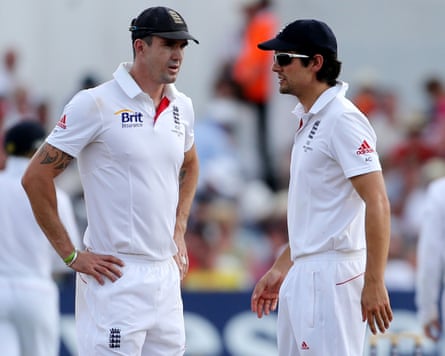
Either way, this has been the theme of a familiar spat this week. It started when Cook said on a podcast that he thinks Jacob Bethell will learn little from “sitting on his arse” at the IPL and would be best served playing for Warwickshire. Bethell responded, putting the case for the “intangible benefits” of being around elite players, having lots of eyes on him and so on.
Best of all, Kevin Pietersen then SENSATIONALLY WADED IN, stating that Cook “has absolutely NO IDEA what it’s like to be in the IPL”, while also, for good measure, slagging off Derby in April. At first glance this is just great stuff. It’s warm, it’s familiar, it’s retro. Pietersen’s own desire to play in the IPL created a huge faultline during Cook’s time as a senior England player and then captain. These days his role is to have been right all along. KP basically is IPL Jesus. I died so that Jamie Overton could live.
Watching this feels like a note from the comforting past, English cricket’s version of a springtime civil war re-enactment, the middle aged men out there sombrely packing their muskets, resketching old battle lines. Let’s talk about Tony Blair while we’re at it. Is there a third way? Maybe! History is over. House prices make sense. It’s all going to be fine because KP and Cook are arguing, daddy’s home, and Kate Moss has a new Glastonbury look we’re calling Heroin Wellies.
But this is also a very current issue, as cricket continues its breathless paradigm shift. Albeit, one where it is always hard to make out anything that might actually be called the truth. County cricket is reflexively defensive, understandably so given it is literally being attacked and dissolved. The IPL is hard to talk about generally because it is an expression of evangelical nationalism as much as a piece of pure sport.
To secure their future livelihood, players and pundits have to pretend not just to like the IPL but to be entirely consumed by its wondrousness in every aspect. The commentator Danny Morrison, for example, appears to exist in a constant state of emotional priapism, describing even a swiped edge to third man in a voice that suggests he’s just been hit over the head with a rock and it’s the greatest thing that’s ever happened to him.
Can we just be clear on this for once? Real talk: Bethell can do whatever he wants. Nobody is going to muck about with a $250,000 deal to play and/or watch cricket. It would be irrational to turn this down.
At the same time, can we also stop pretending there is any kind of working plan here, as opposed to fudge, chaos and unplanned make-do? Do you learn more by training and watching alongside famous people? Nobody knows. Anyone who claims they do with any certainty is making it up.
KP is very good and often brutally honest as a pundit. He was a self-made revolutionary as a cricketer. But, like Cook, he also has no real idea if young players learn a lot on the bench at the IPL because he never did it either. Pietersen was not a readymade prodigy in that sense. Like it or not, he forged his own second life as a brilliant high-craft batter in the shadows, grafting in club cricket, working out how to score extraordinary red-ball double hundreds (literally) against Derbyshire. Although if anyone is entitled to guess about this, it is still probably KP.
Bethell is also a difficult example. Yes, he will probably learn more talking to Andy Flower than Brendon McCullum. Bethell is English cricket’s precious blond boy. Keep him away from the bullshit whisperer. But he is also a unicorn in this world, notably level-headed and, above all, preternaturally talented. His hundred in the Ashes was so jaw-droppingly good you thought, yes, here is a player who can straddle these worlds.
But there are degrees here. Bethell had been in a Test bubble for two months at that point. Last summer’s hodgepodge of a schedule muddle led him into a Test at the Oval where he looked like he’d never actually done this before, but had watched some cricket on TV and was willing to give it a go.
The real point is simple enough: there is no version of this that doesn’t come back to the fact red-ball cricket is doomed. And doomed in the most fudged and half-baked way, despite being the form that most people like in this country, and which still pays most of the bills.
We can at least look this in the eye and accept that hard choices are being made. The fact is these two forms of the sport cannot exist at their best levels in the same space. Right now there are spots available in the England Test team and six English players at the IPL with an interest in playing Tests, who have spoken candidly about their desire to do so. But only one of them, Jofra Archer, has played a game so far this season. This is why James Rew is going to get the gig: he’s actually in the country. This is why the ECB is talking about relaxing the eligibility rules for England. Basically, get Leus du Plooy in as soon as you can. He always turns up. He may even have a car.
In the end it doesn’t matter which one you prefer, or which is better. The battle is over. Cook and KP is just a fun background set-to, some dads arguing at a barbecue over whether the BMW 320d turbocharged diesel unit really is the most advanced piece of mass-market engineering ever devised.
Much better to look this in the eye, to see a sport that has now separated into two codes, with players still caught between the tectonic plates. And to decide out in the open which parts you actually want to preserve, how you’re going to do it, to make some clear lines; before what remains turns into its own kind of wasteland.