.png) 3 months ago
81
3 months ago
81
‘And as things fell apart / Nobody paid much attention,” David Byrne sings with a gentle shake of his head during (Nothing But) Flowers, Talking Heads’ hymn to human complacency and self-interest. That line had teeth back in 1988. In 2026, it’ll take your hand off as soon as look at you. But Byrne doesn’t oversell it. His latest spectacle isn’t a telling-off; it’s a reminder of what happiness felt like, of what joy in movement feels like.
Surrounded by a large ensemble in matching blue suits – dancers who sing, percussionists who dance, guitarists who also shred on a violin – he continues his career-long obsession with blurring the line between live show and theatrical art-piece. At the rear of the stage, a series of huge concave screens are a continual source of wonder. Alongside Strange Overtones, the sun sets on a cityscape presented in deep focus, details popping into the distance, while a pogoing Byrne, picked out in blue against saturated orange during Once in a Lifetime, offers a thrilling punk jolt amid a meticulously planned whole.
With a set list built around elastic bass and polyrhythms, from Talking Heads’ Slippery People to What Is the Reason for It?, a brass-driven groover from his recent LP Who Is the Sky?, there is a feeling of perpetual motion as bodies flit from one side of the stage to the other. Byrne is among them, required to hit his marks like everybody else, and that egalitarian spirit is fundamental in delivering his message of collective resolve.
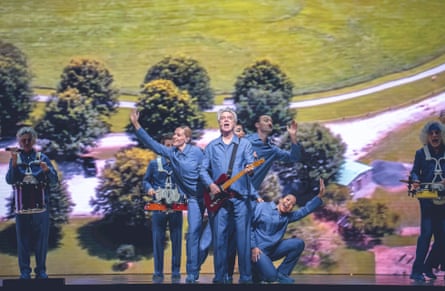
Throughout a hideously apropos Life During Wartime, footage from ICE raids bleeds into the arena, while the insularity of the pandemic is a recurring theme, notably when the screens re-create his home for My Apartment Is My Friend. Byrne’s response is noise, laughter and community. It’s beautiful to see the audience pulled from their seats – slowly at first, then all at once – by the guitar stabs of This Must Be the Place (Naive Melody), their voices turning something lithe and delicate into a collective shout along. “Love and kindness are a form of resistance,” Byrne says at one point. You’d hope so.