.png) 3 months ago
52
3 months ago
52
Before George Floyd, after Rodney King, and in between countless others, there was Tyisha Miller. She was 19 when she was shot dead by police officers while she lay unconscious in her car in California, in 1998, joining the long, appalling, litany of Black victims of police violence.
Here she is named Myeisha Mills, still dead after an officer shoots 12 bullets into her body, but simultaneously alive or rising from the dreamscape of the title to tell us about herself with a painfully exuberant, sweet guilelessness.
American writer-director Rickerby Hinds’ award-winning production, which played at last year’s Edinburgh fringe, is told entirely through beatboxing, spoken word, hip-hop and dance (excellent choreography by Carrie Mykuls). It is a dazzling, disturbing experience, its dream world bringing great non-naturalistic power.
This is a two-hander mostly narrated from the point of view of Myeisha, but there is no mention of police violence or race from her. She is not a victim to herself but an aspiring hip-hop artist, determined to make it big as an MC. It takes a while to realise that this vital, sometimes funny and playful character is no longer alive, yet her narration pushes back out from her deathly limbo to speak of all she was and could have been. There is a recurring reference to dreaming – “Ever had one of those dreams/ Where nothing comes out when you try to scream? – but this is the only allusion to the violence of her death we get, from her.
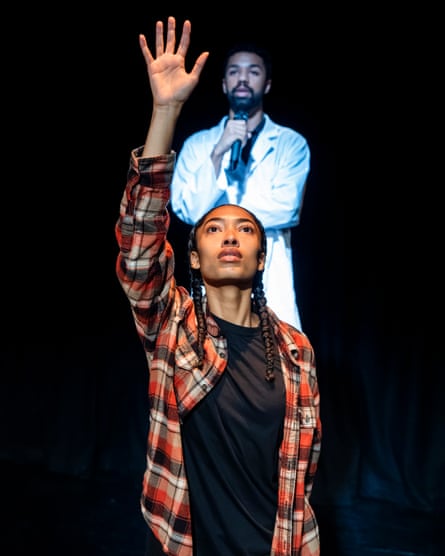
Jada Evelyn Ramsey, as Myeisha, speaks from her chair on a bare stage but also moves – she floats, dances and comes to sudden wide-eyed stops, maybe from the shock of another bullet? It’s an extraordinary performance filled with beauty. She sits back-to-back with Josiah Alpher, who is just as charismatic as he beatboxes, raps and narrates the part of characters including the police officer and voices the dehumanising language of her autopsy report.
Through the description of the bullets and their entry points in her body, Hinds’ script brings Myeisha’s body to life, tracing its history and recorded experience: a bullet to the head sparks a story about hair (“Hands off the hair”), her first awkward but exhilarating sexual experiences are remembered when the coroner speaks of the bullet to her breast, and a tattoo when he arrives at the bullet to her lower back.
There is a paradoxical but palpable sense of joy and zest for life among the unspoken, gruesome, injustice of her untimely death. It is a dream of hope and a nightmare from beyond the grave at once. Myeisha’s voice has no anger. Yet this is what you leave the show feeling: profound anger, deep, deep sadness.