.png) 3 months ago
76
3 months ago
76
Genes capable of creating antibiotic-resistant superbugs have been detected in the UK’s largest lake, which supplies drinking water to about 40% of Northern Ireland.
Testing of water from Lough Neagh, which has a surface area 26 times bigger than Windermere, found genes resistant to a wide range of antibiotics, including carbapenems – drugs reserved for life-threatening infections when all other treatments have failed.
The discovery comes as deaths linked to antibiotic-resistant infections are rising worldwide. Nearly 400 resistant infections are reported each week in England, with deaths linked to them reaching an estimated 2,379 in 2024, according to UK Health Security Agency data.
The World Health Organization (WHO) describes this antimicrobial resistance (AMR) as “one of the most urgent, complex and frightening health challenges of our time”.
Samples taken by Watershed Investigations and the Guardian found resistance genes spanning multiple antibiotic classes, from common penicillins to last-resort carbapenems, as well as quinolones, macrolides, aminoglycosides and cephalosporins, which are used to treat pneumonia and other serious infections. Genes resistant to tetracycline, widely used in livestock, were also present.
“Carbapenems are known as the last-line-of-defence antibiotics because they are only used when other treatments have failed,” said Will Gaze, a professor of microbiology at the University of Exeter. “If pathogens are resistant to the carbapenem antibiotics, they’re resistant to many others too.”
Samples from a designated bathing water area on the lough were also affected. Gaze said: “If a swimmer swallowed 30ml of the lough water, they’d get a pretty good exposure to carbapenem-resistance genes, but we don’t know what impact that has on the gut microbiome or risk of infection.”
Alongside the resistance genes, markers of human, cow and pig faeces were detected in the water. Sewage and livestock slurry create ideal conditions for superbugs, flushing pathogens, antibiotic residues and resistant bacteria into waterways where they can mix, multiply and spread.
“Sewage and livestock manures can contain pathogens that can cause serious infections,” said Gaze. “If those organisms are carrying resistance genes, they’re much harder to treat.”
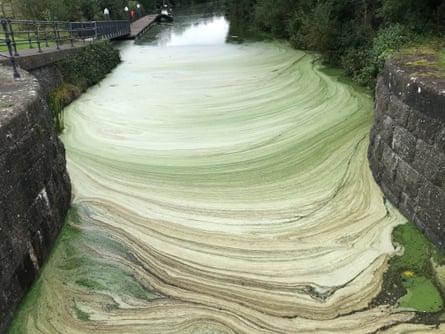
Sewage and slurry pollution is widespread across the UK. In Lough Neagh it has fuelled vast toxic algal blooms, visible from space, that suffocate wildlife and help spread antibiotic resistance. Despite various environmental protections, the lake is now in such poor health that campaigners recently held a mock funeral for it.
Northern Ireland’s Department of Agriculture, Environment and Rural Affairs (Daera) minister, Andrew Muir, said more than 20m tonnes of untreated sewage spilled into the country’s waterways each year. About 30% of Northern Ireland Water’s storm overflows spill raw sewage into Lough Neagh, 106 directly and 618 indirectly via rivers.
But the scale of the problem may be even greater. A water industry expert warned that monitors were being installed on the water company’s storm overflows but not at outfalls from wastewater treatment works, where larger volumes can enter waterways unchecked.
“Much more raw sewage is getting into rivers and lakes than the water company estimates imply,” the expert said. “Forty per cent of Northern Ireland are drinking water from a fetid pond filled with bacteria from human and animal waste, and now, unsurprisingly, there are AMR genes.”
Yet, even treated sewage poses a risk. Davey Jones, a professor of environmental science and public health at Bangor University, warned: “Just because wastewater’s treated, it doesn’t mean it’s safe.”
“[Sewage overflows] are really bad, but they’re not always discharging and can be diluted, whereas AMR genes are pumping out every single day through treated sewage.”
He described sewer networks as a “mega-network of an epic breeding ground” for resistant microbes, and called for better treatment technologies at wastewater plants.
However, the Northern Ireland Fiscal Council, a non-departmental public body, said the company lacked sufficient funding for the scale of wastewater investment required and was forced to prioritise drinking water instead. As a result, Northern Ireland Water is spending public money trying to clean up pollution caused by its own infrastructure.
A Northern Ireland Water spokesperson acknowledged “decades of underinvestment”, saying the company had been left with “very limited scope for upgrades” and that only a “permanent, sustainable investment plan” would close the long-term funding gap.
In the meantime, “the consequences are restrictions on development, increased pollution risk and worsening pressure on the environment”, they said. “Stringent targets” to reduce pollution incidents are being introduced and new monitoring equipment is being installed to track storm overflows in the Lough Neagh catchment, they added.
Sewage is only half the story, however. Livestock slurry runs off farmland, feeding algal blooms and flushing antibiotics, pathogens and resistance genes into the lake.
The pressure from farming has intensified in recent years. Since a government policy promoting intensive agriculture was introduced in 2013, pig numbers in Northern Ireland have risen from 517,075 to 744,643, while poultry numbers have jumped from about 19.5 million to 25.8 million. There are now approximately 1.6 million cattle and 1.8 million sheep in the country.
Jones described cattle as “pathogen bioreactors on four legs”, arguing that streams should be fenced off to prevent animals defecating directly into waterways, and that farmers must stop spreading slurry at the wrong time of year. “I’ve seen people doing it because their slurry tanks are full and they’ve got to get rid of the stuff,” he said.
A recent study found E coli in every sample of cattle manure tested.
Progress has also been hobbled by governance failures. The Office for Environmental Protection watchdog found that Northern Ireland lacked an environmental regulator free from government influence.
A source within Daera described collapsed morale inside the Northern Ireland Environment Agency. “They’re not allowed to talk, to breathe, to do their jobs. They’re not supposed to prosecute agriculture or take Northern Ireland Water to court, despite so many wastewater works being beyond capacity.”
Northern Ireland Water has largely avoided prosecution since 2007, when an agreement was signed limiting regulators’ ability to pursue the company, though Muir withdrew that agreement on 3 March this year.
Muir has also attempted to establish an independent environmental regulator, but the proposal has been blocked at Stormont by the Democratic Unionist party (DUP). The Daera source alleged that agriculture held significant political influence, with many farmers forming part of the DUP’s support base.
“Antimicrobial resistance is an urgent global challenge and evidence has been found in Northern Ireland’s aquatic environments, including Lough Neagh,” said Muir, adding that there were plans for more testing. “Restoring and protecting the ecological health of Lough Neagh cannot be overstated and work is under way on the Lough Neagh action plan.”
Overuse of antibiotics in both people and livestock underpins the increase in resistance.
In an attempt to tackle it, the UK government has a target to reduce their use in humans by 5% by 2029 from a 2019 baseline. NHS prescription of antibiotics fell slightly between 2019 and 2024, but private prescriptions more than doubled over the same period, pushing overall primary care use up 10.7%, with 22% of all antibiotics now dispensed privately. Northern Ireland has the highest rate of antimicrobial prescribing in the UK.
Ruth Chambers, a senior fellow at the thinktank Green Alliance, said the situation had “all the ingredients to be a perfect storm for the health of Northern Ireland’s people and environment” and called for an independent environmental protection agency to be fast-tracked.
Natalie Sims, a policy adviser at the Royal Society of Chemistry, warned that the UK risked falling behind the EU, which is introducing laws requiring countries to monitor AMR in wastewater. “We still understand far too little about how the aquatic environment contributes to the spread of AMR,” she said. “Without robust environmental data, we risk missing a major part of the problem.”
Without urgent action, the WHO warns, drug-resistant infections could claim 39 million lives worldwide by 2050 and impose an annual economic burden of up to $412bn (£307bn).