.png) 1 month ago
48
1 month ago
48
EU expects 'some positive decisions' on €90bn loan for Ukraine on Wednesday
But it looks like there is some movement on Ukraine.
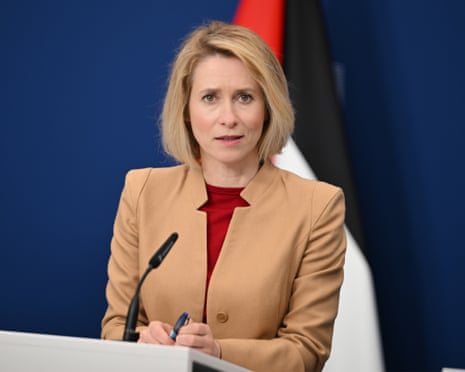
EU foreign policy chief Kaja Kallas has just confirmed that she expects “some positive decisions tomorrow” on the €90bn loan.
“Ukraine really needs this loan and it is also a sign that Russia cannot outlast Ukraine. This is extremely important at this moment.”
Key events Show key events only Please turn on JavaScript to use this feature
'We won't have Trojan horse in our castle' any more, Lithuania's foreign minister says after Hungary election
Lithuania’s Kęstutis Budrys is also clearly relieved about the election result in Hungary, as he says it’s “a great development.”
Now we won’t have a Trojan horse in our castle [any more], and it’s a good thing.
Ouch.
But he says that “what was done before should not be forgotten” as he urges the EU to continue its investigation into what the outgoing Hungarian foreign minister Péter Szijjártó shared with Russia and when.
“On Ukraine, using this momentum, we have to release the support loan to Ukraine, €90bn. It is important to move fast and to have the first payment already next month,” he says.
But, somewhat optimistically, he also says he wants to see progress on Ukraine’s accession to the EU – but there seems to be no political agreement on this issue at the moment.
Funds from EU loan to Ukraine could start flowing in May, Latvia's minister suggests
On Ukraine, Latvia’s junior foreign minister Artjoms Uršuļskis gives us a bit of news as he says that it’s hoped that the EU could start disbursing to Ukraine “already in May.”
Germany urges Iran to engage with US, but dismisses call to suspend association agreement with Israel
On the Middle East, Germany’s Wadephul urged Iran to engage in talks with the US in Islamabad and to ensure “free and safe shipping lanes through the Strait of Hormuz without delay.”
He said that Iran should accept the US request for talks “in the interests of its people,” as he said “there is still a window of opportunity to end this war through negotiations.”
But on Israel, just I like suggested earlier (10:05), he made it clear that Germany would not support the suspension of the association agreement, calling the suggestion “inappropriate.”
But he did say that the EU needs to have a word with Israel – “critical, constructive dialogue” in diplospeak – and demand it “confronts the settler violence clearly, firmly, and with all legal means.”
Germany's Wadephul welcomes Hungarian election in hope of movement on Ukraine very soon
German foreign minister Joseph Wadephul also makes it very clear that he is relieved with the change of government in Hungary, calling it “a breath of fresh air” and a promise of hope for Ukraine.
He urged Hungary to drop its “unusual blockade” for policies for Ukraine “as quickly as possible,” pointing to what he argued was a clear pro-European mandate from the electorate in Hungary (it’s a bit more complicated than that, though).
He said the 90bn loan needed to be released “very swiftly,” and there is no time to wait for the change of government next month.

Jakub Krupa
For what it’s worth, Viktor Orbán also said earlier this week that he would drop his veto on the €90bn loan the moment the oil deliveries were flowing again through the Druzhba pipeline, which had been under repair for months.
As this is now expected to happen essentially any moment now, it looks like there could be some movement on the loan even before the government in Budapest changes.
Remember: the new Hungarian administration won’t take office before mid-May.
Ministers express relief after Orbán's defeat in Hungary as they hope to progress Ukraine loan, sanctions against Russia
Back in Luxembourg, it’s quite telling how many ministers are talking with relief about the expected change of government in Hungary after Viktor Orbán lost to Péter Magyar just over a week ago.
The issue comes up in almost every doorstep, with ministers talking about how hopeful they are that the €90bn loan for Ukraine will finally be able to progress.
Sweden’s Maria Malmer Stenergard said she was “quite optimistic that after the Hungarian obstacle is gone, so to speak, we will be able to deliver on the promise we have made to the Ukrainians … and move forward with the 20th sanctions package” against Russia.
Poland’s junior minister Ignacy Niemczycki said that “after the expected change of government in Hungary, many things to do with Ukraine will get unblocked.”
“I am hopeful that we will be able to swiftly progress the loan for Ukraine, and the 20th package of sanctions, and I am expecting decisions already in the coming days.”
EU's top court finds Hungary's crackdown on LGBTQ+ content against EU law in fresh political test for Magyar
The EU’s top court has ruled that a Hungarian law banning content about LGBTQ+ people from schools and primetime TV violates basic human rights and freedom of expression.
In its ruling, the first time an adverse finding was made on the basis of the EU’s foundational list of values, the court said the Orbán-era reform violated “several fundamental rights” protected by the EU laws.
“The law is contrary to the very identity of the Union as a common legal order in a society in which pluralism prevails,” the court’s statement said.
Hungary should comply with the judgment “without delay”, posing a fresh political test for the incoming Tisza government of Péter Magyar as he hopes to improve Budapest’s relations with the EU.
If the country does not follow the ruling, the European Commission could bring a further legal action asking for financial penalties to be imposed, like it happened in a separate case on Hungary’s asylum laws.
More on this to follow.
Irish foreign minister presses the EU to 'make progress' on Ukraine, Israel
Ireland’s foreign minister Helen McEntee has just been speaking with reporters as she arrived at the meeting in Luxembourg, and she offered a neat summary of where we are on both issues.
On Ukraine, she said it was “really important as the EU that we make progress” on the loan and the related 20th package of sanctions against Russia to “exert as much pressure as possible on Russia.”
She said that talking to Ukrainian leaders it was clear “we are at that breaking point where that loan is absolutely essential.”
She also pointedly welcomed the new Hungarian government’s position on this, and said she hoped that “we will see the release of funds” soon.
On the Middle East, she said the joint Spanish, Slovenian and Irish initiative to ask for a debate on the association agreement was meant to send a clear signal that “we … need to uphold our fundamental values” in relations with associated countries.
“Israel has, since our last meeting, enacted a new law which essentially introduces the death penalty, but in particular penalises and specifically targets Palestinian people. It’s completely unacceptable, and so we have asked for a suspension of the Israeli agreement, and if not, then a suspension on the trade elements of the Israeli agreement.
We must be seeking to have this not just as a discussion here today at the council but that there would be some clear actions at the next council meeting.”
Again, she says that the result of the Hungarian election last week, “it is very clear that there has been a shift” there in terms of political signals coming from the new government.
Ukraine loan release closer than ever amid expectations Druzhba will be reopened
Jakub Krupa
This is not entirely unexpected and, as explained earlier, it is still hinging on the Druzhba pipeline restarting in the next 24 hours, but it definitely sounds like there are growing reasons for optimism among the EU’s most senior leaders.
Could the loan, agreed in December but held up by Hungary and Slovakia, be finally released to Ukraine in the next few days or weeks?
EU expects 'some positive decisions' on €90bn loan for Ukraine on Wednesday
But it looks like there is some movement on Ukraine.
EU foreign policy chief Kaja Kallas has just confirmed that she expects “some positive decisions tomorrow” on the €90bn loan.
“Ukraine really needs this loan and it is also a sign that Russia cannot outlast Ukraine. This is extremely important at this moment.”
Jakub Krupa
For what it’s worth, it’s unlikely that any decisions on this will be actually made today on this – but the request for a focused debate on this marks growing concern among EU member states and mounting pressure on the EU to act more decisively.
Spain, Slovenia, Ireland request discussion on suspending EU association treaty with Israel
Just as expected.
Spain’s foreign minister José Manuel Albares has just confirmed that Spain, Slovenia and Ireland have requested a discussion on suspending the EU’s association treaty with Israel at today’s meeting of the bloc’s foreign ministers.
He said the process was about the EU’s “credibility” on all other issues, as the bloc is expected to stand “for the same principles” everywhere.
He said that if the EU is “not capable to say today to Israel” that it is expected to respect human rights and international law, and not make war a foreign policy tool, “we are going to lose that credibility.”
“We have to say the same thing that we say to Russia concerning Ukraine, and that we say in other scenarios, and since the last time we brought this same position, things have worsened,” he said.
“European Union has to say today very clearly to Israel that that change is needed. That’s not the right path, and that while Israel continues in that path of a permanent perpetual war, we will not be able to [run our relations] in the same way.”
He said that if suspending the association treaty in full is unacceptable for some members, the bloc should consider suspending at least the trade element of the deal.
Morning opening: EU foreign ministers to discuss Ukraine, Russia and the Middle East
Jakub Krupa
EU foreign ministers are meeting in Luxembourg this morning to discuss the latest on Ukraine, Russia and the Middle East.
The ministers are awaiting an update on the Druzbha pipeline carrying Russian oil to Hungary and Slovakia, which is understood to be close to being operational against after months of bitter disputes between Ukraine and the two countries.
Hungary’s outgoing prime minister Viktor Orbán suggested he would drop his country’s veto on the EU’s €90bn loan for Ukraine as soon as the oil starts flowing, which could happen this week. Slovakia is understood to be in the same position.
The issue is currently expected to be discussed by EU ambassadors on Wednesday, but could come up earlier. One to watch.
But the discussions will also focus on the situation in the Middle East, with the Lebanese prime minister, Nawaf Salam, joining the ministers to give an update on the regional security situation.
Spain, Ireland and Slovenia are among countries calling for closer scrutiny of Israel’s actions, including a more radical step of suspending the association agreement with the EU and imposing sanctions on violent Israeli settlers.
While substantial progress is unlikely to be made on this today as Orbán’s Hungary, a close Israel ally, continues to oppose any such move, the ministers will probably be looking at what could be possible at their next meeting once the government in Budapest changes.
EU foreign policy chief, Kaja Kallas, hinted yesterday that the position of Magyar’s government could be different, saying – without naming Hungary specifically – that there could be “a new approach” to the issue:
“Now this country [has recently] had the elections and will [soon] have a new government. I will not speak for the new government, but definitely I think we can look into all these policies and see whether they have a new approach.”
Lots for us to cover this morning.
I will keep an eye on all of that and bring you the latest here.
It’s Tuesday, 21 April 2026, it’s Jakub Krupa here, and this is Europe Live.
Good morning.