.png) 3 months ago
74
3 months ago
74
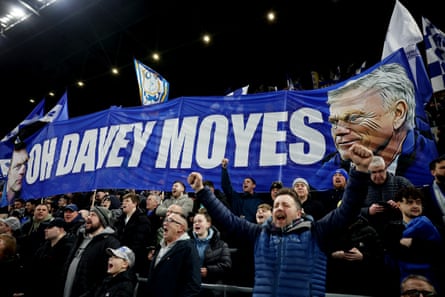
David Moyes has numerous theories on why Everton do not yet feel completely at home at Hill Dickinson Stadium, beyond the fact that change is inevitably strange after 133 years at Goodison Park. Wins would be instrumental, but his team have managed only five in 16 matches. Supporters connecting to the magnificent venue through a new matchday routine would help too, but for many that is proving nigh on impossible.
One season-ticket holder, who lives in the south of England, said on social media recently that they expect to miss seven or eight home games this season owing to the curse of the modern fixture schedule. The club are aware that this is not an isolated case. The problem is not new nor confined to Everton, who of course reap the benefits of every game that is switched for live television purposes and, let’s be frank, have not held as much appeal for broadcasters in recent years as they do this season. But in their inaugural campaign at a new home, Everton’s schedule has proved to be peculiar and, in turn, detrimental to fans adapting to new surroundings.
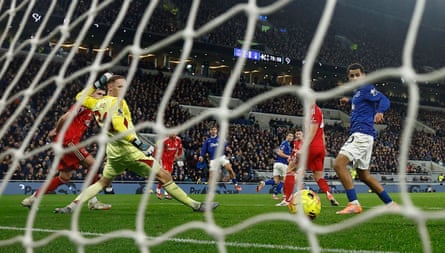
Burnley’s visit on Tuesday evening will be the fifth Premier League home game in succession that has been staged on a weeknight. They last played at home in the league on a weekend on 4 January. Their last 3pm Saturday home game was against Nottingham Forest on 6 December, which was also the last time Everton registered a home win in any competition. Should the Merseyside derby in April and Manchester City’s visit in May be moved for TV, as appears certain, then Everton’s first season at their new stadium will have featured as many Monday 8pm kick-offs as Saturday 3pm starts – three.
It is a schedule that deters children and elderly people from attending matches, as well as fans who live further afield. The new bars that have sprung up opposite the stadium anticipated more weekend business, too. At least the street lighting along Regent Road has been improved for the many night-time walks to and from the ground. That, and upgrades to the access at nearby Sandhills train station, are among some of the modest improvements to the area made by local authorities.
Everton are asking fans to complete “experience surveys” after every home game this season. The feedback about the stadium has been overwhelmingly positive, unsurprising given the club spent approximately £800m to build one of the finest venues in Europe, and will shape changes that can be made. Those implemented so far include hiring more staff and installing more kiosks to reduce queues for food and drink, and improving vehicle access for disabled supporters. Only Manchester City now have more disabled parking bays than Everton in the Premier League. As for the queues for the men’s toilets in the South Stand, another regular complaint, you may just have to keep holding on.
The main criticism in the surveys, and from the Fan Advisory Board’s meetings with the club, has centred on the transport infrastructure around Hill Dickinson Stadium. It was always going to be an issue from the moment Everton settled on a dockland site that allows access on only one side. The number of night‑time matches has exacerbated the problem of traffic congestion for local residents, businesses and fans alike, with workers leaving Liverpool city centre just as road closures begin.
The flipside is that a riverside location close to the city centre is an essential part of the stadium’s appeal and has generated opportunities that should transform the finances of a recently troubled club. Sponsorship deals with global brands including Pepsi and Budweiser are a huge commercial leap on what Everton were able to attract before the move. “The club is on course to deliver its strongest annual commercial performance to date,” according to Andrew Middleton, who started as Everton’s first president of business operations in January. “The move to our new stadium has been a vital catalyst in that growth.
“We are exploring commercial opportunities connected to events at the stadium, including the usage of the hydraulic tower. We are looking at how we can further enhance the experience on the Budweiser Plaza and continuing to evolve our premium areas.”
Those commercial opportunities are coming in fast, raising the stadium’s profile as well as revenue. The success of the rugby league Ashes Test between England and Australia in November led to a deal to host the Super League’s Magic Weekend in July. A Nations Championship rugby union match between Fiji and England will be held there the following week. Scotland play a World Cup warm-up against Côte d’Ivoire on the banks of the Mersey in March and the Lionesses will face Ukraine in a World Cup qualifier at the Euro 2028 venue in June.
The operational success of Everton’s relocation has attracted delegations from Premier League, Championship, Bundesliga and even South American clubs to Hill Dickinson Stadium as they explore possible stadium moves of their own. Milan were recent visitors, taking tips on how to leave an iconic stadium behind. It will not be easy. It never is.
“You think of Goodison; narrow tunnel, the lights, the crowd can touch you every time you’re off the pitch,” Moyes says. “This is completely different for the opposition. Other teams come here and enjoy it. It might not look it, but it feels a bigger space than Goodison. There are things about it which are different and we have to get used to but, you know something, I think our games are better than at Goodison; our team is better this year.”
That may be true but, for various reasons, Hill Dickinson Stadium has yet to become the fortress that Everton crave.