.png) 2 months ago
60
2 months ago
60
The first object visitors to the Wellcome Collection’s forthcoming exhibit, The Coming of Age, will encounter is a pure silver sake cup. In 1963, Japan’s government began a tradition of issuing these honorary gifts, or sakazuki, to citizens who lived to see in the morning of their 100th birthday. A total of 153 people received one in the first year.
By 2009, such was the growing number of centenarians that a decision was taken to reduce its size in an attempt to curtail costs. It wasn’t enough. Since the mid-2010s, the tens of thousands of Japanese elders who arrive at the increasingly common milestone now have had to make do with a cheaper nickel-silver alloy version instead. Still, as exhibition curator Shamita Sharmacharja suggests, “it’s better than a letter from the king!”
The elegant silverware is a self-contained and reflective statement on modern attitudes towards elderly people, including the encroaching reality of ageing, if not already super-aged, societies. Older generations are heralded as doyens worthy of respect and deference, yet on the flip side are often considered especially vulnerable and an embodiment of mortality and decline. They are presented, at once, as priceless in their provision of unpaid labour such as childcare, and pricey in the burden they place on state pension budgets.
Paradoxes abound, or as Sharmacharja puts it, “people want to live for ever, but they don’t want to get old”. With the prospect that one in 10 boys and one in six girls born in the UK today can expect to live past 100, The Coming of Age opens at a time when anxieties over ageing have risen to the fore as the perceived solidity of life stages melt into thin air, from the perennial adolescence of adults in their 20s unable to move into a home of their own to the boom in cosmetic surgeries that promise to maintain a person’s youthful appearance against the onslaught of incoming years.

“It’s an exhibition that I’ve been thinking about for quite a long time,” says Sharmacharja. “When I told people I was working on an exhibition about ageing, it was the most extreme reaction I’ve had and people were just going, ‘Oh, so depressing, I really don’t want to think about it.’ It’s a really interesting reaction, given that globally we’re living longer than ever before.”
The exhibition reassures visitors that we have been here before. Sebald Beham’s The Fountain of Youth, an artwork from the German Renaissance showing elderly figures being granted a new lease of life by the mythical elixir, appears as an analogue to the displayed longevity products associated with the contemporary Don’t Die movement. In contrast to this lies the memento mori of Charles Darwin’s skull-tipped walking stick and the director Sam Taylor-Johnson’s 2001 time-lapse film, Still Life, in which a baroque-looking bowl of fresh fruit remains in position as it embarks on its inevitable journey of ripening and decay.
In another turn away from the anthropocentric, Maija Tammi offers “a philosophical inquiry as to what time means if you don’t age” through her image-based exploration of regenerative freshwater organisms known as hydra, which in Immortal’s Birthday are left as the last remaining witnesses to their own agelessness. Yet, there is also an intent on the part of the exhibition to go beyond solely biological definitions of age.
“When the pandemic happened, it really threw into very sharp relief the ways that we talk about age, and particularly around older age in terms of value and worth and vulnerability,” Sharmacharja says. “But it also really highlighted just how unequal our society is, and how differences in health and equity start from birth and just get wider.”
Representing the younger end of the spectrum, the Acting Your Age? section of the gallery features portraits of teenagers involved with one of the world’s largest studies of adolescence, currently taking place in West Yorkshire. Part of the Born in Bradford research initiative which began in 2007 to track the health of newborns and their families, the Wellcome Trust-funded Age of Wonder project has been building on that work through the use of questionnaires and youth engagement with decision-making in ways that challenge stereotypes of juvenile immaturity.
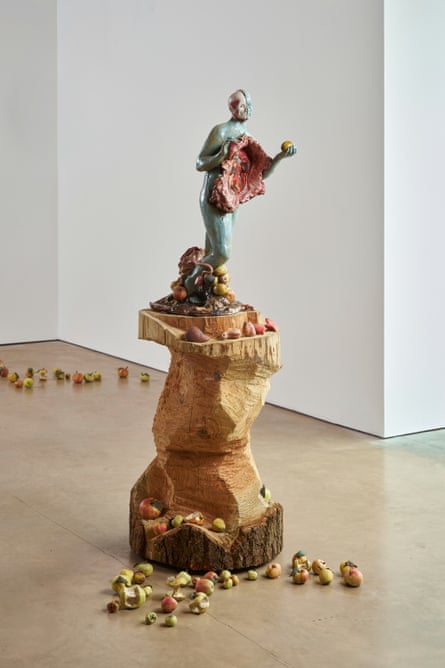
Within the same section, Serena Korda’s sculptures and accompanying soundtrack – entitled Wild Apples – subverts other entrenched narratives with her use of a feminist lens to reappropriate folkloric figures such as the crone. Described by Korda as an “all-powerful, all-seeing” character who represents an older woman’s transition to a life of wisdom, she explains how “many centuries of patriarchal retelling of this figure” have reduced this archetype to appearing “maligned and negative, and like … sort of a cursed old hag”.
Inspired by her personal experience of perimenopause, during which she was unable to get a diagnosis due to inconclusive tests and felt “very destabilised”, Korda interrogated the gender health gap whereby “most medicine is based or predicated on the male body” and sought to find amid the ambiguity “a moment of power rather than a moment of loss”.
She invited other women who were experiencing, or had experienced, perimenopause to act as life models for her sculpting. “When you look at women in art historical paintings, they’ve been painted by men,” says Korda, “and there’s very much that gaze that I’m trying to dismantle”. Wild Apples is “about looking at older bodies … and if you really look at the bodies, you see the mastectomy and you see the scar on the other woman’s body so you know they’ve been through things”.
Korda remains skeptical of the level of depth that comes with greater public discussion about menopause and how women age. “It almost feels like, ‘Oh, well they’ve done that, it’s sorted out’, and it’s definitely nowhere near sorted out. Even with films like The Substance … it is, again, a woman in her 60s who looks amazing. Are we all expected to look like that when we’re 60?”
Alongside gender, the intersection of ageing and disability is also addressed in relation to care. On show is Rory Pilgrim’s Software Garden, a multitrack music video that brings together eclectic arrangements and choreography in an underlying engagement with the role that technology might play in facilitating compassion.
Developed a decade ago, the film features a robotic companion and betrays a hint of the techno-optimism that was once of a piece with an era that produced works such as Nick Srnicek and Alex Williams’s Inventing the Future, but predated the high-water mark of enshittification. Pilgrim, however, says that dreams of utopia had already receded long before then and that “the future in relation to technology did not look right” at the same time as a UK government sought to reform disability entitlements and Trump launched his first bid for the White House.
Looking back on the video, Pilgrim maintains the need to “create technological systems … that connect, rather than divide people any further” and this includes rigid dichotomies.
Technology, he says, “has to coexist with really good face-to-face services. I think the danger is when we start to see it as a total replacement or as cost-cutting. I think the future lies with tech, which does that in coexistence to all of our amazing tools that we just have as humans to check in on one another.”
Software Garden shares the same final gallery section – Connection and Care – as Suzanne Lacy’s Uncertain Futures, a Manchester-based project that focused on the urgent social challenges that continue to be faced by women over 50 and how campaigns might be harnessed to overcome them. For Sharmacharja, the hope is that multigenerational groups will attend the exhibition, find commonalities and recognise the extent to which our environment, rather than genetics, influences how we age.
“There’s quite a lot that we can change in society for things to be better and so I hope that people come away with a feeling of agency from that.”