.png) 3 months ago
79
3 months ago
79
Yes, it’s time to talk about the ski jumpers’ penises. Although to be honest the ski jumpers themselves would prefer it if everyone could keep the conversation to their testicles. Figuratively. “This sport,” the former Olympic champion Sven Hannawald once said, “has a lot to do with balls.”
This turns out to be more true than you might imagine, even for a sport that involves flying 100m down a mountain. As the world now knows, being well endowed is a distinct advantage for the simple key reason that when a jumper spreads their legs the crotch of their trousers stretches out into a wing, and the bigger that wing is, the further they’re likely to fly.
Computer analysis suggests they get an extra 2.8 metres of distance for every extra centimetre of fabric.
Which is why the ski jumping rules state that a suit is only allowed to be 4cm larger than the surface area of the body wearing it. But of course anyone who can find a way of temporarily enhancing that surface area when the official measurements are being taken would have the advantage of a few precious extra square centimetres of material with which to work. Which is why last Thursday the president of the World Anti-Doping Agency, Witold Banka, found himself fielding questions about whether or not the organisation was investigating reports that some jumpers had started injecting hyaluronic acid into their penises to make them bigger.
No one in the ski-jumping community wants to discuss this. The federation that runs the sport says it is just a “wild rumour”. But the unfortunate truth is that the sport, and the Norwegian team in particular, has invited all this speculation after two of their athletes, Marius Lindvik and Johann André Forfang, were banned for three months after their coaches were caught sewing extra material into the athletes’ jumpsuits at the World Cup last year. Someone, and no one ever seems to have found out who, posted an online video of them doing furtive things with a sewing machine.
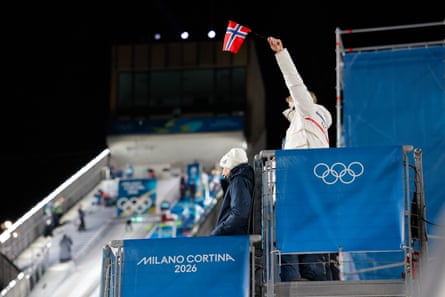
In the beginning the coach denied it. But when he came clean, he and two of the support staff – including the team tailor – were banned for a year and a half. The athletes got off with three months because they claimed to be oblivious to what was going on. Which is how they came to be back competing in the Olympic normal hill competition on Monday evening (normal, it has to be said is a very relative concept in this sport).
It was a national scandal in Norway, which is the proudest, and most successful, of all the Winter Olympic countries. The Norwegians have won more medals in ski jumping than anyone else, and Lindvik is the current Olympic champion in the long hill. As funny as you and I might think this is, ski jumping is a beloved sport in the handful of countries that practise it, and the Norwegian fans I talk to about it during the Olympic competition don’t enjoy becoming a punchline. “I don’t want to talk about it,” one tells me. “It’s all behind us now,” is the only thing another will say. “It’s sad, very, very sad,” says a third.
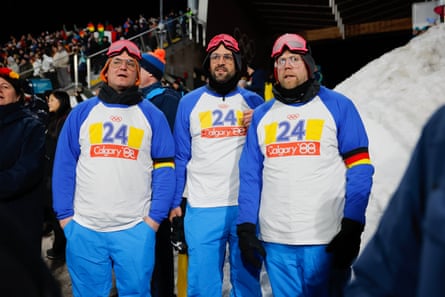
By the end of the night I’m beginning to understand more about why they’re so upset. Ski jumping is a great evening out. In Predazzo, where the Olympic competition is taking place, a big, happy band of fans from across Europe, North America and Japan are knocking back beers and hotdogs and shouting out at the athletes as they fly through the night. People are blowing horns, and banging cowbells. It’s an easy sport to love, and an astonishing one to watch.
But the truth is no one really knows if this scandal is “behind us” or not. The federation insists it is, but a lot of the sport’s former stars have spoken out about stretching the rules themselves, partly out of a desire to take the heat off the men who have been banned, and partly as a call to reform the sport. The former Olympic medallists Johan Remen Evensen, Anders Jacobsen and Daniel-André Tande all told the Norwegian broadcaster NRK that cheating was common during their careers. They spoke about how jumpers used to wear suits with low-slung crotches, or tug their underpants down by their knees to stretch out their trousers then tuck them up again during inspections.
Then Switzerland’s former world champion Andreas Küttel said he had been doing it, too. He admitted he used to spray his suit with hairspray before competitions, to stop the air from passing through it.
The margins in ski jumping are so small, the stakes so high, and the sport is so sensitive to the tiniest variations of physics, that the athletes are always looking to game the rules. In the early 2000s, there were a series of scandals involving the suits and bindings, and in the late 2000s another involving extreme weight loss, which lead to widespread problems with eating disorders among the competitors. This problem still exists, despite the federation bringing in rules around the body mass index of the jumpers. Federations are perpetually caught in trying to find better ways to regulate the sport as the athletes look for new loopholes.
This one will pass. Then another will come. And in the end these few months will be remembered as a brief moment – the briefs moment – in the history of the sport.