.png) 1 month ago
42
1 month ago
42
Not two minutes after his side’s dramatic, extra-time quarter-final victory over Switzerland on Saturday, the Argentina head coach, Lionel Scaloni, was already getting asked about the semi-final. Looming on the horizon was a match against bitter rivals England.
“This won’t just be a special game from a footballing standpoint,” the reporter asked in Spanish, “but also in an emotional sense. How do you imagine you and the players will come out for this game and what message would you give to all of us Argentines that are …”
Scaloni cut the reporter off.
“This is a football match, OK?” he said, quite curtly. “The message is that this is a football match. Let’s not look for anything else. This is a football match.”
Forty years ago, in the buildup to a match against England in the quarter-finals of the 1986 World Cup, Diego Armando Maradona also met the press, standing outside Argentina’s training facility. Many of those reporters had positioned the match as a proxy for the Falklands war, the 74-day conflict four years earlier that took the lives of 649 Argentinian soldiers, 255 British soldiers and three islanders. Control of the Falkland Islands – the Malvinas, as they’re known by Argentinians – was eventually wrested back from Argentina after a brief occupation. To Argentinians, was understandably a very fresh wound.
“This is just a match, OK?” said Maradona. And then he repeated himself several times, just as Scaloni would decades later.
Maradona persisted with that narrative, his teammates remember, until the two teams walked out of the tunnel at Estadio Azteca the next day.
“Diego was walking in line with us,” Argentina defender José Luis Brown recalled before his death in 2019, “and he started raving. He says: ‘Let’s go, yeah? These motherfuckers killed our neighbours, they killed our relatives.’ I understood, obviously … After the anthems, nobody said anything. We hadn’t said anything about that before the game but we’d all been thinking about it. We just went out there and ran.”
Wednesday’s semi-final between England and Argentina is, of course, not just a game. To the English in particular, it is no longer about the Falklands war. To the Argentinians? The conflict still persists in memory and has been passed down to players and coaches via oral history, inescapable in print and social media alike. And Maradona persists as well, still very much the figurehead of all of it even after his death in 2020. English fans do not hold up flags bearing the likeness of Bobby Charlton or Bobby Moore during matches; supporters of Brazil do not do so with Pelé.
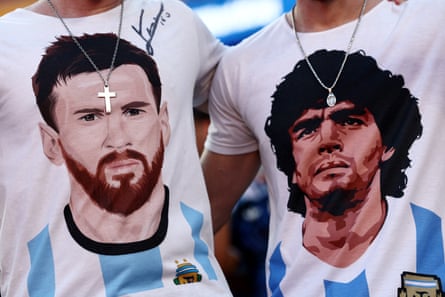
The image of Maradona has been ever present throughout this World Cup, as he was in 2022, in Qatar. In stadiums across the United States, it has been held aloft by Argentinian supporters, often alongside the heir to his throne, Lionel Messi, and his name has been invoked in song. AI, of course, has added a new layer to this. In one widely circulated post, Messi visits Maradona in heaven as the two walk alongside Jesus Christ himself. It is a level of idolatry reserved solely for El Pibe de Oro, it seems.
And so, Maradona’s views of England have also been kept alive this summer. A new generation of Argentina fans have been exposed to the iconic images and quotes circulating on social media – the photo of Maradona celebrating his second goal in 1986, framed by furious English supporters behind him.
Clips of him saying he’d played that match with not only his boots, but a rifle as well, seeking vengeance. And more recent rants – claims that England stole their victory against Colombia in the 2018 World Cup, and the 1966 World Cup as well.
Not that Argentina’s current squad needed any help. After their dramatic victory over Egypt in the last 16, the team sang and danced in their locker room, chanting the lyrics to La Cuarta Estrella (The Fourth Star).
I’m Argentine from the cradle to the grave,
For Malvinas, for Diego, for the last [championship] of Leo,
Argentina, I want to see you as “bicampeon”.
The song, which has been adopted by Argentina’s players and fans alike as the anthem of this World Cup, was released in March – long before Argentina knew they’d be facing England at all. When it comes to anti-English emotion among Argentina fans, the country’s presence at a match is not required.
All of this – the spectre of Maradona, the anti-English sentiment fueled by decades upon decades of on-field drama – is likely to provide some inspiration to an Argentina side who have played 240 minutes of football in less than a week.
This collection of players has yet to truly demonstrate their quality at this World Cup, where they are led by an ageing core and have very nearly been eliminated twice by far inferior opposition. At times, they seem to have advanced on chaos alone.
Messi, notably, has never played against England, having missed his only chance in 2005 while serving a red card suspension, in what would have been his fifth cap. After Argentina’s victory over Switzerland, Messi breezed past reporters towards the team bus, stopping only briefly to answer a few questions. He was almost immediately asked about England.
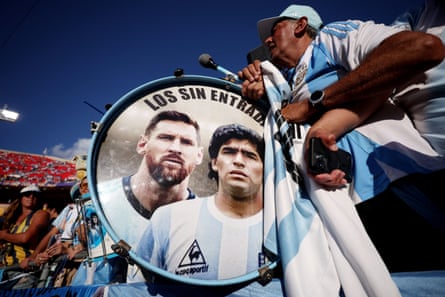
“It’s a special match because it’ll be my first time facing England,” he said. “I’ve played against almost every major national team, but never them. England are one of football’s great powerhouses, so it’s always exciting to take on a team of that caliber, especially in a World Cup semi-final.”
It is the type of bland, nonchalant answer we’ve come to expect from one of the most media-trained players in the world, one who rarely opens up. And it was also easy enough to see that there was much more at stake for him in what could prove to be his final meaningful match in an Argentina shirt.
Like Scaloni – and Maradona before him – Messi wasn’t fooling anyone.