.png) 3 months ago
77
3 months ago
77
Russia’s invasion of Ukraine, now entering its fifth grim year, has already gone on longer than the entire fight on the eastern front in the second world war. The Soviets marched from the gates of Leningrad to Berlin in a little over 15 months in 1944-45; today the Russian rate of gain in Pokrovsk in Ukraine is 70 metres a day, in Kupiansk, 23 metres, according to the Centre for Strategic and International Studies.
The gains are trivial, given Ukraine’s size, amounting to 1,865 sq miles during 2025 (about 0.8% of the country) – so the idea touted by the Russians, sometimes accepted by a credulous White House, that Ukraine is suffering a slow-motion defeat, is not accurate. In reality, even allowing for the fact that hundreds of thousands of homes are without electricity, heating and water after Russian bombing, Ukraine is clarifying its strategy and pushing back with modest success.
A Ukrainian counterattack north of Huliaipole, in the open terrain of Zaporizhzhia province, has gained an estimated 40 sq miles this month, taking advantage of the belated decision by Elon Musk’s Starlink to prevent Russian soldiers using the satellite communications system inside Ukraine. It follows on from Ukraine recapturing Kupiansk, in Kharkiv region, in December. Ukraine’s president, Volodymyr Zelenskyy, visited three weeks after Russia said it had captured the town.
“The Kremlin is trying to create a narrative that Ukraine is on the verge of collapse,” says Christina Harward, of the Institute for the Study of War. “It’s completely false. What in fact we are seeing are small-scale liberations by Ukraine, taking advantage of winter weather and the blocking of Starlink.”
Against this backdrop, it is not surprising that Russia continues to demand that Ukraine withdraw its military from Kramatorsk, Sloviansk and the remainder of the Donetsk (the latest suggestion seems to be the creation of a demilitarised zone, though Russia wants to patrol it). Earlier this month, a Nato intelligence official estimated that they did not believe Russia could capture the region “anytime within the next 18 months” – though it is so urbanised that it could take far longer, at a cost of 600,000 Russian casualties or more.
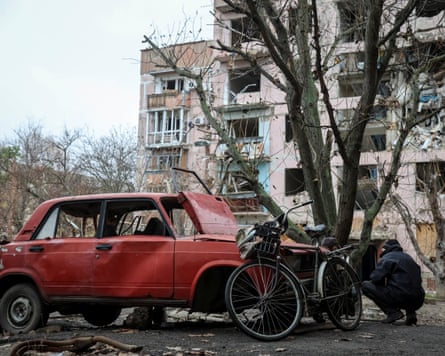
The diplomatic misdirection demonstrates how poorly Russia’s military is performing. Last week, Sergei Lavrov, Russia’s foreign minister, became the latest Kremlin official to refer to understandings agreed in Anchorage, a claim that at the August summit in Alaska US president Donald Trump had agreed with Vladimir Putin that Ukraine should be made to hand over the rest of Donetsk without a fight. But if Trump has flirted with the idea at times, it is not a position the US has sought to enforce amid Ukrainian and European objections.
Contrast to almost exactly a year ago. Trump and Zelenskyy openly argued in the Oval Office and it appeared the US would end support for Ukraine completely. “The worst-case scenario didn’t happen, though,” said Orysia Lutsevych, a Ukraine expert at Chatham House thinktank. “The US is selling arms to Ukraine, still supplying intelligence and whatever the pressure, it is not so strong that Kyiv has to concede.”
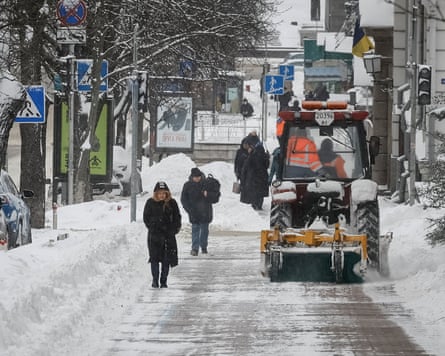
Ukraine, of course, faces considerable difficulties elsewhere. The utility situation is catastrophic after systemic Russian bombing, with more than a million Ukrainians without electricity, heating and water during a cold winter, temperatures have dropped to -20C. In Kyiv, 2,600 buildings are without power or heating, with the worst-affected area being on the eastern left bank. Temperatures drop to 5 or 6C inside apartments, residents say, after a cynical bombing campaign sometimes described as the kholodomor (death by cold).
Though the weather is poised to turn for the better , the failure of western allies to manufacture enough air defence missiles is not only obvious, but arguably getting worse. Hopes have been placed on cheap ground-based Shahed interceptors such as Wild Hornets’ Sting missiles, in the frontline from the autumn, but a statistical analysis from the Institute for Science and International Security shows the proportion of armed Shaheds hitting targets increased from 6% last January to 30% in May and remained at 29% in December.
Yet, the relentless attacks on Ukraine’s civilian population have so far brought minimal strategic gain for Russia, and it is a curious strategy for Putin to adopt given he notoriously claimed the two countries amount to “one people”. Ukraine’s population may be exhausted but there is still no desire to yield to Russian dominance, never mind hand over the rest of Donetsk. Nor is there any obvious change to the battlefield dynamics in Moscow’s favour.
Ukraine, meanwhile, has adopted a more forceful approach. Mykhailo Fedorov, the country’s new defence minister, wants to eliminate 50,000 Russian soldiers a month, an increase from the current casualty rate of about 35,000 a month, of which Nato has estimated 20,000 to 25,000 were killed. It is a stark target, designed to exceed Russia’s current recruitment rate of about 30,000 to 35,000 a month, and force Moscow into a politically risky mobilisation, or even a more realistic diplomatic position.
Experts believe the higher target is achievable in theory, though it depends on Russia keeping on attacking. An estimated 80% of casualties are caused by drones, operating to a depth of as far as 15 miles (25km), which effectively prevents either side from massing any more than a handful of soldiers unless under the cover of rain or fog. But Ukraine has also to contend with the sheer exhaustion of so many of its best units and soldiers.
Last month Fedorov acknowledged 200,000 Ukrainians were absent without leave, unable to keep up with the strain of staying at the front. The army may not be able to operate at a higher tempo.
Jade McGlynn, a research fellow at King’s College, said she feared that Ukraine’s allies had no credible plan to try to force Russia into a ceasefire in a conflict that was essentially deadlocked. “I don’t see a strategy in Europe, and the US has its eggs in the peace process, but there is no process if Russia is not engaging properly,” she said.