.png) 2 months ago
69
2 months ago
69
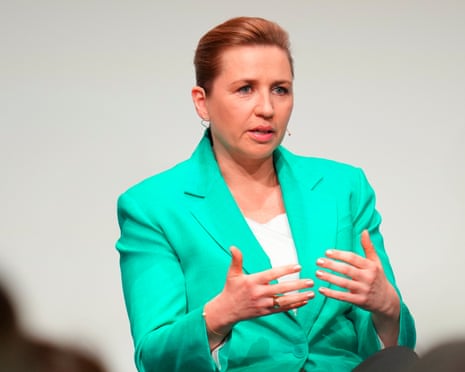
Social Democrats leader Mette Frederiksen appointed to lead talks on new government
Just as expected – and now confirmed by the Royal Palace.
“His Majesty the King has then received the acting prime minister and, based on the parties’ statements, has concluded that the parties representing the largest number of seats in the Folketing have recommended that acting prime minister Mette Frederiksen be appointed to lead negotiations on the formation of a government.”
Key events Show key events only Please turn on JavaScript to use this feature
Frederiksen gets backing from parties with 84 seats in new parliament, but long talks ahead – snap analysis
The statement from the palace sums up the positions of all parties and their preferences for who should lead the talks.
It says that Mette Frederiksen will be tasked with exploring a new majority with “the Social Democrats, the Green Left, and the Danish Social Liberal Party.”
But the three parties only have 68 seats, so will need other partners to get over the line, with 90 seats required for majority.
The Red-Green Alliance and the Alternative party also indicated they would be open to a forming a new government led by Frederiksen (with some caveats), and that potentially gets her to 84 seats out of 179 in the new parliament.
But that’s still a few seats short of the majority.
Could they possibly get someone else to join them, for example Lars Løkke Rasmussen’s fourteen Moderates, despite his earlier scepticism about forming a cabinet with the Red-Green Alliance (11:23)?
For what it’s worth, asked about their preferred candidate to explore a new majority, Løkke Rasmussen suggested, well, himself.
The “blue” bloc’s candidate, Troels Lund Poulsen, secured only 73 mandates “on paper,” the royal statement said.
The process is not going to be easy, so brace for a potentially long process of political talks ahead.
Social Democrats leader Mette Frederiksen appointed to lead talks on new government
Just as expected – and now confirmed by the Royal Palace.
“His Majesty the King has then received the acting prime minister and, based on the parties’ statements, has concluded that the parties representing the largest number of seats in the Folketing have recommended that acting prime minister Mette Frederiksen be appointed to lead negotiations on the formation of a government.”
And Frederiksen is now out after a brief visit to see the King at Amalienborg, spending less than 10 minutes inside.
She doesn’t stop to respond to any questions from reporters on the way out.
So our wait for clarity on what does it all mean continues.
Frederiksen to meet Danish King to discuss next steps on government formation
Back to Denmark, the Royal Palace has just said that King Frederik will meet with the outgoing/acting prime minister Mette Frederiksen again at 5pm today local (4pm UK) to discuss the results of the “royal round” and who will be tasked with the job for exploring a possible new coalition government.
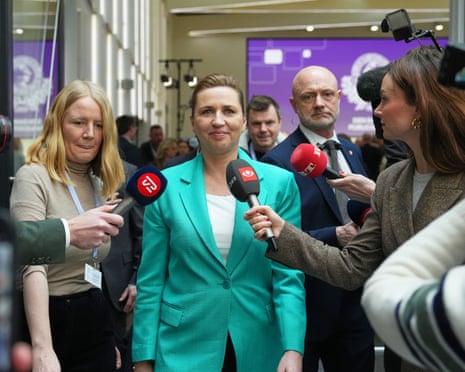
Could it be that she will get the role?
Could the European far right be suffering from a Trumplash? — analysis

Jon Henley
Europe correspondent
The Rassemblement National is not invincible. A year out from a make-or-break presidential vote, that might be the main lesson (though there are others, which may prove more significant) from last weekend’s local elections in France.
More broadly, there were other tentative signs this week that Europe’s populist far right may be encountering headwinds – perhaps due, in part at least, to what might be called a Trumplash.
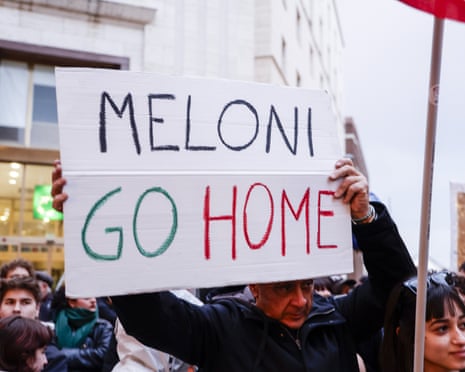
Giorgia Meloni’s referendum defeat in Italy, Janez Janša beaten in Slovenia, Hungary’s Viktor Orbán in trouble, the left bloc largest in Denmark all might suggest the rest of Europe’s far right are not having it all their own way, either.
Lars Løkke Rasmussen: Denmark’s pipe-smoking kingmaker who cleans his teeth with soap

Miranda Bryant
in Copenhagen
At the end of a long, gruelling night for the biggest parties on the right and left, there was one veteran of Danish politics who came out of Tuesday’s general election with a smile on his face – and a pipe in his mouth.
Lars Løkke Rasmussen, the two-time prime minister whose Moderates party is not aligned with the country’s left or right-leaning political blocs, is poised to play a central role in any coalition deal reached in the coming weeks.
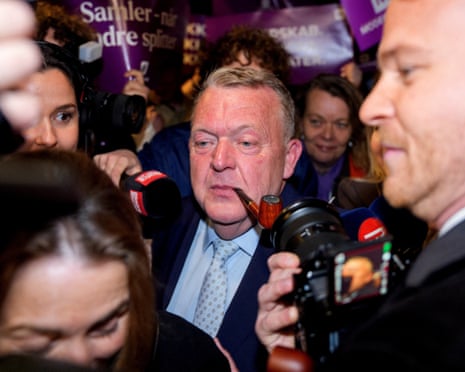
Clearly enjoying himself, and still carrying his pipe, Rasmussen, 61, urged the leaders of the Social Democrats and the liberal Venstre party on Tuesday night to “come down from the trees” and join him on the centre ground.
It was a dramatic turnaround for a political veteran whose fortunes were looking decidedly uncertain at the end of last year, when polls showed support for the Moderates had plummeted. Then came the Greenland crisis.
At the height of Denmark’s geopolitical drama with the US in January, Rasmussen, the foreign minister in Mette Frederiksen’s centrist coalition, went to Washington to meet the US vice-president, JD Vance, and the secretary of state, Marco Rubio.
He was pictured afterwards smoking a cigarette and fist-bumping the Danish ambassador, and has since been credited with helping to successfully cool Copenhagen’s tensions with Donald Trump.
Rasmussen’s party secured 14 seats in Tuesday’s elections, significantly fewer than his former coalition partners, but by refusing to take part in old-fashioned “bloc” politics, he has effectively become kingmaker.
While he is unlikely to be prime minister, although it should not be ruled out, he is likely to come out of talks with another powerful ministerial position and a government of his choice.
Danish election expert Rune Stubager believes Mette Frederiksen could still stay on as the Danish prime minister.
“Whether it will be in a new centrist coalition or a government based mostly on votes from the red bloc, that is up to the negotiations,” Stubager, who co-heads the Danish National Election Study, told AP.
Stubager said the leaders should be able to force concessions from each party’s campaign promises to reach their goal of a centrist government.
“As far as I can see it, it’s not possible to form a government if all these tripwires are intact,” Stubager said. “So somebody will have to go back on a promise in order for there to be a government.”
He added that Moderates leader Lars Løkke Rasmussen, who is now in a position to decide the next government, benefited from leading Denmark’s response to US president Donald Trump’s interest in Greenland.
“Donald Trump put up a stage on which Lars Løkke could perform, and he performed well in the eyes of most Danes,” Stubager said.
'Royal round' over as 12 party leaders propose their picks for leading government talks
Back in Denmark, all 12 party leaders have now visited King Frederik in what is known as “the royal round” process to discuss who they think should lead the government formation process.
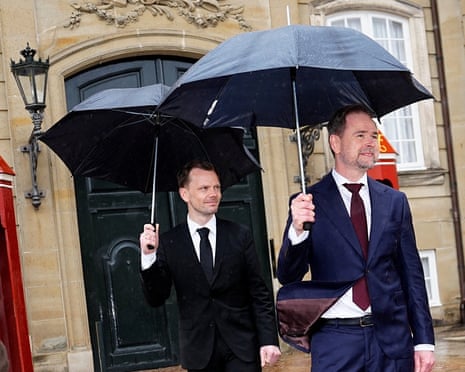
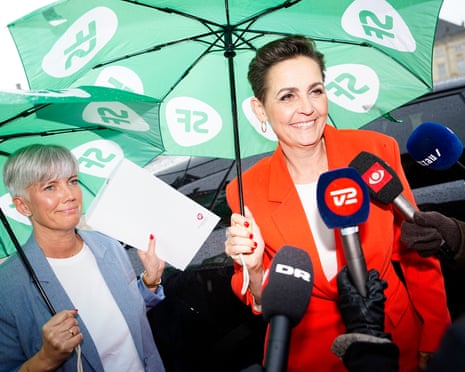
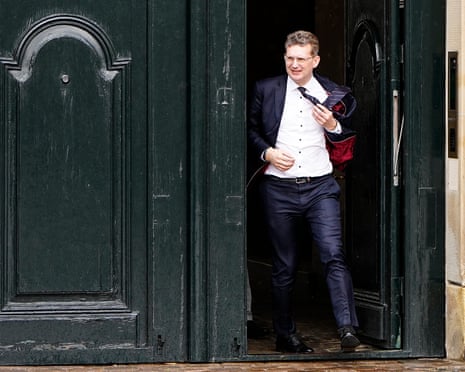
We will see what comes out of this meetings: the name of the “royal investigator” could come as soon as later today.
Germany pressing for end to war in Iran, Merz says
Meanwhile, Germany’s chancellor Friedrich Merz said on Wednesday Germany was making every effort to persuade the United States and Israel to find an end to the war with Iran, Reuters reported.
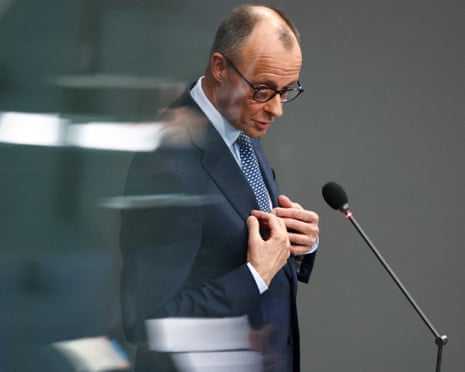
Answering questions in parliament, he said Germany would be ready to join international efforts to stabilise the region after hostilities end but added that any operation would require a mandate from the United Nations.
Poland's Tusk calls Hungarian minister's calls with Russia 'a disgrace'
Following the reports on his phone calls with Russian and other third-country leaders, Poland’s prime minister Donald Tusk criticised Szijjártó on social media and calling his behaviour “a disgrace.”
He said:
“Orban’s Foreign Minister has confirmed that he systematically informed Moscow what EU leaders talked about behind closed doors. What a disgrace.”
In response, Szijjártó – who regularly clashes with Tusk and other senior Polish officials on social media – said:
“This is another lie, why do you still believe fake news??”
Hungary's Szijjártó says he often discusses EU issues with Russia, other partners

Jennifer Rankin
in Brussels
Meanwhile, the Hungarian foreign minister Péter Szijjártó has admitted that he routinely calls his Russian counterpart “before and after” EU meetings, amid ongoing questions about Hungary’s contacts with the Kremlin.
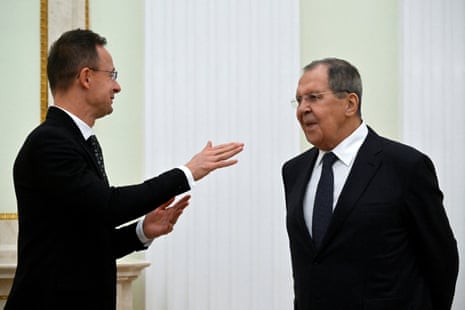
As our friends at Euronews reported Szijjártó confirmed the calls at a campaign event in Keszthely in western Hungary on Monday, but suggested he was just doing his job because EU decisions affect Hungary’s “partners” outside the bloc:
“These issues must be discussed with our partners outside the European Union. I talk not only to the Russian Foreign Minister, but also to our American, Turkish, Israeli, Serbian and others before and after European Union Council meetings… What I say may sound harsh, but diplomacy is about talking to the leaders of other countries.”
After the Washington Post reported that Szijjártó had routine conversations with the Russian foreign minister Sergei Lavrov during EU council meetings, Szijjártó dismissed the allegations as fake news. He maintains that he has not breached any security protocols.
It seems highly unlikely that this explanation will satisfy Hungary’s EU partners. Several have strongly criticised his contacts with Russia, which is heavily sanctioned and routinely condemned by the EU for its relentless aggression against Ukraine.
A council official on Wednesday described reports of the alleged disclosure of closed-door ministerial discussions to a foreign power as “greatly concerning”.
Under the council’s internal rules, discussions are covered by an obligation of professional secrecy, except when decided otherwise, for instance the publication of documents or live-streaming of council discussions.
The council official said this obligation of professional secrecy “is an expression of the principle of sincere cooperation and of the principle of mutual trust that are binding on all member states and are fundamental to the work of the European Union and of its institutions”.
Denmark braces for lengthy and challenging coalition talks — analysis
Miranda Bryant
in Copenhagen
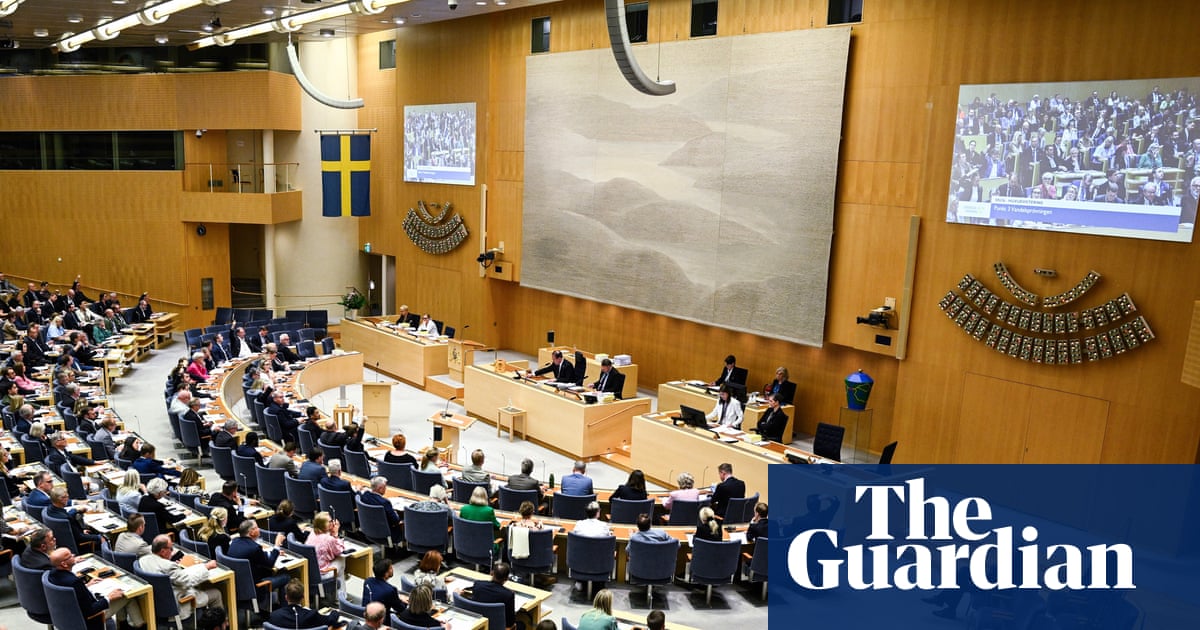
Denmark is braced for lengthy and challenging coalition talks after neither Mette Frederiksen’s leftwing bloc nor the rightwing parties managed to get a majority in Tuesday’s election.
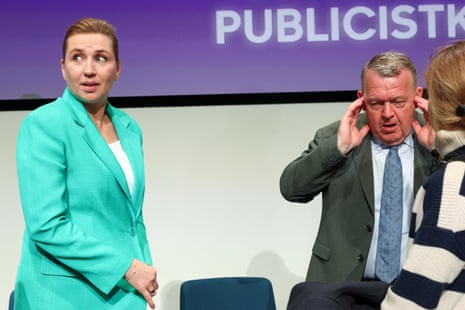
After a bruising night for her Social Democrat party, which despite remaining the biggest party in the Danish parliament had its worst general election since 1903, the prime minister went to Amalienborg palace on Wednesday morning to submit her government’s resignation to the king.
Later in the day, parties will start arriving at the palace in order of size, starting with the largest, the Social Democrats, to tell the king who they think should have the role of “royal investigator” – whose task it will be to try to form a government.
The failure of the left-leaning “red bloc” and right-leaning “blue bloc”, which won 84 seats and 77 seats respectively, to get a majority in the 179-seat parliament left the Moderates, with 14 seats, in a potentially powerful position to play a key role in forming a new coalition, putting committed centrist Lars Løkke Rasmussen in the position of kingmaker.
Drones reported in Estonia and Latvia suspected to be stray Ukrainian UAVs, authorities say
Elsewhere, we now know a bit more about the drones reported in Estonia and Latvia (10:12), with authorities suspecting them to be stray Ukrainian military drones, Reuters reported.
The UAVs that hit the Nato member nations were believed to be part of a wider Ukrainian attack on Russia, Latvian and Estonian authorities said. They follow another stray Ukrainian drone that Lithuania said on Monday had crashed into a lake.
The drones landed in Estonia and Latvia at around the time that Russian officials said a Ukrainian drone attack set fire to oil facilities at Russia’s Baltic Sea ports of Primorsk and Ust-Luga, major export hubs located near Estonia and Finland.
A third drone briefly entered Latvian airspace via Belarus before flying into Russia, Latvian authorities said.
“The drone was not directed at Estonia. This is a concrete consequence of Russia’s full-scale war of aggression,” Estonia’s foreign minister Margus Tsahkna said in a post on X.
“The war, provoked by the aggressor Russia, has got us to this point, with drones falling on the territories of all three Baltic states within 48 hours,” Lithuania’s defence minister Robertas Kaunas said in a statement.
There is 12 parties, so 12 audiences with the King, meaning the process will take into late afternoon.
DR has the schedule, with 10 minutes slots, from 1pm to 2.50pm (local time).
Mette Frederiksen is up first at the top of the hour.
The post-election debate is now over, but the government forming process very much is only starting.
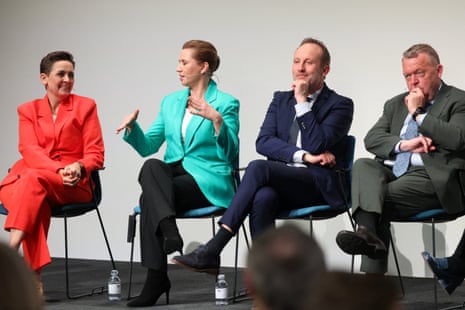
The party leaders are expected to see the King this afternoon to propose the names for who should be the “royal investigator” tasked with exploring what majorities could be formed (11:25).
Let’s see what comes out from that.
'It's not me who blew up this government,' Poulsen hits out at Frederiksen
Miranda Bryant
in Copenhagen
And there are signs of nervousness and tensions among the other leaders too.
Outgoing deputy prime minister Troels Lund Poulsen has hit out at Mette Frederiksen mid-debate, for calling an early election.
“It’s not me who blew up this government. It’s not me who called the election,” he said.
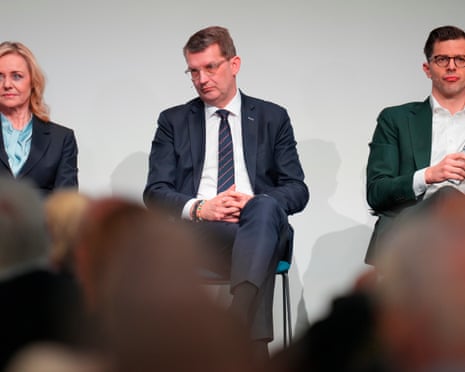
There’s still a lot of laughter in the room, especially after Lars Løkke Rasmussen speaks, despite the enormity of the task ahead.
But Rasmussen refuses to respond to Morten Messerschmidt, leader of the far-right Danish People’s Party, when he suggests the pair “pack our egos together and let Troels [Lund Poulsen] form a government.”
Next government needs to be ready to tackle major crises, Frederiksen says
In her comments at the leaders’ debate, Frederiksen also sets out the scale of challenges that the next government will probably have to face, starting from the consequences of the Iran war.
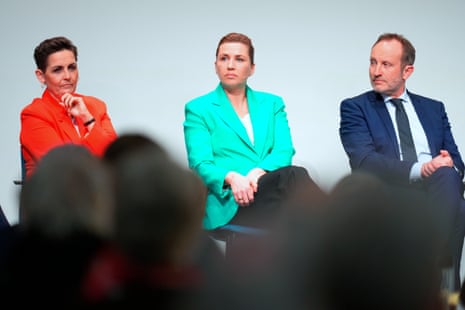
She says the closure of the Hormuz Strait and the impact on petrol, oil, diesel prices could put “Denmark’s overall competitiveness under threat.”
She says that with the ongoing war in Ukraine, increasingly aggressive Russia and “no one knowing what’s going to happen with the Americans,” the leaders should stop “playing word games as if the old world still existed.”
“It does not,” she warns, as she says the next government will have to be ready to take on really tough challenges.
She also takes a swipe at the far-right Danish People’s Party’s leader Morten Messerschmidt for being congratulated on his result by Hungary’s Viktor Orbán.
“When Viktor Orbán congratulates someone on the election, it’s because he sees an opportunity to undermine Europe, to divide us from each other,” she says.
Next steps in Danish government formation process
Essentially, what is expected to happen now is that when the parties meet later today, they will be expected to produce a piece of paper with the name of who they think should be appointed as the “royal investigator” and lead the government formation talks.
12 parties, 12 pieces of paper, 12 names. It is an early indication of who they think they could do business with.
It’s probably worth noting that person does not necessarily have to go on to be the next prime minister, but it tends to happen that’s what happened in 2022 when Mette Frederiksen led the process.
There are several possible investigators: from Frederiksen on the “red” side, Troels Lund Poulsen on the “blue” side, and Lars Løkke Rasmussen in the centre, as his party, the Moderates, is most likely to decide the next government.
For what it’s worth, the latter openly said he did not want to be the next prime minister.
But that was before the election…