.png) 3 months ago
64
3 months ago
64
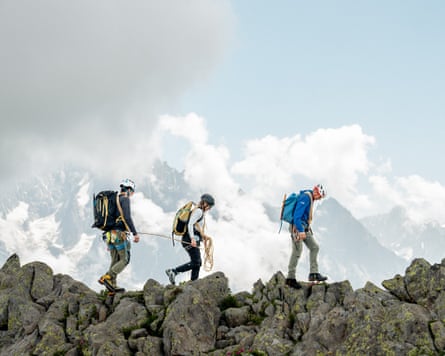
After a day spent hiking across the Col d’Entrèves glacier, a sugar hit is required. I descend on the cable car and join the queue at the ice-cream counter. Above me, surrounded by jagged peaks, looms the huge white figure of Mont Blanc, serene and pure against a brilliant blue sky. Although it’s late afternoon, people are still heading up the mountain, and there are two clear groups. On one side are the tourists, who are about to be lifted into unfamiliar frozen realms at 3,375 metres (11,072ft), hoping to grab a picture and return. Mixed among them are the weathered faces of mountain experts: hikers confidently heading for a high-altitude hut, or climbers with coils of rope.
How many of those tourists, I wonder, are wishing they could be mountaineers, secretly regretting the twists of fate that kept them away from that path? But all is not lost. The aspiring adventurer, no matter what age or background, can begin the journey to competence in the mountains. The annual mountain festival I am attending aims to facilitate that by offering the chance to gain hands-on experience with experts.
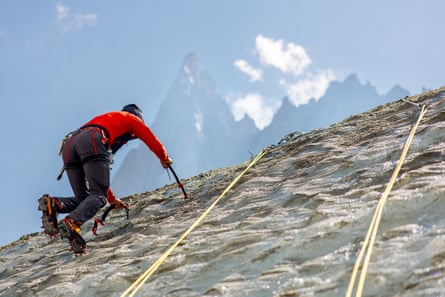
I have been up on the glacier with an Italian Alpine guide, who was coaching me in crossing the ice safely. Next to me when I make it to the lemon sorbet is Meta, a musician from Berlin, who has just been rock climbing. “I’ve only ever climbed indoors,” she says. “But I want to get experience outdoors. This seemed the perfect way to start.” What had held her back? She raises an eyebrow. “Berlin doesn’t have any mountains.” And how was it? “Amazing. I definitely want to do more.”
The Arc’teryx Alpine Academy in Chamonix began 16 years ago with a focus on rock climbing, but has since extended its range. There’s now a UK festival too in the Lake District in May. These days, there’s tuition in everything from Alpine botany to advanced multi-pitch climbing. Max from Rome is buzzing after a day of trail-running with experts. “They were so helpful, sharing their knowledge and tips.”
When we get back to the festival base camp, I meet others who have been out studying photography and mountain geology. Frenchman Jean-Luc is in a state of blissful shock. “I went on a climbing course and found myself teamed up with Jim Pope,” he says. “Can you imagine? He’s a climbing hero of mine, and was so friendly and encouraging. I still can’t believe it happened.” Elvin and Annie from Stockholm did an introduction to ice-climbing and thoroughly enjoyed it.
Meta and I watch the male and female Alpine guides chatting. “Look at them,” she says. “I want to be like that: with that physique and those skills.” She turns back to me, laughing. “They are cool.”
Rock climbing as a sport is cool right now. My local climbing wall is full of cool. Hamish McArthur, one of the stars of world climbing and an expert tutor at the festival, began his career on that wall in York.
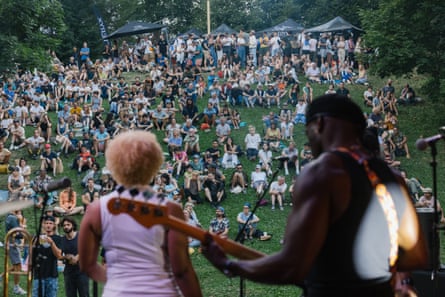
Meanwhile, the crowd is enjoying the festival. There is a programme of music too, from live bands to DJs, and the London band Kokoroko are playing as I tour the stalls. There’s one where you can borrow equipment for a day, just to try it. That solves one tricky part of the how to get started equation. At another stall, I learn how to wash my waterproofs correctly and do small repairs. At the next tent, I get a beer and wander over a small grassy hill to discover Austrian climber Alex Luger chatting to a small group about psychology and climbing. Alex is a professional climber turned psychotherapist who specialises in facing fears, an appropriate area of expertise for a man who has scaled some of the most terrifying rock walls on the planet. “I enjoy meeting such a variety of people,” he tells me afterwards. “And facing fears is not just about climbing; it applies to many situations.”
Next to the food tent, I meet organiser Stéphane Tenailleau, from the brand Arc’teryx, who is also facing his fears. “Sending 800 people, some of them total beginners, into the mountains carries a certain amount of risk.” That number includes disadvantaged kids from Paris and other underprivileged groups.
All too soon, the festival is over, but nearby Geneva provides an interesting coda. I stroll around the historic old town, my need to climb still burning. On the side of a cable car station overlooking the city, I find a climbing wall and instructor Pierre, who turns out to be an unsung genius of motivational psychology. I had always regarded the crux of a climb, the hardest bit, as the moment when I give up. Pierre rewires my brain. On the 20-metre concrete wall, with Lake Geneva far below, I reach the pinch point and get ready to fail.
“That desire to stop,” pipes up Pierre, who seems to know exactly what I’m thinking, “that is the dark place of climbing. Now balance your mind and body. Breathe. Move your left foot 2cm to the right. Extend the ankle. And now go on.”
And I do.
The trip was provided by Geneva Tourism, with accommodation at the Crowne Plaza Geneva, doubles from CHF 225 (£212). The 2026 Arc’teryx Alpine Academy in Chamonix, with a range of individually priced clinics, takes place 2-5 July. Other locations for the festival include the Lake District, 23-25 May