.png) 1 month ago
44
1 month ago
44
Anyone who thinks flower paintings are stuffy should spend a few minutes with Tulip (Helen Josephine) by Rory McEwen. Standing in front of this exquisite watercolour, my senses come alive: I can taste strawberries and cream, and feel the velvety petals between my finger pads. McEwen had a lifelong love affair with plants, which he painted from life, making changes with a pen knife or scalpel, wearing surgeon’s spectacles for the fine details. Crisply defined and gleaming in the light, his tulip is beautifully mesmerising.
It’s one of several flower paintings hanging on white and leaf-green walls at Kettle’s Yard. Inspired by the fresh cut flowers and paintings of flowers in the neighbouring house, Handpicked brings together more than 40 artists from the beginning of the 20th century to the present who share a floral passion. It’s a delightful exhibition, perfectly timed, and as I pass between splashy chrysanthemums and dancing fritillaries I’m considering what to pick up from the florist on my way home. But don’t be fooled into thinking that flower paintings are all decor and delight. Folded in with those soft-to-touch petals are intense human emotions and stark reminders of the fragility of life.
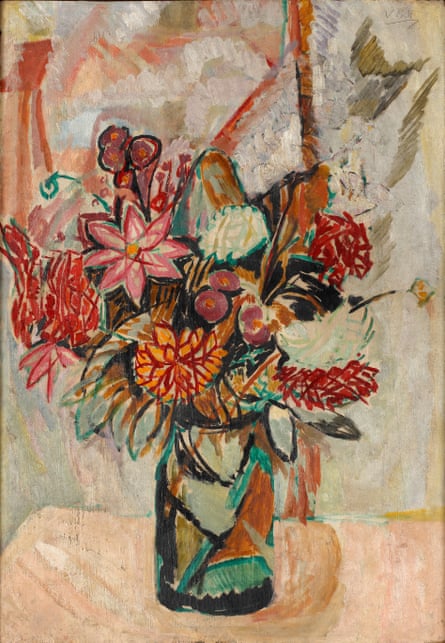
Every good garden show needs variety, and the same goes for an exhibition dedicated to blooms. Across the two ground-floor gallery spaces is a vast array of species, approaches, techniques; upstairs are black-and-white photographs and a film. Cedric Morris’s voluptuous arrangement of irises and lilies is wild and free beside Christopher Wood’s neat and tidy flowers in a vase, carefully observed. With its graphic shapes and black shadows, Vanessa Bell’s semi-abstracted still life of dahlias, chrysanthemums and begonias manages to make William Nicholson’s pillow-soft peonies softer still.
Tirzah Garwood appears to have taken that single perfect tulip painted by McEwen and unfurled a few of its petals. In The Springtime of Flight (1950), it sways in a gentle breeze alongside a long, lean daffodil and other wildflowers presided over by a pale yellow butterfly and a small, flimsy aeroplane. Against the overcast sky, the blossoms shine bright, and yet, there’s a foreboding sense of doom. Garwood’s husband, Eric, disappeared in a search-and-rescue flight some years earlier, and in 1948 she was diagnosed with cancer; she painted this work during the last year of her life.
Death and birth. Loss and love. There are flowers for every state and stage. In Delphinium, February 14th, Celia Paul captures an elegant branch of blue flowers reaching up and across the paper, with streaks of watercolour and pastel smudges that make me think of tear-stained mascara eyes. It may be Valentine’s Day, but things aren’t looking rosy.
Gluck, who went by a single name, began painting flowers in 1932 when she fell in love with the famous florist Constance Spry, who had once sent a bouquet of convolvulus to her studio. She painted Convolvulus in 1940 while staying with her next partner, the American socialite Nesta Obermer, who was refusing to separate from her flush older husband. When you know the backstory, it’s hard not to see those tendrils curling up and over the lip of the vase and licking at the shiny marble tabletop as a creative effort to elicit jealousy.
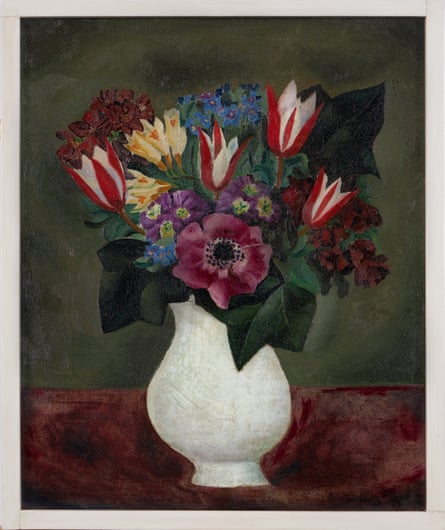
Apparently, convolvulus wilt in a matter of hours, so Gluck had to keep nipping outside and burrowing through the hedgerows for replacement buds. Caroline Walker didn’t have that problem with her shop-bought bunch, but that’s not to say Kitchen Table is a scene free from demands. The artist’s daughter sits at the table with her felt-tip pens and paper, partially obscured by a lush bouquet recently arranged in a glass vase. Beside the vase is a sippy cup, a reminder that the artist now has two living things to care for. The brown paper packaging lies on the table, a pair of half-opened scissors on top, the silver blades overlapping with one of a handful of discarded stems waiting to be tossed.
The single stem with three rose heads painted by Alison Watt seems to me an older, wiser cousin of McEwen’s perfect upright tulip. Someone who’s seen and heard things, who isn’t under any illusion about the ways of the world. Standing in front of it, my mind skips to the dead toreador painted in the 1860s by Manet (another fabulous flower painter), with his pink cape and rosy sash. In Watt’s wonderful painting, the creamy pink petals are beginning to wilt and brown, as if they’ve caught on the tip of a flame. “As soon as a rose is picked, it’s dying,” says the artist, who’s placed the stem in the foreground, within touching distance, as if to say, go on, I dare you, grab it.