.png) 2 months ago
63
2 months ago
63
Joy Gharoro-Akpojotor had a little wobble when she stepped on to the stage after the screening of her debut feature, Dreamers, at the London film festival. The Nigerian-British director’s film is a love story set in an immigration detention centre. It had already premiered in Berlin earlier this year. But showing her semi-autobiographical film to a home crowd in London felt exposing. “I suddenly had this feeling: Oh my God, everyone can see me. Everyone knows everything about me.” She laughs.
Gharoro-Akpojotor has built a reputation as a rising star producer. Her company Joi Productions makes films telling black, female and gay stories. (“All of the above, sometimes individually.”) Her credits include Rapman’s Blue Story and Aml Ameen’s romcom Boxing Day, and she is currently working on Ashley Walters’ directing debut Animol.
We’re speaking by video call at the end of a long day’s work. Behind her on a shelf cardboard boxes have the titles of film projects neatly labelled with a Sharpie. Within five minutes you can see why directors pick Gharoro-Akpojotor to produce their films. She takes her work very seriously, but has a good laugh at herself – and is in possession of such an air of calm, not even the apocalypse would faze her.
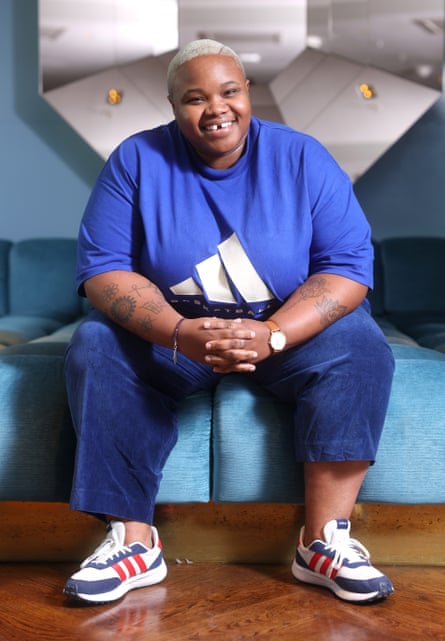
Dreamers is inspired by her own experience seeking asylum in the UK aged 25. It tells the story of Isio (Ronkę Adékoluęjo), a Nigerian woman being held at removal centre while the Home Office decides whether or not it believes that she is who she says she is – a lesbian whose life would be danger if she were sent back to Nigeria.
“I always say it’s loosely based on my life,” Gharoro-Akpojotor says. She herself she did not experience the trauma that is her character’s painful backstory. Nor was she detained while her asylum application was processed, though it was a close shave. “My immigration lawyer said it was 50/50.” The night before her own appointment, Gharoro-Akpojotor had a leaving party with friends. “Because we weren’t sure I was going to come back. The next morning I got on the bus at 6am to Croydon.” After giving her fingerprints and handing over her passport she was allowed to leave.
But some of the scenes in the film in which Isio is being interviewed by a Home Office caseworker are practically verbatim, Gharoro-Akpojotor says. Before her own interview, her legal aid lawyer advised her to take along a copy of her written statement. “She told me that the Home Office hates to read. They won’t have read it.”
Her lawyer wasn’t wrong. “When I got there, the caseworker hadn’t read it. He knew nothing about where I’m from. He knew nothing about my case. He hadn’t read anything I sent him. Yet 202 questions later he would be making the decision about whether I get to stay or not.”
The interview included some remarkably uninformed questions. “My caseworker asked me, ‘Is there is a Brighton in Nigeria?’”
Was he was asking if Nigeria has a gay-friendly city in which she could live? “Yes! He then asked, ‘OK, if your family are in the south and they know you’re gay, why can’t you go up north?’” Gharoro-Akpojotor explained to him that in many northern states of Nigeria, Sharia law criminalises same-sex activities. The maximum penalty is death.
Next came a grilling about her sexuality. “He said to me, ‘Tell me the name of a gay bar in London … What have you done sexually with a woman? … What have you done sexually with a man?’” Then at the end of the interview, “‘How do I know you’re not straight?’”
Gharoro-Akpojotor counts herself as one of the lucky ones. She had been warned a decision about her asylum claim could take years. But five days later a letter landed on the door mat; her application had been approved. She has a hunch that her bonding with the caseworker over Dagenham had something to do with it. She had been working in a bookmaker’s in Dagenham, and it turned out the caseworker was from there. “We spent a lot of time talking about Dagenham. I think that was a privilege for me because we could find that rapport. But a lot of people don’t have that.”
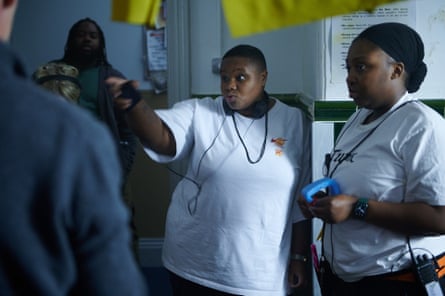
In Dreamers, she portrays the grimness and bureaucratic indifference of UK immigration. A system that processes people without listening to them or looking them in the eye. That is not mindful of trauma. But it is not a grim film. There are female friendships, and gorgeous love story between Isio and another woman in the detention centre Farah (Ann Akinjirin). The script subtly challenges stereotypes about refugees. Between them, Isio and Farah have degrees in politics and philosophy, and bicker about Karl Marx. Like its director, the film is funny and warm.
We meet before the government announces proposals for sweeping new changes to the asylum system, which would include making refugee status temporary. But I ask Gharoro-Akpojotor what she thinks about the recent protests against hotels housing asylum seekers. “I feel like the protests are in the wrong place,” says answers. “Those guys coming in, they didn’t make any of the rules. They didn’t make any of the policies. If anything, you should be at No 10 protesting. That’s where the rules are being made.”
As a child in Nigeria, Gharoro-Akpojotor’s father worked for Shell. Growing up, she loved telling stories and wrote a book in her bedroom aged 11. “Well, I say book …” she grins. “I think it was called The Vampire Busters. My teacher told my mother that I could be an author.” Her mum was having none of it. “She said, ‘There’s no money in that! My daughter will be an English teacher.’”
After her father died, Gharoro-Akpojotor’s mother sent her three brothers to the UK to boarding school. She followed when she was 16. And it was after moving to London that she discovered films. Every week Gharoro-Akpojotor and her mate would buy two-for-one cinema tickets: “We’d get a ticket and then just stay in the cinema watching films back-to-back. I was like: Oh my God, I love cinema.”
At the same time, she was thinking about her sexuality. “I always knew I liked women, but I didn’t really understand it.” In Nigeria she couldn’t do anything about her feelings. “Now I thought I should probably watch more gay cinema, to understand what it means to be black and gay and Nigerian. But I couldn’t find anything to watch.” It sparked an idea: “What if I could make it myself? That’s where my journey began. I just wanted to see myself on screen.”
Gharoro-Akpojotor wrote her first script while doing her A-levels. It was a murder mystery about characters high on mushrooms. She studied cinema at university, which was not quite the degree she thought she was signing up for. “Admittedly, I believed it was more of a practical course,” she says grinning. But at university she learned about cinema. Watching films by Wong Kar-wai, François Truffaut and Ousmane Sembène, the world grew bigger. “I learned that art is an expression of yourself. French new wave taught me that. It’s an expression of who you are as a person. That was something I was trying to do with Dreamers, to find myself in it.”
After university, her mother advised her to get a sensible job at the BBC. “But I always felt like I needed to do more.” She worked part time in the betting shop while studying for a master’s part-time, and making short films.
It was on the set of a short that an actor told her that she had a knack for producing. And she liked it too. “I enjoyed the organisational part, I enjoyed talking to people. I enjoyed seeing the film come together.” It got her thinking. “What stories do I want to put in the world? I need to find things that speak to me, and make me feel fulfilled as a human being. I need to feel like I’m giving something back. I really wanted to make films that allowed other people to see and hear themselves on screen.”
She achieved exactly that with the first feature film she produced, Blue Story. It was a drama about two friends who get caught up in gangs from rival postcodes in south London, directed by the rapper Rapman. Blue Story was the sixth best opening of any British film during 2019: “There were people in the audience who just went to see it over and over again.”
Then it became embroiled in controversy, after a brawl in a cinema foyer in Birmingham. Two cinema chains pulled the film off screen, leading to accusations of “institutional racism”. The cinemas swiftly backtracked. At the time Gharoro-Akpojotor says she didn’t understand why it was banned. It didn’t glorify gangs: “It’s an anti-violence film. The film was all about calling young people to question why they joined gangs. I guess we felt a bit demonised.”
What she wants more than anything is to make films that challenge people to see the world differently. Her next project is about a young man with mental health problems. “By the end of that I want you to be like, next time you see a guy on the road, and you hear him shouting, take time to think. We’re so used to walking by. We treat people as the other. It’s the same with immigration – it’s those guys over there. We forget the human links that tie us all together. I think it’s about empathy. ”
She laughs. “I sound like a bumper sticker. But I really do believe that if we had more understanding of social issues, we would have so much more care for each other.”