.png) 3 months ago
74
3 months ago
74
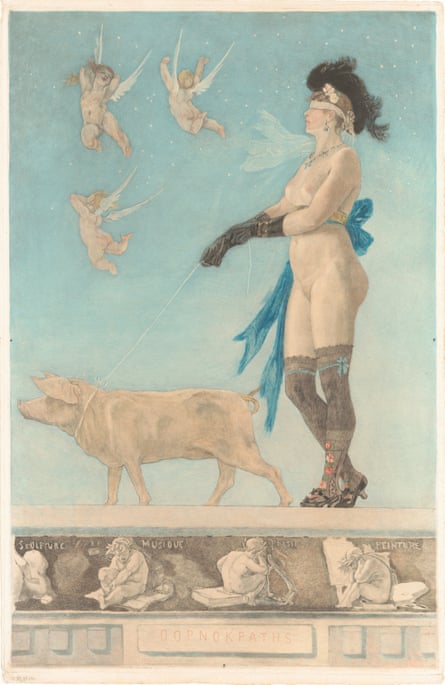
During an oppressively hot week in Paris in 1878, the bohemian Belgian artist Félicien Rops painted a picture of a woman walking her pet pig. In it, the woman is blindfolded and naked – bar some stockings, long black gloves and a jaunty feathered hat – and the pig has a cute, pink curlicue of a tail. Pornocrates – which roughly translates as “the ruler of fornication” – is an eye worm. Once seen, it’s hard to forget.
Rops recalled composing his most famous work “in an overheated apartment, full of different smells, where the opopanax and cyclamen gave me a slight fever conducive towards production or even towards reproduction”. As viewers of Laboratory of Lust, a new exhibition on Rops at Kunsthaus Zurich, will discover to their amazement, or perhaps indignation, mating and painting were indelibly linked in Rops’ psyche.
In the late 19th century, Rops created a vast oeuvre of drawings, etchings, prints and paintings of such breathtaking fruitiness – often laced with satanic elements – that even Picasso responded to him in awe (in homage, the Spaniard drew a cartoon of a man in the form of a pig performing cunnilingus on a woman). Rops’ works depicted naked witches riding brooms, voyeurs in top hats and courtesans riding penis-shaped bicycles. The French art critic Félix Fénéon called him an artist “who paints phalluses the way others paint landscapes”.
“Even today’s viewers are sometimes left breathless – whether at the sight of a naked woman tied to a cross, a risque Parisian woman walking her pig, or an Eve being ensnared by a phallic snake,” notes Ann Demeester, director of Kunsthaus Zurich. Rops would have loved such gasping. Writing about his most shocking images, he noted: “I sometimes do things like this to bring my backside up to the level of your faces.”
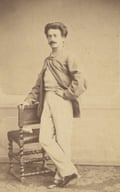
Rops was born in Namur in central Belgium in 1833. The son of a wealthy industrialist, he was an unlikely future decadent. He studied law and married the daughter of a magistrate, who owned a local castle. He might have settled into the life of a country squire but art, Paris and philandering beckoned. With a razor-sharp goatee and brooding brow, Rops had the looks of a young Ethan Hawke. He perfected a kind of shabby-garret style of dress.
His illustrative work, for authors such as Charles Baudelaire and Paul Verlaine, shifted from realist subjects to his infamous fantastical pictures of the women of the demimonde – who he called Ropsiennes. He saw modern women as femme fatales, but it was the bourgeois men undone by temptation that were his real target.
His own love life matched his art. Having abandoned his wife and son, he lived for three decades in a menage à trois with the sisters Léontine and Aurélie Duluc, and fathered children with both. He navigated the outrage of the more moralistic elements of belle epoque society, and his unconventional domestic situation underpinned an extraordinarily successful career: by the mid-1870s he was the most highly paid illustrator in Paris. He died, aged 65, in 1898, the same year that he received the Légion d’honneur. In his later years, he grew roses.
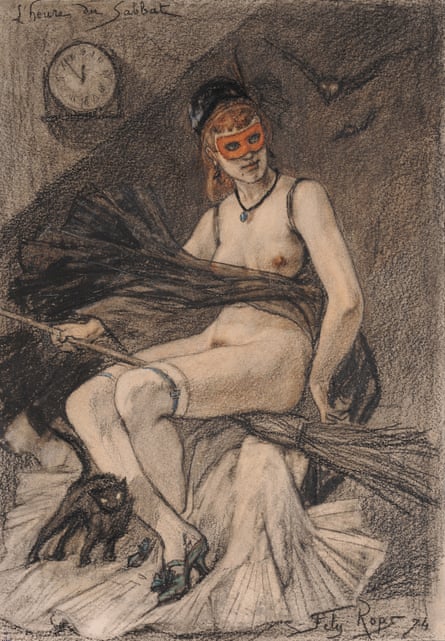
There is a small, dedicated group of collectors for works by Rops, says Claude Piening, specialist in 19th-century European pictures at Sotheby’s. “His watercolours and his oil paintings don’t come up often because many are spoken for by museums and collectors. What does come up is his printed work and if you’re a bibliophile you’ll see his work in frontispieces.” A rare and candid watercolour, Le Calvaire (Les Sataniques), in which a woman is strangled by her own hair while wedged under the genitals of a crucified Satan, sold at Sotheby’s in 2007 for about £160,000. The auction catalogue observed: “Satan’s testicles sitting atop the woman’s face like a beret are more comical than frightening.”
There are no issues in offering Rops’ work at international auctions. “There’s erotica or pornography, but that shouldn’t be conflated with art. It’s two different things,” says Piening. “His subjects are quite risque, yes, or, for want of a better word, original. Now, as they were then. And, yes, he might have been out to shock, but at the same time he’s doing this as a self-respecting artist.”
The Zurich exhibition has been orchestrated by Jonas Beyer from the Kunsthaus Zurich and Daan van Heesch, curator for prints and drawings at the Royal Library of Belgium (which has loaned pictures from its 2,000-strong collection of works by the artist). On view will be secret albums that were destined to be viewed in a “male collector’s cabinet”, including frontispieces to pornographic novels and standalone drawings of sex workers.
How difficult is it to stage Laboratory of Lust in an age of conflicting conversations about sex, of #MeToo and OnlyFans? “That’s a central question,” acknowledges Beyer. “I think in Zurich it will be a task to show such explicit works. It’s very traditional.” Phalluses perhaps don’t sit easily with high-end chocolate and luxury watches. “It’s worth the risk because we’re in times when you have to discuss sexuality. If you look at the Epstein files, I think you have to talk about how male culture perceives women.”
The curators aim to present Rops in the round. “He was one of the most accomplished and successful symbolist artists of his time, working together with all the famous authors,” says Van Heesch. “But at the same time his art is so disturbing, violent and shocking, and fascinating as well. I think we want to look him in the eye and read him a bit against the grain, without cancelling him.”