.png) 2 months ago
56
2 months ago
56
Nine times. As Henry Nowak lay dying in handcuffs, he told police officers that he could not breathe nine times.
To recount his final moments: last December, Nowak, who was walking home alone after a night out with university friends in Southampton, encountered Vickrum Digwa. As the judge said in his sentencing, only Nowak and Digwa know exactly what happened in their interaction. But what is clear is that Digwa stabbed Nowak repeatedly and lied to the police when they arrived on the scene: he claimed that Nowak had racially abused him. The police pulled Nowak across the gravel and forced his hands behind his back. As he pleaded with officers, telling him that he had been stabbed, one officer dismissed him, saying: “I don’t think you have, mate.” Another simply says “he hasn’t been stabbed”. Just the sound from the bodycam footage is enough to make your blood run cold.
On the steps outside Southampton crown court, his father, Mark Nowak, described his son as “one of the kindest, friendliest and most inclusive people you could ever hope to meet”. He said that “instead of being treated as a dying victim, [the] police formally arrested Henry for assault and read him his rights. That was the last thing he heard. Henry did not die with dignity. He did not die with the care he deserved. He lost consciousness before anyone believed him.” His son was only 18. He had only just started university. And he was only walking home.
The Nowak family are right to describe their son’s treatment by the police as “inhumane and degrading”. That still would have been the case even if Nowak had done something wrong. Even if Nowak had racially, verbally or physically assaulted Digwa, the police’s encounter with him should have prioritised protecting his life, as mandated by the College of Policing guidance under the European convention on human rights. Nowak’s innocence deepens the tragedy, but it is not his innocence alone that makes this an injustice. He was not killed by the police, but they made no attempt to save him when it mattered – and he died in their custody.
The issues raised by Nowak’s death are not unique to this case. They are part of a much longer history of deaths following police contact and the campaigns that this has inspired. Take the United Families and Friends Campaign (UFFC), which works with families from all ethnic and cultural backgrounds and is aimed at preventing such deaths. Nowak is not the first white man to die in police custody, nor will he be the last. Many white British people have died in the custody of police in circumstances just as brutal – in fact, the majority of such deaths are indeed white people, which is common sense given that white people are the majority in this country.
And yet Nowak’s case – and the fact of his killer being a Sikh man who carries a kirpan (though this religious knife is not what was used to kill Nowak) – has been used to refuel a pervasive lie: that ethnic minorities receive preferential treatment from the police, so-called two-tier policing. This has quickly been exploited by Reform UK, which has sought to explicitly racialise the tragedy. In the Commons, Reform’s Robert Jenrick asked the home secretary: “Why do officers behave in this way? Is it because they have been taught repeatedly to elevate perceptions of ethnic minority communities over the safety of white British people?” Within hours of the bodycam footage being released, Reform’s leader, Nigel Farage, said the incident demonstrated a “two-tier Britain … where the rights of white people matter less than ethnic minorities”. What should the response be from those concerned? “Pure cold rage,” Farage said.
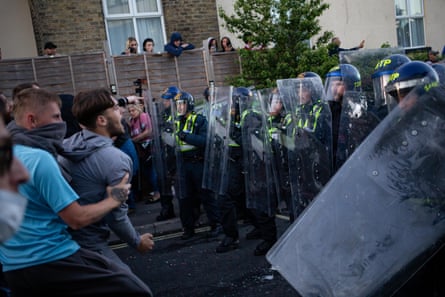
Rage did indeed come, in the form of riots in Southampton, complete with Nazi salutes and neo-fascists present. This is all despite the explicit wishes of Nowak’s family that “we do not want [Henry’s] death to be used to create further division, hatred or tension. We want his story to make our streets safer for everyone.” But, weakened by scandals, outflanked on the right by Restore Britain and anxious about its chances in the upcoming Makerfield byelection, Reform is clearly desperate for any kind of culture-war flashpoint to stir up anger in service of its populist project. Do these men know no shame?
It feels perverse that such a tragedy being recast in racial terms makes it necessary to restate the facts of policing in this country. And yet this is necessary because the right has been allowed to seize the narrative around Nowak’s death to construct an inverted reality.
Inequality in policing plainly does exist, and it has been borne out over decades by collected data. Black people in Britain are seven times more likely than white people to die after police restraint. Black children in England and Wales are almost eight times more likely to be strip-searched and are also overrepresented in the use of force through tasers and handcuffs. The disparity in these issues have been campaigned against for decades. And yet, as in the case of UFFC and other campaigns, campaigners have always recognised how bad policing makes all of us unsafe. Nowak’s case could be pulled into this long history of policing failures; instead it has been spun as a nativist tale that represents the threat that immigrant and minority communities present to white British people.
Where is the government to steer us through all of this? The policing minister, Sarah Jones, has come out to criticise anti-discrimination guidance, stating that a framework that suggests treating black and white suspects differently “gives the wrong impression”. Perhaps there is a need to review such guidance. But none of this has to do with the circumstances of Nowak’s death, or the fact that bad policing allowed him to suffer such indignity. That Digwa disgracefully lied about racial abuse has provided a convenient narrative, but his lies should not undermine the necessity of anti-racist practices among the police forces.
Our leaders have been worse than useless. The home secretary, Shabana Mahmood, says that: “The police in this country have a sacred duty: to police without fear or favour. Everyone is equal before the law.” Starmer says that there are serious questions for the police on “how accusations of racism inform decision-making in this case”. Can none of our political leaders bring themselves to say that two-tier policing is a myth, and inequality and racism is still present in the institution? Can none of them say that the life of any person in police custody should be preserved in any circumstance?
Like the family of Lee Rigby, who rejected the exploitation of his murder for political purposes, the cowardice and opportunism of our politicians has likely condemned the Nowaks to seeing their son reduced to a pawn in this country’s increasingly violent culture wars. Nowak died not being believed by those who were meant to protect him. The least we could do is refuse to allow others to exploit his death to write more fiction.
-
Jason Okundaye is a Guardian Opinion assistant editor
-
Do you have an opinion on the issues raised in this article? If you would like to submit a response of up to 300 words by email to be considered for publication in our letters section, please click here.