.png) 2 months ago
65
2 months ago
65
Led by a probably doomed prime minister, presiding over a struggling economy, exposed by an ongoing scandal, besieged by populist insurgents to its right and left, ambushed by a war that will bring higher inflation and public debt, and predicted to win just 75 seats at the next general election, according to the website Electoral Calculus, Labour is in an unprecedented crisis. The party will have to do unprecedented things to get out of it.
One could be making its political approach both narrower and more expansive. This would require Labour to drop habits and orthodoxies which have become ingrained since the 1980s.
By narrower, I mean abandoning the failed attempt of Keir Starmer’s government to simultaneously appeal to voters on the authoritarian right and the liberal left: for example, by launching ever harsher immigration policies while also standing up for a multicultural society.
Back when most voters always chose between Labour and the Tories, parties often had to be politically ambiguous – “tough on crime, and tough on the causes of crime” was New Labour’s canny example – because winning a general election required a broad coalition of voters. Yet nowadays, with the electorate much more fragmented, and the divides much clearer and more acrimonious than in the relatively placid 1990s and 2000s, ambiguous political messages often come across as incoherent and inauthentic – common criticisms of the Starmer government.
Broad coalitions of support are also becoming less necessary. With five or six parties in contention across the country, any which attract as little as 25% of the electorate could win a lot of parliamentary seats, if that support is efficiently distributed.
For Labour, such a focused approach would have to mean becoming a more clearly left-of-centre party again. As a new report by the non-partisan analysts Persuasion UK makes clear, the party’s loss of support to the Greens, Liberal Democrats, Plaid Cymru and the SNP is both larger and more reversible than its loss of support to Reform UK. “About 10% of the electorate”, finds the report, is “open” to either returning or switching to Labour from other progressive parties. Whether or not the party secures a substantial proportion of this 10% may make the difference between a general election win and a rout.
Yet along with concentrating on its more natural supporters, in other ways Labour would need to be more expansive, because it is so unlikely to get a second term in office without an alliance with other parties. The Lib Dem leader, Ed Davey, has not ruled out a coalition with Labour. It could compensate for the Lib Dems’ disastrous involvement in David Cameron’s rightwing government, and thus re-establish their identity as a genuine centre party.
Meanwhile, the Greens’ leader Zack Polanski has said that he “could see the potential to work with” Labour “to stop Reform” – and to draw Labour into “conversations about proportional representation, a wealth tax, climate action”. However, such a collaboration would be conditional, he has also said, on the Labour leader no longer being Starmer, but Andy Burnham: a change that remains easier to advocate than arrange. Burnham already has some cross-party credentials, from working with Lib Dems on the Greater Manchester combined authority. And Labour has collaborated nationally with another party before, most recently in the Lib-Lab pact during Jim Callaghan’s premiership. But that was almost half a century ago, and the arrangement lasted barely a year. Burnham apart, most senior Labour figures have spent their entire careers believing their party has a rightful monopoly of British left-of-centre politics, however rightwing some of its actual policies.
The same mentality drives many Labour activists. Cold days spent leafleting and door-knocking breed tribalism, as they do in all parties, while the current Labour machine is particularly aggressive towards leftwing rivals. It presents the Greens as extremists whose priorities are legalising hard drugs and undermining Nato. Meanwhile, Polanksi has said that his party ultimately intends to “replace” Labour. Any coalition talks between the two sides would include the difficult task of replacing mutual contempt with a degree of trust.
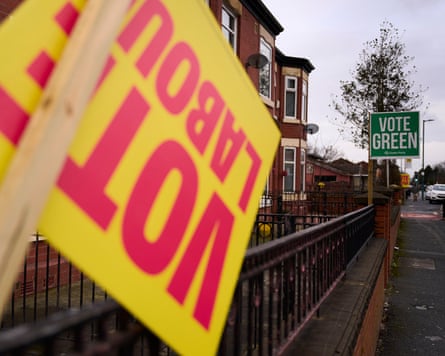
Another tricky but necessary shift for Labour is to become less top-down. Even in strongholds such as London, it is rapidly shedding members, and remaining activists are often disillusioned or angry at having their freedom to debate crucial issues such as Gaza curtailed, and their on-the-ground intelligence ignored by party headquarters. When Labour is popular, grumbling activists may not matter that much – according to the right of the party, their discontent can even usefully be publicised as a sign of Labour’s outward-looking and undogmatic nature – but those confident days are gone. At the next general election, Labour will need every activist it can get.
Those activists could also try feeling less sorry for themselves. Their party is in deep trouble, but so are the Tories. Reform UK is losing winnable byelections, and slipping in the polls. The Lib Dems have failed to make a breakthrough in highly favourable circumstances. And the Greens have a leader who is no longer a novelty but a media target, regularly mocked, provoked and smeared. In the likely three-year gap between now and the next election, all these parties will have disasters and golden chances.
In truly multiparty systems, as many of our European neighbours have long known, no party can convincingly claim to represent the whole nation, or expect to dominate the political field. Whether under Starmer or another leader, Labour needs to realise that it’s playing a new game.
-
Andy Beckett is a Guardian columnist