.png) 2 hours ago
5
2 hours ago
5
There was something old-school about the England women’s team that beat France 38-4 in Toulouse last week. With eight players from Wigan, five from Leeds and three from St Helens, it looked like a Great Britain side of the early 2000s. But among the Wigan contingent was a player with a story that feels very 2026: Mary Coleman, a prop from Kent who works for the Home Office, has a first-class degree in psychological and behavioural sciences from Cambridge University, and had not heard of Wigan – or played rugby league – until she was in her early 20s.
“I didn’t grow up in a rugby household,” says Coleman. “I didn’t really know anything about rugby until I was in sixth form. My school was setting up a girl’s union side and I said to my boyfriend at the time: ‘Maybe I’ll give it a go.’ He said: ‘Don’t be silly, that’s not your thing.’ When we broke up, my 16-year-old brain wondered: ‘How am I going to get my boyfriend back? I’ll give rugby a go.’ My first session was a contact session and I immediately fell in love with someone encouraging me to run at someone as hard as I could.”
Coleman continued her new sporting romance at Cambridge. “When I signed up for the women’s union team at the freshers festival they said I was the only freshman with any rugby experience.” Within weeks she was playing in the varsity match against Oxford at Twickenham.
Her rise in rugby league was equally swift. “I was playing union in Preston when the coach asked me if I wanted to play at Wigan. I just said ‘not really’, not knowing who Wigan was or anything. I’d not really heard of rugby league. Then my friend talked sense into me, saying: ‘Wigan is really quite a big deal – give it a go.’ So I did a pre-season game and fell in love with the sport.”
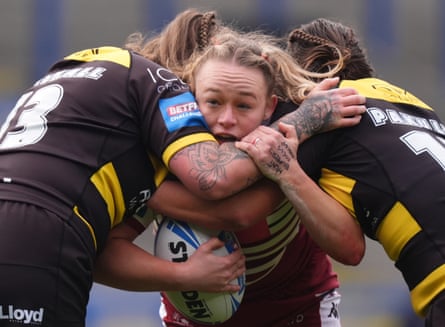
Within four years she was playing for England. “I came in at a lucky time,” she says. “The sport was still young, which made it easy for me to jump straight in. Women’s league is maybe where rugby union was about 10 years ago. We’re still quite a young sport so it was easy to progress. Same when I started playing union. I’m sure every girl who goes to uni now has already played for the last five, 10 years of their life.
“It’s probably very similar for rugby league: the older ones like me weren’t playing when we were kids as there weren’t opportunities, but the younger girls, like Jenna [Foubister, her Wigan and England teammate] have been playing since they were five or six years old. I don’t think someone would be able to do what I did now, given how both sports have grown so much.”
The 28-year-old earned her first England cap by winning the treble with Wigan last season. Wigan retained the Challenge Cup this year and are top of the Super League again this year. Despite all the glory, it has not been plain sailing. Her first few seasons at the club were tough. “In 2022 and 2023 we were losing 40, 50, 60-0 against Saints, Leeds and York,” she says.
“I was completely chucked into the deep end. I was learning how to play rugby league in a Super League environment. But there were quite a few girls in my boat, who’d come from union and weren’t familiar with rugby league. At least 10 of them are still here now. It’s not like we didn’t have the talent and capability – we lacked depth and knowledge. It’s just taken us time.”
Having not grown up playing or watching the sport, how does she make up for the skills gap? “The biggest difference is probably the core skill, being comfortable with the ball in hand and being able to move it quickly. You’ll see it in some of the younger players who just have better coordination, their speed of pass is so much better than those of us who haven’t grown up with a rugby ball in our hands. The girls coming through our academy are so much better than what any of us were at that age.”
Denis Betts, now in his third season as Wigan women’s coach, has asked Coleman to concentrate on what she is good at: running hard, straight lines. “When Denis came in he moved me into the middle and said: ‘You’re not a second row, you’re a prop. You’ve got the energy level of a prop. All you want to do is carry it to other people, so I should put you in the middle so you can do that’.”
That was one of many changes over the past few years. “The biggest has been the way the club has invested in the fundamental support we’ve had,” says Coleman. “Denis coming in is the epitome of that. We get a small amount of expenses, and I’m still not paid to play, but the difference is the medical support – if someone gets injured, they are sent for a scan the next day and don’t have to wait for the NHS – and facilities, gym, supplements, all the things that enable you to do your job well.”
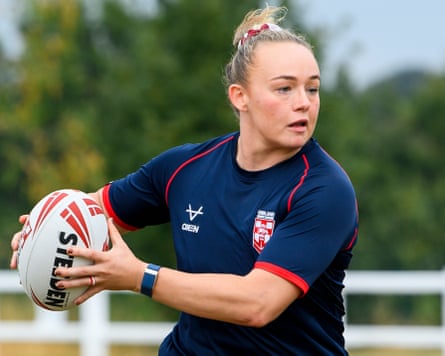
Coleman’s rugby career might have been very different but for a decision made by her employer. When she joined the civil service’s graduate scheme, she was hoping to be posted in London to “have that typical graduate lifestyle”. Instead, she was sent to Blackpool.
“I was like, oh, my God: Blackpool! But I lived in St Annes and fell in love with the north, the people, the culture. Everyone is so nice. One of my first experiences was walking down the high street in Lytham and the local bakery was selling hash brown butty. Carbs on carbs! This is my dream. After about three months living here, I knew I wasn’t going anywhere else.”
Now in Salford after a few years in Preston, Coleman switches from her Home Office role in immigration and asylum projects to evening training at Robin Park. Some of her colleagues have got into the sport by following her progress. They will be tuning into Sky Sports on Thursday night to watch Wigan’s match against their arch-rivals St Helens.
“When I started at Wigan I was a bit shy as I didn’t want to come across like I was bragging, but I talk about rugby league a lot more now,” she says. “We have a work newsletter that said: ‘Mary is playing for England!’ A lot more colleagues will watch the game now because of me, and the great thing about being on TV is all my family down in Kent and Essex can watch my games.”
One family member watching far closer than anyone else is Mary’s wife, Sinead Doria, a former Wigan player who now coaches in the club’s academy. “It can be an interesting dynamic but she primarily coaches the backs. When she’s reffing our touch games or something competitive, it always gets a bit tense! But it’s nice because we get to experience it all together, like Wembley. Having a full-time job and then rugby, which is basically another full-time job, I probably wouldn’t see her if she wasn’t involved in rugby.”
From a sixth-former who had never touched a rugby ball to an England international hoping to represent her country at the World Cup later this year, Coleman has been on some journey. “Since I was a child, I’ve always wanted to represent my country and play on those biggest stages. Admittedly, that dream hasn’t always been in rugby league, but it’s always been there. It was an amazing experience, a privilege and an honour.”
Follow No Helmets Required on Facebook