.png) 3 months ago
73
3 months ago
73
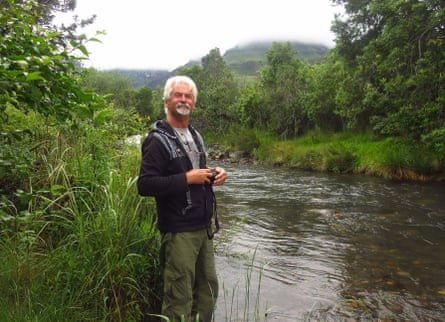
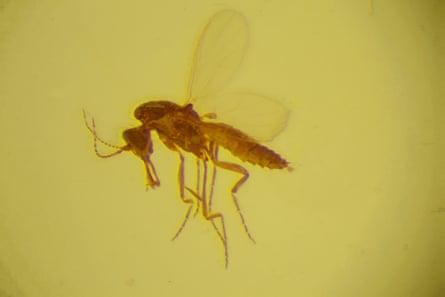
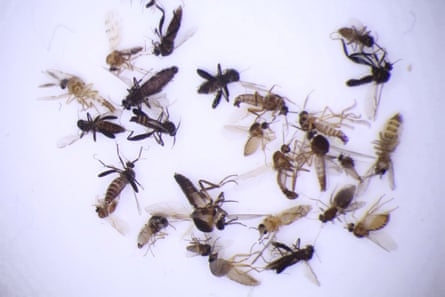
Once Art Borkent starts speaking about biting midges, he rarely pauses for breath. Holding up a picture of a gnat trapped in amber from the time of the dinosaurs, the 72-year-old taxonomist explains that there are more than 6,000 ceratopogonidae species known to science. He has described and named more than 300 midges, mostly from his favourite family of flies. Some specialise in sucking blood from mammals, reptiles, other insects and even fish, often using the CO2 from their host’s breath to locate their target, he says. Tens of thousands remain a mystery to science, waiting to be discovered.
But to Borkent’s knowledge, nobody will continue his life’s work of identifying and studying this group of flies once he has gone.
Autumn has arrived in Borkent’s life. He is strong and energetic, tanned from a recent trip to Mexico with his wife. But his white hair betrays him. One day he will not be able to continue the work he has dedicated himself to since 1989, working as an independent researcher with Royal British Columbia Museum and the American Museum of Natural History. His contemporaries have already gone: one has advanced dementia, another retired last year.
When Borkent stops working, biting midges risk becoming an “orphan group”, a term that taxonomists give for a branch of the web of life that is no longer being studied. It is a pattern playing out across the field, he says.
“I am one of the last few standing. It’s crisis all around. As the taxonomic community ages, we are not being replaced. You cannot get the grant money. There are almost no university or museum positions,” he says. “My science is dying.”
To date, humans have identified more than 2.1 million species on Earth. Even the most optimistic scientists believe that this figure accounts for about 20% of all life, with some estimating that we share the planet with a trillion species. Most mammals, reptiles and birds have been identified. But millions of insects, fungi and other organisms are waiting to be discovered. This is an urgent task: some researchers believe humans are driving the sixth mass extinction of life on Earth, the largest since the time of the dinosaurs, and enormous numbers of species are being lost before they have even been identified.
Insects are by far the most diverse invertebrates. So far, about 170,000 fly species have been identified and named. Entomologists argue about whether there are 2 million or 3 million more waiting to be discovered, Borkent says. Each has been grouped into one of 157 families, of which ceratopogonidae is just one. Half of these are taxonomically orphaned, says Borkent.
Despite the enormous gap in knowledge, taxonomists have become as endangered as some of the species they study. While no reliable figures exist, many fields warn of a crisis in this foundational biodiversity science. A 2025 survey across nearly 100 countries found half had fewer than 10 plant taxonomists. Just 18% were employed as taxonomists full time. In Africa, a continent with enormous areas of unknown biodiversity, less than half of taxonomists had access to computers. The field is also dominated by men: in 41% of countries, all of the respondents were men.
Even though taxonomy underpins multiple fields – from nature restoration to the illegal wildlife trade – many universities no longer teach it as part of biology courses, researchers say. It has also stopped being cool, Borkent acknowledges. Taxonomists have a reputation for being cantankerous, sometimes squabbling for decades over whether an organism deserves to be a separate species or a sub-species. Their published work is almost never headline-grabbing, making it a poor candidate for research grants.
But, Borkent says, that does not mean that the field should be allowed to disappear. “We are not stamp collectors. We are interpreting the world around us,” he says.
“There’s something about our relationship with nature that for me is so deeply intimate. I love biting midges because I know what their hearts look like. I know what their guts look like and I know that they can transform from this wiggling worm-like thing and shape-shift in four days into this little flying machine that can find you via carbon dioxide from that far away. And then go and find a mate. And then go find the right very specialised habitat. This is unbelievable.
“We would not have chocolate without biting midges. They are very important pollinators.”
A key factor in the decline of taxonomy has been the invention of DNA barcoding. In 2003, the Canadian scientist Paul Hebert pioneered a technique that allows scientists to differentiate between species using a small section of mitochondrial DNA. Hebert used moths collected in his back yard to prove the theory. But it quickly became clear that the technique works on almost all species that use oxygen to survive.
It was the biggest change to the field since Carl Linnaeus developed the modern system that researchers use to classify species in the 18th century. Proponents say it is humanity’s only real chance of getting close to identifying all life on Earth, and it has been rapidly adopted.
Borkent is among many taxonomists who point to the technology’s limits. While it can quickly identify a species if it has already been described, a barcode tells you little else. DNA barcodes can pick up the presence of an unknown species but they cannot document how species members interact with each other, how they mate, how they behave and their preferred habitat, says Borkent. That remains in the realm of traditional taxonomy.
“The people who are working with genes, most of them can’t identify what they’re even looking at. Barcoding is a very powerful technique, it’s really useful. But if we barcoded all the animals in Africa, you couldn’t just identify elephants based on a number. They’ve got a long trunk, they walk around and eat things, rip plants up. We need to know something about it. That’s what DNA barcoding does not give you,” he says.
Borkent is not the first to warn about the potential extinction of taxonomists. In 2003, a report from the science and technology committee of the House of Lords in the UK found that expertise in many species was dying out and recommended a drive to get young people involved, along with a makeover of “white-haired scientists” examining old museum specimens. “The leading experts in many species are [in Britain], but they’re getting old,” says committee chair Joan Walmsley. Little has changed, says Borkent.

Every four years, the dwindling group of contemporary taxonomists get together to discuss their work. Borkent calls it the “Olympics of fly workers”, bringing together about 300 people from around the world. Top of the agenda are the hidden extinctions in the animals they study: the hundreds of species they fear are slipping through their fingers, driven by the climate crisis and human destruction, without ever being known to science.
Among the taxonomists in attendance, the fate of their profession is a close second on the agenda.
“There’s a universal lament. The stories are so bad. Last time, I had a colleague who broke down in tears over beers in the evening. They were so stressed. They had no time to do what they wanted to do, what they love,” says Borkent.
“We need this information. It’s part of the beauty and complexity that’s out there on Earth. Humans hardly know anything.”
Find more age of extinction coverage here, and follow the biodiversity reporters Phoebe Weston and Patrick Greenfield in the Guardian app for more nature coverage