.png) 2 months ago
32
2 months ago
32
When Wafa Mustafa was a child, she remembers her father playing the music of Umm Kulthum non-stop at home in Syria, humming along to the legendary Egyptian singer’s melodic tones. One day, in an effort to encourage his daughter to appreciate music, he asked her to take a pen and paper and write the lyrics of a song she loved. Wanting to impress him, Mustafa chose an Umm Kulthum song called “Aghadan Alqak”, which translates to: “Will I meet you tomorrow?”
“The lyrics are literally about someone who’s gone, about the waiting for them and the love you have for them,” says Mustafa. “It feels like I knew what was coming … as if I manifested my life since I was very young.”
In 2013, as pro-democracy protests spread on the streets of Syria, Wafa Mustafa’s father, Ali, was abducted in a Damascus apartment by armed men and driven away. It was the last time he was seen or heard from. Mustafa was 23. Since then, she’s been waiting for a tomorrow in which she can see her father again, or at least find out what happened to him.
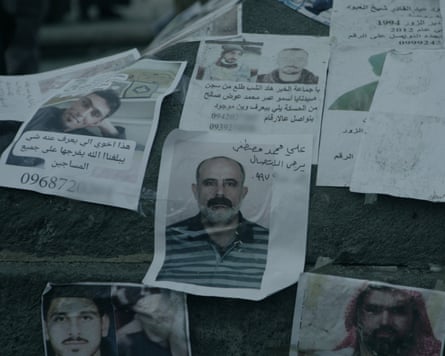
Mustafa’s case is far from unique in Syria. According to the Syrian Network for Human Rights, more than 177,000 people were forcibly disappeared between 2011 and 2025 in Syria, most of them arbitrarily detained and taken into notorious prisons by Bashar al-Assad regime forces or other armed groups, where they were tortured and often killed, during a conflict that broke much of Syria’s estimated 25 million population.
Now, a year and six months after the fall of the Assad regime, under new ruler Ahmad al-Sharaa, the mission remains the same for Mustafa: to fight for truth and justice for Syria’s forcibly disappeared, and to ensure they are not forgotten.
Mustafa has joined up with her childhood friend, documentary film-maker Waad Al-Kateab, who co-directed the Bafta-winning For Sama, to make a new documentary short, Maybe Tomorrow – in reference to the Umm Kulthum song that plays in the film and, according to Al-Kateab, “reflects the film and the experience for Wafa and other people in Syria.”
The film, which premieres this evening at the Sheffield DocFest, is an intimate look at what Mustafa calls “the violence of waiting.” It follows her first in Berlin, where she is now based, and then in Syria after the fall of Assad, in her desperate search for information on what happened to her father.
“Millions of people [in the world] are disappeared,” says Mustafa. “But I only had this father, and he’s gone. And I cannot let him go.”
The film starts in 2020, at the start of Mustafa’s years-long campaign to raise international awareness for Syria’s disappeared. Mustafa was then already speaking about these issues at United Nations meetings, and had organised a one-woman vigil outside a courtroom in Koblenz, Germany, where two former Syrian intelligence officers were on trial for state-sponsored torture.
Like the Oscar-nominated For Sama, which was co-directed with Edward Watts, Al-Kateab wanted this project to be collaborative, but this time with the main protagonist as co-director. While promoting For Sama in Tunisia, Al-Kateab had a realisation.
“I saw the power of what we can do when we own our stories,” she says. “For me, that moment was so big, and I realised Wafa has to do her own film.” She told her friend: “I want you to find your way of how you want to tell this story.”
Mustafa, who has been very active on social media since she was young and has tens of thousands of followers, said the film serves as a condensed “memoir” of her daily life in the past six years, capturing the toll that forced disappearances have on families, especially those exiled in different countries.
She hopes that through this film, audiences can get a glimpse of “what it means to have your father disappeared and not know what happened – to just be told he’s dead, but not being able to accept it. And not being able to because there is nothing to accept.”
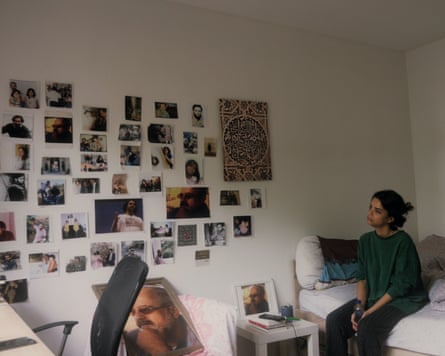
The documentary also evokes the impact that such traumatic cases have on individual and collective memories. “Sometimes we forget things, or our memory blocks things out,” Mustafa’s mum tells Wafa in the film, “I always remember your father telling you … ‘My daughters, you must write things down … document things.’” And so, Mustafa does so, often filming herself, or with another cinematographer when Al-Kateab wasn’t able to join and film her.
“Hope is a very, very dangerous thing,” Al-Kateab said, cautioning that Mustafa and the film’s journey do not promise happy endings. “This film is, at the end of the day, a tool,” she said. “For Wafa, the impact [it can have] is the goal.”
“The fight today is not just for the truth, accountability or even fighting for your loved ones to be alive, but also to prove that they existed,” says Mustafa. This is particularly important in a context in which the crimes and human rights violations committed in Syria have tried to be erased by authorities, leaving few ways to learn about what really happened.
Enforced disappearances “cannot be normalised,” Mustafa insisted, highlighting that this is “not just a Syrian story, but a global story of love but also of violence, especially on younger women.”
Amnesty International notes that “globally, the vast majority of victims of enforced disappearance are men. However, it is women who most often lead the struggle to find out what happened in the minutes, days and years since the disappearance.”
“All of these crimes did not end with Assad fleeing the country and with the downfall of the Assad regime,” says Mustafa, citing that massacres and enforced disappearances have continued under Syria’s new leader. “I don’t want other young women in Syria today to lose their fathers and live their lives in guilt, in the responsibility to save their fathers from authorities.”
Although it remains difficult for Mustafa to even talk about her father, her love seeps though in her actions. “My father was the first comrade I had,” she said.
“Even if Ali Mustafa was not my father, I would have definitely done everything I’ve done for him, because he is worth it. He deserves the world, and he deserves to be remembered.”