.png) 3 hours ago
4
3 hours ago
4
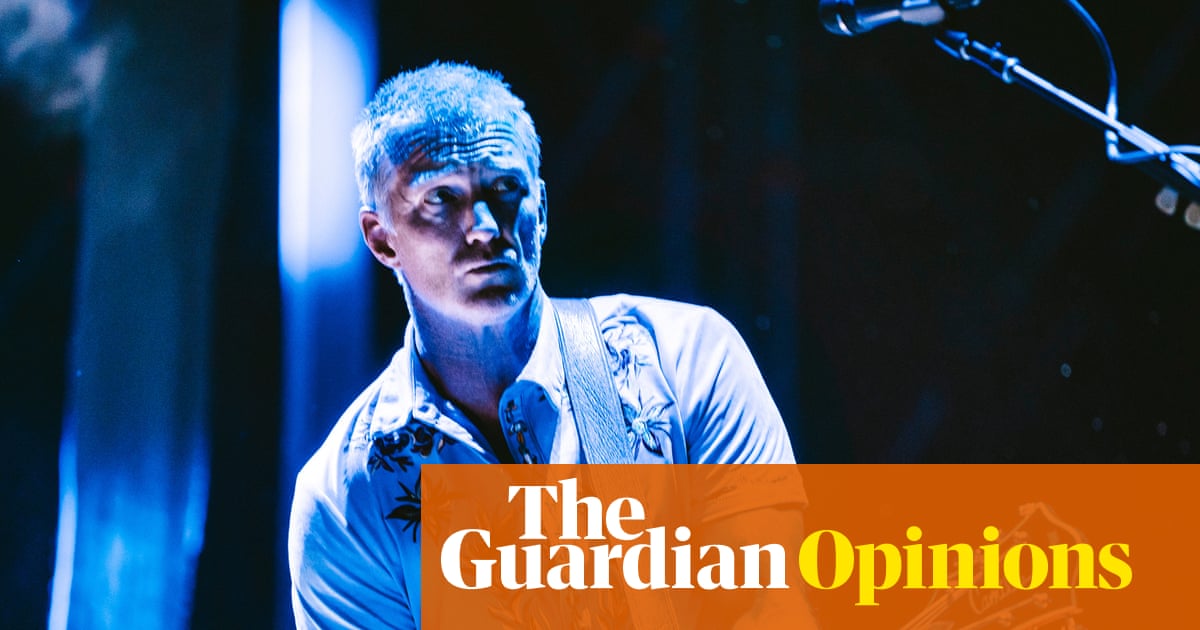
When I speak to Temi Adegbayibi on the phone, the 26-year-old photographer is on the move. He is travelling across London, then running up the stairs to his desk, fitting our conversation into the interstitial spaces of a life split between freelance photography, film production and working at the Royal Albert Hall.
His glittering portfolio includes photographs of Jorja Smith, Basement Jaxx, Fireboy DML and Ezra Collective, but like many in the creative industries, he oscillates between the glamour of the stage and the reality of making a living. “I’ve always had day jobs,” he says. “Most photographers back in the day weren’t shooting for money, they were shooting for passion.”
Adegbayibi grew up in Enfield, north London, and first picked up a camera when his cousin TJ Koleoso – Ezra Collective’s bassist – asked him to photograph their church’s worship band before the service. He shot there for a couple of years before graduating to local gigs, building a body of work by approaching small artists and asking if he could photograph them. “The more I shot, the more confident I felt,” he says. “Then more people reached out to me, based on my Instagram.”
His work with Ezra Collective has been a key part of that trajectory. In 2022, Adegbayibi went to Lewes’s Love Supreme jazz festival to watch the band play one of their first major headline shows. One photo in particular, of TJ leaning back on his bass, and another of the whole band that was subsequently used on an album sleeve, convinced him that photography could become more than a hobby: “I was like: ‘Damn, I can actually do something with this.’”
Since then, he has photographed Ezra on tour and at increasingly large shows, including their performance at the Royal Albert Hall in November 2023. That led to a solo exhibition of his work celebrating British jazz, and eventually to his becoming one of the venue’s in-house photographers. Adegbayibi’s freelance work largely focuses on music, and has taken him to gigs and festivals across the UK, including Glastonbury and Recessland, the London festival celebrating Black music and culture.
What distinguishes Adegbayibi’s photography is its sense of movement, intimacy and joy, particularly in his images of Black musicians. “I’ve always loved shooting Black people,” he says. “You’re spoiled for choice with the amount of beautiful smiles flying around.” He is interested in that split-second smile, the release in someone’s face, whether that’s on stage or in the crowd. There is a conscious resistance behind that approach: “Black people and musicians are often portrayed as aggressive, violent or angry,” he says. “I think my photography serves as an example of Black joy and the truth behind Black communities; what we are actually like.”
His interest in movement has also become a technical fascination. Inspired by visual artist Kat Anderson, he began experimenting with slow shutter speeds, light and layering to create photographs that “almost feel like you’re painting with light”. His Albert Hall exhibition explored movement and stillness within jazz – “how energetic, but also still, jazz moments can be while I’m taking pictures”.
The competitive nature of photography does not escape him. London is full of talented photographers, he says, and consistent work can be difficult to secure. But rather than seeing that as a reason to retreat, he sees the competition as motivation. “I use it as a driving force,” he says. “Having that community in London is inspiring and pushes me to do more.” He was struck by seeing his work’s wider lineage at the V&A East’s inaugural exhibition The Music Is Black, which features decades of images of Black British musicians, and the photographers who documented them. It made him think about the place his own photographs might occupy in that archive. “Maybe someday someone can look at an image and think: ‘That’s what jazz gigs were like back then.’ Or: ‘That’s what Black musicians were doing, and how they were dressed,’” he says. “That’s the hope.”
‘We just went for it’: five of Temi Adegbayibi’s best shots
Ayo Salawu (main picture)
“This was the main image in my Royal Albert Hall exhibition. I’m always trying to figure out how to capture the energy of a drum solo in a still image; I’d been researching slow shutters, layering and double exposures. We shot it in a blackout studio in Greenwich, set up the drums, ordered some pizza and just went for it.”
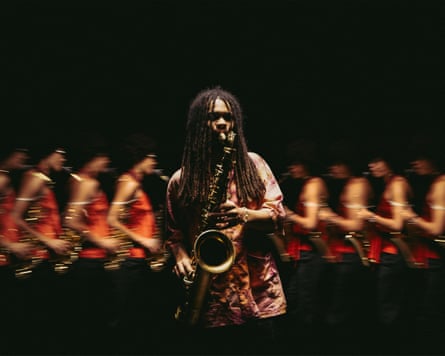
David Kayode and Anna Adetiba
“David is leading on saxophone and Anna is supporting him,” says Adegbayibi of this studio shot. “I asked Anna to keep walking back and forth behind David while he played. I used a slow shutter to blur Anna’s movement while keeping David as still and sharp as possible. I wanted the picture to show those two different kinds of movement happening at the same time.”
after newsletter promotion
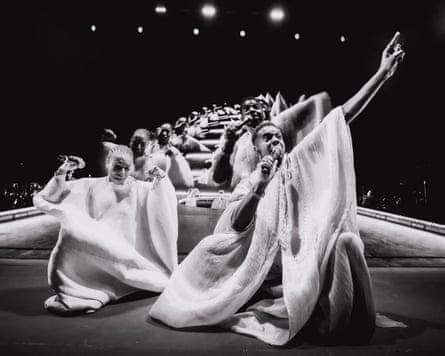
Jai Amore and Blu
“These two were basically the energy drivers throughout the show. Their job was to keep everything going. There was a screen effect behind them that delayed their movements and created copies of them. I framed it so it looked like this deliberate doubling effect. It’s one of my favourite pictures because it came from just paying attention to everything happening around me.”
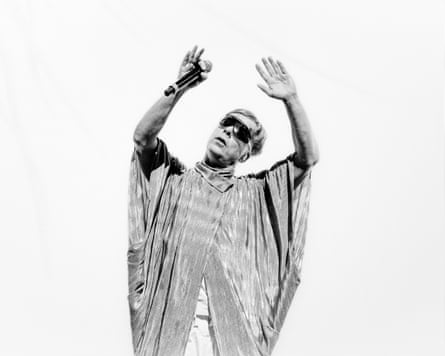
Felix Buxton
“There’s so much going on at a Basement Jaxx gig – dancers, people in monkey costumes, DJs, hype men. At one point Felix was singing by himself, and I was following him when he put his hand up in a way that made him look as if he was floating. I just captured it. The white background is actually a bunch of LED lights that I blew out so it looked like a backdrop.”
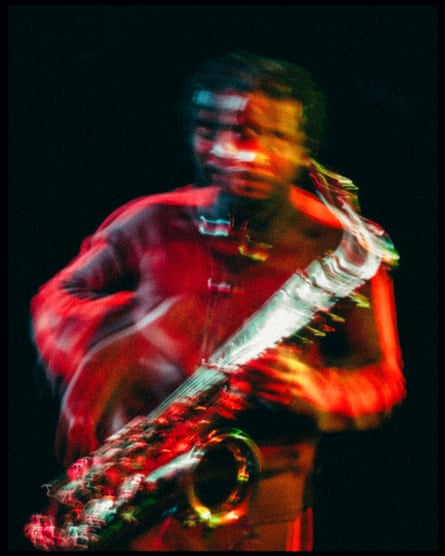
CKTRL
“I shot this about two months ago in the Elgar Room at the Royal Albert Hall. I love CKTRL as an artist, so when I was asked to shoot him it was an immediate yes. The gig was really dark, which can be difficult for a photographer, so I used a low shutter speed and moved with him to create this softer blur. With some post-processing, it ended up feeling almost like a painting.”