.png) 47 minutes ago
5
47 minutes ago
5
Disabled people are being blocked from travelling abroad by NHS care boards and local councils that refuse to let them use their care funding outside the UK, the Guardian has learned.
Campaigners warn of a “postcode lottery” in England where the right of a disabled person to travel overseas depends on where they live or the whim of local officials – even when there is no extra cost to the taxpayer.
Disabled care users report having to abandon travel plans at the last minute, or go for years without a break, when authorities refuse to pay for their care abroad, even though they have agreed to meet all the travel expenses.
The Guardian is aware of instances where individuals have had requests for care and support for overseas travel turned down by NHS officials – only to have the decision reversed when they threatened legal action.
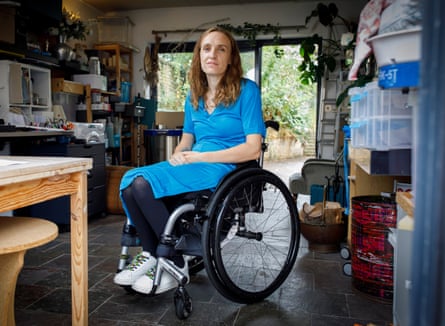
Lucy Robinson, 38, told the Guardian she had been prevented from attending international work events and going on a holiday because health officials in Oxfordshire had refused to allow her to use her care package abroad.
Robinson, who is quadriplegic and has a team of 24-hour personal assistants, is often required to travel in her role as the president of the European Spinal Cord Injury Federation. She has received NHS support for some trips.
She said the experience had caused huge stress: “Travel is one of the things that defines my life, in terms of most of the work I do, but also because I like travelling. My quality of life is based around that. I want to live, not just to exist.”
The cases have led to calls for national guidance amid concerns there are no clear or consistent NHS or council-wide rules clarifying the right of disabled people to take their carers abroad. Their care packages typically provide them with personal assistants for help with dressing, movement and night support.
Campaigners have emphasised this is not about “holidays on the NHS”. There is no extra cost for the health service or local authorities, which are already paying for the care. In almost all cases, the care recipient is expected to pay for their assistant’s expenses and arrange their insurance.
“Refusing to pay for care and support abroad does not deliver any financial savings for the taxpayer,” said Carol Barraclough, the advocacy and support manager at the Spinal Injuries Association. “We’d like to see national guidance on this that is effective and clear on the rights of all disabled people to take their carers outside the UK.”
Robinson said the Thames Valley NHS integrated care board (ICB) told her in April it had rejected her care request to attend a conference in Germany because “NHS funding responsibilities cease at the UK border”.
As a result, she was forced to abandon planned work events in Norway and Albania. She was able to go to Germany only because her 69-year-old mother stepped in as her 24/7 carer.
The care board made a rapid U-turn in June when Robinson threatened the health board with legal action, arguing it was acting unlawfully. It then agreed to fund her care overseas on condition she dropped plans for a judicial review.

Analysis by the Guardian shows a wide variety of policies across councils and the NHS. Some are explicit that overseas care is possible, while some agree in principle but attach a string of conditions. Others say overseas travel is allowed only at the discretion of their officials.
“There’s a postcode lottery in NHS care and support policy to allow recipients of funding to take their assistants with them outside the UK,” said Barraclough, who added she was aware of several cases where disabled individuals had been turned down for care abroad.
Giselle Hoad, the founder of the Adult Social Care Warriors campaign group, said: “There’s a concern that cultural prejudice about disability – that we don’t have families, partners, or jobs – means the care system sometimes assumes disabled people should be satisfied with opportunities closer to home.”
Disabled people in England can get care funding through two main sources: NHS continuing healthcare, which provides support for daily living for people with the highest needs, and social care paid for by local councils.
Anne-Marie Irwin, a solicitor at Rook Irwin Sweeney who represented Robinson, said NHS care boards had a legal duty to meet a disabled person’s assessed needs. As long as the care user remains a resident of the ICB’s area this duty does not stop if they temporarily leave the UK.
Thames Valley said it did not comment on individual cases. It added that where a patient requested temporary travel abroad an ICB “may consider if it’s appropriate to continue commissioning care to meet their assessed health needs while they are outside the country”.
It said its decisions were informed by considerations of patient safety, practical care delivery factors and risk assessment and insurance issues.
Local authorities hold a similar duty to ICBs, previous court judgments suggest.
Chelsea Pettitt, 25, and her parents, have been in dispute with Lancashire council over her entitlement to care on holiday.
Chelsea, who has cerebral palsy, quadriplegia and learning difficulties, wants to return to Spain where she had a week-long break in 2022 accompanied by two assistants. Like other twentysomethings, she loved the sun, the swimming, food and culture. “I felt like I belonged there,” she said.
But her parents, Barbara and Alison Pettitt, said they were told by a social worker that she was no longer eligible for care abroad as she now lived in supported accommodation.
Her care plan specifies two-to-one care for seven nights a year for trips outside Lancashire – but the council stipulates the care must be used by Chelsea to “maintain … important relationships” with her birth family and friends.
A lack of national guidelines means the family is unsure where this leaves Chelsea’s right to choose whether – or where – to travel. All Chelsea can do is savour her memories of Spain. “She had an absolute blast,” said Barbara, “and she’d like to do it again.”
The council said it did not object in principle to Chelsea using her care package on a holiday abroad and it was “working closely with the individual, their family and care provider to understand the issues that have been raised and support a positive resolution”.
A Department of Health and Social Care spokesperson said: “This government is committed to making sure all those who are eligible for NHS continuing healthcare receive the support they need to live independent and fulfilling lives.
“Integrated care boards are responsible for planning a package of care that meets each individual’s needs. We expect them to fulfil this duty in line with national policy and legislation.”
Additional research by George Francis Lee