.png) 2 months ago
58
2 months ago
58

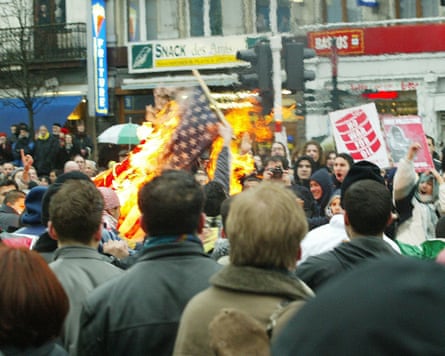
Early one Sunday morning in the summer of 2003, I drove into the center of a little South African beach town on the Indian Ocean to pick up the Cape papers. Local news agents still employed the English custom of putting front pages on A-frame stands on the sidewalk. It was during the first months of the Iraq war, and from two blocks away, I could see the headline, in big block type: “WHY BUSH IS WORSE THAN BIN LADEN.”
It was disheartening to see – especially so far from home – but it did correspond to something familiar: American favorability around the world tends to swing sharply with wars (especially ones America starts) and who the US president is. Within weeks of the American attack, the international support the US had after 9/11 was squandered.
In 2003, after the invasion of Iraq, American global favorability was at a modern low: in the 30-40% range. It had been above 50% for Jimmy Carter, Ronald Reagan, George HW Bush, and got into the 70% range for Bill Clinton. (Some wars are more popular than others: George HW Bush’s Gulf war to liberate Kuwait was globally popular.) After the decline of the Iraq war, American favorability shot upward again with the election of Barack Obama, whose favorability reached 75-80% in some countries.
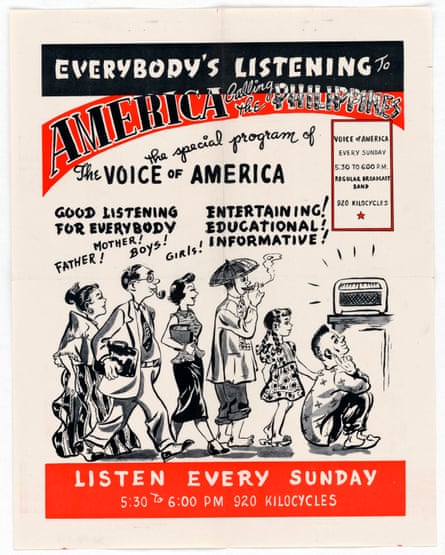
The foreign policy word for favorability is soft power: how our culture and popularity, rather than our military strength, allows us to influence other nations. The US government buttresses this with foreign aid (once abundant) and US international broadcasting, such as Voice of America. But culture always outperforms government programs, Beyoncé always beats bureaucracy. It is the power of influence, not the influence of power.
American soft power often mirrors what we do with our hard power: our influence declines when we use the latter and increases when we don’t. Absent military action, Taylor Swift is more important than Tomahawk missiles. Most of the time, culture eats policy for breakfast, except in wartime – like now.
I was the under secretary of state for public diplomacy in the Obama administration, which is the job of soft power czar. In some ways, I thought of myself as the chief marketing officer of “Brand USA”. The mission is to help shape and promote America’s image abroad. During the cold war, we used to send Louis Armstrong and Ella Fitzgerald to eastern Europe as cultural ambassadors, to show foreign publics that we were broad-minded and freedom-loving. During that same time period, we created Voice of America and Radio Free Europe to broadcast news in places where it was repressed or distorted.
Of course, these efforts were not all innocent. Many were financed by the CIA. Sending Black American entertainers to eastern Europe was a way of counteracting Soviet claims about racial segregation and voter suppression in the American south, which of course were largely true. American influence campaigns in Guatemala, Iran and Italy, among others, were also part of the darker side of soft power.
But I believe because of Donald Trump and his war in Iran, American popularity will descend to depths it has not seen this century and may never recover to the median levels that we saw with Jimmy Carter and Ronald Reagan. Forget Barack Obama numbers – they’re out of reach. Confidence in Trump’s ability to navigate global affairs was already around 30-40% before the invasion of Iran. That will be the new ceiling. “The world is watching,” Trump said in his White House address on Wednesday. Yes, it is.
Our allies – and our adversaries – have long been confounded by the eternal see-saw of American presidential politics, where conservatives are replaced by liberals who are replaced by conservatives, and on and on. Biden’s confident assertion after his election that “America was back,” and that we were once again a reliable ally, was met by our friends with the question: “For how long?” It was a fair question. The assumption of the Biden administration was that Trump was the authoritarian anomaly, bookended by two liberal internationalists. It turns out that Biden may be the aberration.
Since Woodrow Wilson, American presidents have been in the democracy promotion business. That era may now be over.
With the war on Iran, US action in Venezuela, and increasingly bellicose talk about Cuba, the Trump administration is reviving the old trope of the Ugly American, but this time without the once obligatory paeans to democracy. That old image of America as a narcissistic and culturally insensitive bully is back with a vengeance. “A Reckless Imperial Error,” read a headline about the Iran war in Le Monde. From Die Zeit: “How Trump is turning the U.S. into a source of chaos.” Le Monde: “Trump’s outbursts no longer reassure financial markets.”
But the Ugly American archetype was also an image of someone naive and even, occasionally, well-meaning. Those clumsy crew-cutted Americans just didn’t understand the world, the thinking went. But Trump has turned the Ugly American into the Immoral American, a prototype of a predatory sociopath who is entirely transactional and probably does know better. The Immoral American is more unscrupulous and corrupt than the Ugly American and, unlike the latter, cannot be evolved but only replaced.
Projecting Trump’s venal persona on the American character will do years of damage to America’s image.
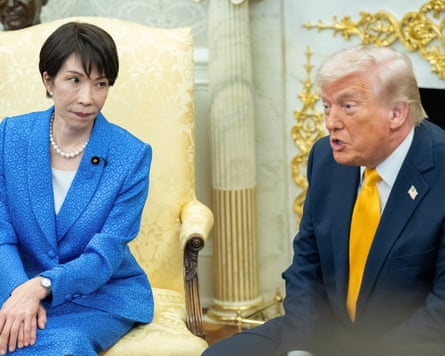
In Germany, the UK, Spain and France, support for the war is in the 20s. One in five Europeans sees the US – not Iran – as the principal threat to world peace. Put yourself in the position of an ally. When the US president has the prime minister of Japan in the Oval Office and, after an incredibly gauche reference to Pearl Harbor, asks her for help in the strait of Hormuz, what will she do? Support for the Iran war in Japan is 10%. Trump never seems to remember that foreign leaders have their own domestic constituencies.
“America first” has largely meant America alone. Over and over, we’ve seen unilateral actions by the US without consultation with allies. And then complaints by the administration when the allies are not supportive. Trump’s assertion that we don’t need allies may be rhetorical red meat for his base but it’s objectively wrong, as we’ve seen with the strait of Hormuz. Even with the war in Iraq, the Bush administration painstakingly enlisted allies and made its case to the UN.
The 1950s-era macho language of Trump (“the big one is coming soon”) and his defense secretary, Pete Hegseth (“we’ll negotiate with bombs”), is reinforcing the image of an America obsessed with violence and careless about the use of it. The defense department’s release of Top Gun-style videos interspersed with clips from Braveheart and Breaking Bad and video games such as Call of Duty and Grand Theft Auto seems both juvenile and like spiking the football. The success of these video games is a big part of America’s global soft power. But the gamification of war is not.
I’m afraid there is no soft power action, no movie, no song, no video game, that can make up for an errant Tomahawk missile that kills dozens of children at a girls’ school.
Sure, there are a handful of nations where we can do no wrong. In Israel, Poland, Nigeria and the Philippines, American popularity is always in the 80s. A swaggering musclebound tough-talking hegemon will only be more popular in those precincts. But the moral fallout of the war on Iran will echo for decades. In so many regions of the world, this war is seen as the equivalent of Vladimir Putin’s invasion of Ukraine. The decades we’ve spent trying to ethically distance ourselves from Putin are now over.
Trump’s hardline authoritarianism is devastating to American soft power. He is a one-man wrecking crew for values that presidents of each party tried to promote. America the generous? He eviscerated USAID, America’s foreign aid agency. America the democratic beacon? He pardoned the January 6 rioters and sent ICE to Minnesota. America the welcomer of immigrants? He has cut off visas from “shithole” countries and kicked out immigrants who lack documentation. America the beacon of free speech? He arrested grad students who speak out against the government. Try telling someone overseas that we are a shining city on a hill.
At the same time, there are many countries who welcome an America that doesn’t preach democracy and transparency – an America that is transactional and not judgmental. India and Turkey and China and Russia and the countries of the Middle East have always chafed under American diplomats talking to them about human rights. I saw it over and over myself. They understand a system where the son-in-law also rises and a politician’s family and friends get rich. Now, so many nations, when negotiating with the Trump administration, have learned to add lucrative side deals that promote business interests that indirectly or directly benefit Trump and his family. Now, that’s an America they know how to deal with.
The world will happily continue to buy iPhones without lectures on democracy. But so much is being lost. This administration has actively and deliberately dismantled American connections with international organizations such as the World Health Organization, Unesco, the Paris climate agreement, and the UN human rights council. It has imposed untold tariffs – a tax on other nations that pushes them away. It criticizes our closest allies for small free-speech violations, but says nothing about the 1.5bn people in China with no free-speech rights at all, or about countries like Russia and Turkey that routinely imprison journalists.
It has also eviscerated US global media, essentially killing Voice of America, Radio Europe, and even the VOA Persian service, which would certainly come in handy now. At its height, US global media reached more than 300 million people around the world, a heck of a lot more than Fox’s 2.5 million primetime viewers. These were among the few soft power levers we once were able to pull.
The Trump administration’s visa policies have wounded one of America’s other greatest exports, our university system, which is almost universally admired around the world. New international enrolment has fallen by as much as 20% and foreign students contribute more than $40bn to the domestic economy and support more than 350,000 jobs. International tourism to the US is down by about 7% which is a loss of about $10bn to the economy. Foreign Stem scientists and grad students working and studying in America are now being recruited by China and our European allies.
As America’s soft power diplomat, I saw the limits of what the government can do to promote favorability. The truth is, American public diplomacy has always had a mixed record. If you already dislike the US, no communication from the US government is going to change that. When we talk about freedom and the rule of law abroad, but do not demonstrate them at home, we are rightfully seen as hypocrites. (Not to mention the many times in history that we sought to actively influence elections around the world.) We need to demonstrate the values at home that we talk about abroad.
But today’s unprecedented disengagement with diplomacy and our allies diminishes Brand USA. To call it a suicide pact is too strong, but it is a deliberate, conscious unraveling of the things that truly made America great.
What Trump is doing to America is a deliberate, slow-motion version of how Great Britain, one of the world’s great powers in the 20th century, became little England after the second world war. Within 15 years, an imperial hegemon became a medium-sized, more inward-focused European country concerned more with domestic economic recovery than foreign influence.
That is essentially what Trump is doing to America. Post-Trump, America will be a more domestic, inwardly focused nation, a country with fewer international connections and allies, but with an outsized, muscle-bound military, and always willing to do anything to make a buck. That is the fortress America of the 19th century, protected by two oceans and happily self-absorbed and insular.
No, we were never quite the shining city on the hill we thought we were. But, post-Trump, the United States will become little America. Smaller, meaner, less shiny.
-
Richard Stengel is a former under secretary of state for public diplomacy in the Obama administration and was previously the editor of Time. He is the author of Information Wars: How We Lost the Global Battle Against Disinformation & What We Can Do About It