.png) 7 hours ago
10
7 hours ago
10
Iceland has rejected the government’s proposal to hold accession talks with the EU after a closely fought campaign that has divided the country.
After a long and anxious night for those on both sides of the debate, the no camp ended up with 52.8% of votes and the yes camp 47.2%. Voter turnout was high at 82.5%.
After the final results were released on Sunday morning, the Icelandic government said it would be holding a press conference to “review the results of the referendum” at 1pm local time.
The result deals a blow to Brussels, which had been keen to welcome a wealthy new member and appeared willing to compromise with Iceland on thorny issues to facilitate its accession. It quickly attracted the attention of anti-EU European leaders.
The government in Reykjavík had framed its membership plan as a “now or never” moment, and the prime minister, Kristrún Frostadóttir, told voters in August that a no would put all EU speculation aside.
On Sunday, she told the public broadcaster RUV she hoped the vote would not leave the nation divided.
Kristrún, who spoke at public meetings around the country in the final weeks in support of yes, said: “I don’t experience this as hurt. I know some people have been in a state of shock, but now I’ve sat with a large group of people across the country and people are completely open to different outcomes.”
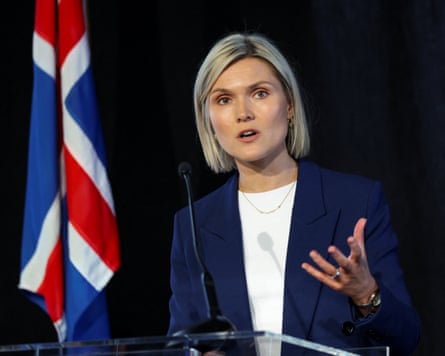
She acknowledged that many people in Iceland – particularly from rural areas – had concerns about the impact on agriculture, fisheries and natural resources of joining the EU.
“I promise that we will handle these issues well and keep these concerns in mind,” she said.
Yes campaigners said joining the bloc could ease high interest rates and offer more security in a world unsettled by war in Ukraine and the US president, Donald Trump’s rhetoric about annexing another Arctic island, Greenland.
But campaigners for no said EU membership would threaten the country’s sovereignty and fishing waters. Their victory was hailed on Sunday by the far-right French leader Marine Le Pen.
“At a time when some are pushing for greater federalism and the transfer of sovereignty to the European Commission, this vote reminds us that another Europe is possible, a Europe of free, sovereign nations cooperating voluntarily on matters of common interest,” Le Pen wrote on X.
Nigel Farage, the leader of Reform UK, wrote on the same platform: “Congratulations to Iceland on voting to keep their independence.”
Iceland first applied to join the EU in 2009 when a financial crisis hit the country’s small, exposed economy. A Eurosceptic government ended talks in 2013.
The current government pledged to hold a referendum when it came into office, but it ended up being held much earlier than expected.
Geopolitical turmoil over Greenland, war in the Middle East and US import tariffs brought urgency to an issue Icelanders had debated on and off for decades.
Hulda Þórisdóttir, a politics professor at the University of Iceland, said she was not surprised by the results given the tone of the latter stages of the campaign, with misinformation spreading and the considerably bigger financial resources of the no campaign.
“No won due to a combination of factors: a strong feeling that the EEA [European Economic Area] is all we need, a sense of Icelandic exceptionalism, economic self-interest and a lot of misinformation among the least engaged, for example ‘I don’t want my son to have to join the EU army’,” said Hulda. “But very importantly, it seems clear to me that the no campaign was much, much better funded.”
-
Reuters and Agence France-Presse contributed to this story.