.png) 1 month ago
53
1 month ago
53

Sid Lowe, the Guardian’s Spanish football correspondent. Composite: Guardian Design
Show key events only Please turn on JavaScript to use this feature
Key events Show key events only Please turn on JavaScript to use this feature

Sid Lowe
Thanks everyone, it’s been a pleasure. Sorry I couldn’t get to every question. I did try. But I overwrote … me?! Never!
How will Spain get on at the 2026 World Cup?
RobboRobbo asks: How do you rate Spain’s chances at the World Cup this summer? Where do you think other teams might be able to get at them?
Sid:
They’re gonna win it.
Which Spanish coach should Premier League teams be looking at?
Alsop03 asks: Iraola has been superb at Bournemouth. Who is the next Spanish coach the Premier League teams should be chasing?
Sid:
His assistant, Iñigo Pérez!
How is Spanish football dealing with racism?
paulhs asks: For some time there has been a lot of talk about dealing with racism in Spanish football but little seems to have changed. In your extensive experience of watching football (and speaking out about the problems of racism/xenophobia) are things actually changing or will we have to wait until a layer of ‘leadership at the top’ is replaced (or something else)?
Sid:
Lots to get into here. One thing I would say at the outset is that my experience, which has not always been very pleasant, suggests that actually things have changed, and maybe quite a lot. Which they should have and needed to and which is not an obstacle for saying things still need to.
I think there has been a shift in attitudes, at least on the surface (that’s my fear, that it is only superficial), that new generations do see it differently, that waves of immigration change lived experiences (sadly of course, that also makes for nastier manifestations of racism too, and a growth in an even more pernicious, less casual type of racism, a political option built on that, on anti-immigration, etc), that media and authorities react differently now: very differently. There is a willingness to denounce that I think wasn’t there. But it is also true that there is a defensiveness too, or a dismissal of racist episodes as not significant. It’s often said that more needs to be done, that it needs to be taken seriously, and the risk is that it becomes just a thing to say. It’s worth a discussion of what that is, how it is done, and so on. An example here of how that doesn’t necessarily always shift things, that the idea that there is a ‘solution’ is flawed, is the anti-racism protocol: put together to challenge it, to provide a mechanism with which to do so, but, perhaps inevitably, feels like it falls short and needs re-writing.
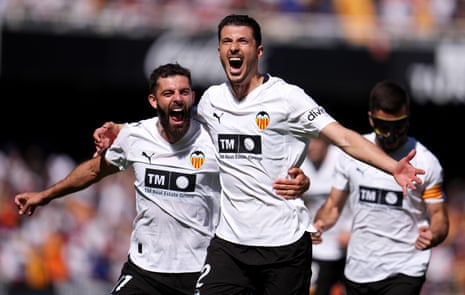
Will Valencia go down this year?
jhopgood asks: I used to live along the road from Mestalla. What has happened to Valencia, will they be relegated this year and will the stadium ever be finished?
Sid:
It’s tragic really, weaker all the time … I don’t think they will be relegated, no, and the stadium project is actually up and running again, in theory. Here’s a bit on it:
Do you have a favourite book?
jm1998 asks: Hi Sid, I love your style of writing. Do you have a favourite book/author who has influenced you?
Sid:
Thank you. (I hate it, but can’t help it … well, not that I hate it but that I think I probably make life hard for myself and find myself dragged into it, trying to find a way through all the images in my mind, the things I want to say, the information I have, the points I want to make, the story i want to tell and how, the structure that holds it together, etc … sometimes I wish I had the gift of just, well, writing it. Bish, bosh, done).
I don’t think I have any author that influenced me consciously, no. And my background is in history so I was a reader of that rather than novels and so on, while I also find that I travel with a book (and good but unfulfilled intentions) far more often than I actually read one these days, so I wouldn’t say I have a favourite writer really. At least not in the sense of saying I’ll read all his/her books. That said, there must be some recurring authors. I reckon GB84 by David Peace might be the book I liked most.
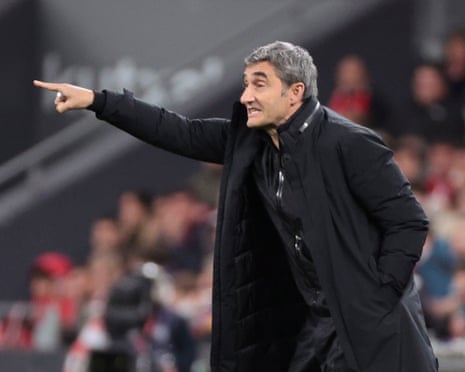
How do you rate Ernesto Valverde?
PradyumnaJ asks: What are your thoughts on Ernesto Valverde? IMHO fantastic manager – won two La Ligas with Barça (albeit that night against Liverpool must sting), won the Copa with Athletic, along with the various titles with Olympiacos. Should Bournemouth or Palace be looking at him?
Finally, here’s a nostalgia one for you. Who are you picking in your midfield from the following:
1) Prime Valeron
2) Prime Aimar
3) Prime Redondo
If you can fit all three of them into your team?
Sid:
I think he is great, yes, and would love to see him in Premier League. But he’s also a coach that won’t hurry and won’t be drawn to something that doesn’t capture his curiosity … and that will be more about the experience than just ‘I want to work’. Frankly, he doesn’t want to do just any old thing.
I’m picking all three. Pff, what a question. Valeron, I think.
Sherbert asks: When did Tom Waits get into football management, and do you think his Atlético side is as good as his seminal 1983 album, Swordfishtrombones?
Sid:
How could it be? Come on now. A lookalike thread surely incoming.
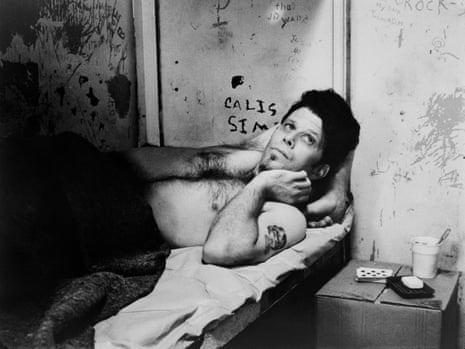
I always thought Joaquín Caparrós was Michael Keaton. On this by the way, a few years ago Filippo Ricci and I had a section on Spanish radio station Cadena SER about football and music. So much fun. John Charles singing Sixteen Tonnes is glorious:
And I urge you to watch this Brolin-inspired cover of Dolly Parton’s Jolene:
Do Spanish fans have similar frustrations to those in the UK?
RPDolan asks: Do Spanish football fans share the same frustrations about the modern game as many fans in the UK do? Whether that be ticket pricing, more irregular kick-off times, quality of football, etc?
Sid:
The big one is the kick-off times and dates. It’s miles worse … and yet miles less is said. And it drives me mad, to be honest. I moan about it and people always say: ‘You’d think you were new here.’
How much longer can Simeone last at Atlético?
Shed7 asks: Just how much longer can Simeone go on? Are we looking at a Ferguson/Roux thing here?
Sid:
Been wondering this for a long time … Don’t know about you, but if I was Simeone and I won the Champions League this year, I would go the very next day.
What is your favourite remontada?
DoNotTouchWilly asks: What is the best remontada you have ever seen and why did you choose Super Depor against Milan? And what are your thoughts on Deportivo?
Sid:
Hahaha! That was absolutely amazing, yeah. That Depor team were amazing … and I’m looking forward to them coming back to primera.
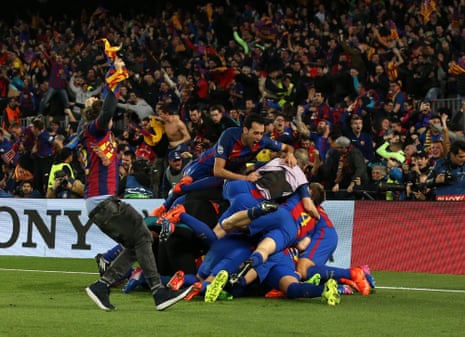
I guess the maddest ones are RM’s recent absurd run in the Champions League and that Barcelona 6-1 against PSG. But my favourite, that comes to mind, is Toledo 3-4 Fuenlabrada in 2017. Third tier. Fuenla had a certain Luis Milla playing for them.
What is the Spanish link with Harborough Town?
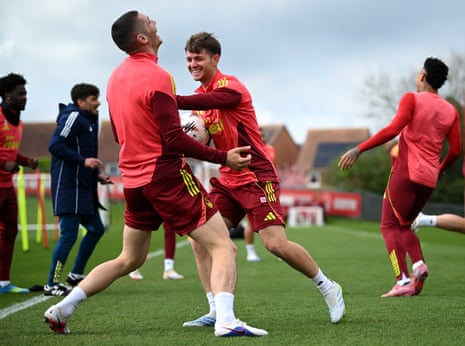
generally_fed_up asks: Are you aware of the Spanish connection at Harborough Town, who have just won promotion to the National League North? That story could make for a fun article alongside reports of La Liga and the European competitions.
Sid:
Yep. My nephew played for them, and even with him not there now, having gone to university, I get sent clips and stuff from time to time. I actually thought someone had written it … Worth a look, for sure.
Which type of manager do Madrid need next season?
Madrlieno asks: Real Madrid have had a range of managers with different capabilities. Recently, they have ranged from dressing room managers like Ancelotti to tacticians like Alonso. What do you think is the ideal style for Madrid and who will be there next season?
Sid:
History suggests dressing-room managers and, if you listen to Steve McManaman (last night on TNT? I saw the clip somewhere), that’s the natural way … I am a bit reluctant to make it either/or. And it (rightly) annoyed both Ancelotti and Zidane that people thought they were ‘just’ man managers, as if that isn’t difficult and/or important anywhere. But this does talk to what we were discussing before: the idea of culture. There’s also a contradiction in there with the president, who is the ultimate decision-maker. He is drawn to the idea of a coach who takes the players on, imposes, has authority all that stuff … but when it comes to it, doesn’t reinforce their ability to do that, and players have the greater weight. Partly because he is convinced that is how it should be: there’s only one Vinícius but loads of managers. At heart there’s an idea that lingers that none of the managers matter really. They’re kind of there to be sacked. (Or, preferably, to win.)
What can be done to break Barça's Liga F monopoly?
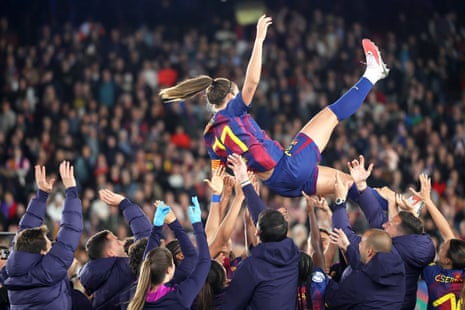
inwatermelonsugar asks: My question is about women’s football in Spain. Can anything be done to break the Barça monopoly in La Liga F? Are other clubs making investments or inroads to try to compete, or is it by necessity a race to see who can become the next best? Can you see a time when the best players at Barça might end up in other leagues due to lack of competition, not to mention the parent club’s financial precariousness? (Perhaps winning never gets boring!)
Sid:
Investment and genuine commitment is the simple but also over-simplistic answer, I would suggest. Barcelona have such a head start, such a solid project, an academy structure, a financial structure, an ever-more consolidated place within its societal and sporting environment, that it can look like an impossible task. A race to be the next best would, I suppose, at least be a step towards being the best, to competing (from there). And yes, I can see a time where Barcelona too are impacted by it (already are); their own players are alerting to this, saying they want the league and other clubs to step up, and the financial difficulties of the club will make holding players harder of course
Is money killing football?
CalumGilhooly asks: Do you agree that money is killing football? Teams like Forest, Celtic, Ajax, Steaua will never be able to develop a team to compete now. Should we go back to the European Cup format where only the champions of each country (automatically) qualify, and it’s a straight-up cup competition again, with no seedings, no draws to ensure the big boys avoid each other?
Sid:
This is such a broad question that I don’t really know where to start. I suppose we would have to say: how are we defining ‘killing football?’ Which teams? Which elements of the game? And is it money alone that’s doing that? Is a one-team European Cup the solution? And having watched the Champions League, if that came along now wouldn’t we think ‘this is a bit rubbish’? Is having this big Champions League actually a bad thing? Or a good thing with bad elements, bad consequences, etc? At heart though, of course, there are too many aspects of the game that are driven by revenue above all else. And that idea of not being able to compete is true, yes. That said, is it true of Forest, for example? A Premier League team, if they got into the Champions League, for example, they would start with a budget bigger than most teams.
Is Spanish dominance in Europe coming to an end?
Slimmorrell asks: It feels as though the Spanish pre-eminence of European football is coming to an end, at least at the club level. We all thought that the physicality of Premier League teams would be what dominates, but the tiredness of the teams seems to be holding them back on that count. Bayern and PSG are stepping up. How is all of this viewed in Spain? Is it something that is talked about? If so what are the reasons behind it?
Sid:
This is another question that is deep, complex, and for which I don’t have a simple answer.
Structurally, financially, the English teams are the strongest around, across the board. But super clubs (PSG, Bayern, RM, FCB) can match them, and their players are every bit as good or better. And then there are other elements in play. The physicality one is difficult to measure (or perhaps it’s not: perhaps it’s absolutely tangible, but I don’t have the figures.) I saw that Arteta had said it is because the English schedule is so demanding and there may be something in that. But I would also think it is a partial answer, as well as being one that risks suggesting there aren’t demands in other leagues, which I don’t think is true. In any knockout competition there are of course circumstantial reasons: the draw, luck, etc …
If we’re asking why English teams didn’t reach the semis, for example, I suppose there are also things like: well, Liverpool aren’t very good (and played PSG); Newcastle, much the same with Barcelona; City messed up badly and were against RM.
Spanish pre-eminence ending in Europe: how are we defining Europe? They have teams left in all the European competitions. The financial disadvantages are real though, of course. So much so that the view from here is kind of that you can’t compete with English clubs … and yet it then turns out, when the actual competition comes round, that mostly you can. But yes it’s absolutely the case that in Europe the Premier League is looked upon as a problem, dominant, a kind of de facto super league. One of the things that is often said here is that Spanish clubs can’t spend as much as that Spanish FFP rules should be abandoned … which seems to me to be exactly the kind of thinking that means FFP rules shouldn’t be. But maybe there is a discussion to be had on relaxation of those …
We briefly interrupt this Q&A to plug a Sid piece: his interview with Luis García:
Should Uefa interfere in domestic league fixtures?
ianu05 asks: PSG got time off from their league activities before and during their Champions League matches against Liverpool, doubtless giving them an advantage (and one that the Premier League, La Liga, etc would never sanction). Should Uefa stop this practice and mandate they fulfil their fixtures and put their reserves out if necessary (a la Atlético Madrid)? PSG’s opponents in their league were against the postponement of these fixtures.
Sid:
There’s been a bit of discussion of this here … Real Madrid have had three Friday games to give them more time (the third is for the semi-final … which they don’t now need, of course), but that’s not the same as cancellation. I do feel like there should be some sort of universal rule yes, and yet, at the same time, the concept of Uefa interfering with domestic fixtures is hard to accept. Also, here’s the thing: Spanish fixtures have more basic issues to deal with, in my view, than the fit with European games. And the opposition to PSG getting the change from the league highlights what I think is a key emotional/conceptual problem with it: another advantage for a team that already has all of them.
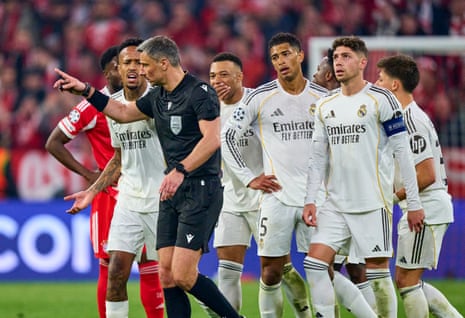
What has been the reaction to Camavinga's crucial red card?
LouisLou asks: How’s the Camavinga sending off going down in Spain this morning, and how is it going down with you?
Sid:
Oh, badly. Very, very badly. More badly than it should, in my opinion, although I can understand it.
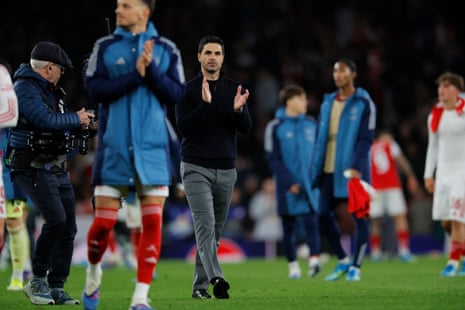
Will Arteta head for La Liga after Arsenal?
DingALing asks: Hello Sid, do you think Mikel Arteta will manage in Spain after he leaves Arsenal?
Sid:
It would seem the logical step, wouldn’t it? And yet … while his name has very occasionally been linked to Barcelona I don’t quite see it, still less with the current discussion/criticism on style. I suspect that he wouldn’t want a step down now, so that rules out everyone else in Spain except Real Madrid (or maybe Atlético?) One consequence of what I guess we can call a ‘Super Club’ era is that it sometimes feels like, for the biggest managers (and players too I suppose), the options are actually quite limited. The Spanish national team one day? PSG? Manchester City … can you do that now, after Arsenal?
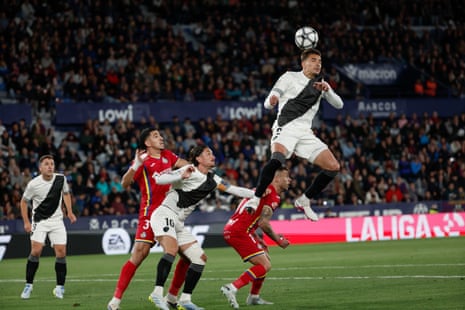
Why have Spanish clubs slumped domestically despite strong showings in Europe?
trollercoaster asks: Why have so many Spanish clubs competing in the Champions League or European Cup been relegated? It happened with Real Betis and with Villarreal. We have seen leading Spanish clubs fall to the second division and even to lower leagues, see Deportivo.
Sid:
There are lots of elements at play here, and they are not all the same going back over time, as the structure of Spanish football has changed (collective TV deal, etc), while some clubs had their own specific issues (Depor’s success, built on money they didn’t really have, was what brought their fall, for example). The short-term reason for some teams – look at Athletic this season, for example – is that they don’t always have the resources for both competitions. There’s definitely a financial component to it. Villarreal’s relegation in 2012 was baffling but internally they had overspent – which is unlike them, a stable and financially strong club – although they did learn from that.
Look at the second division now and it is full of massive clubs (historically). Zaragoza are the really clear example … Sporting, Málaga, Depor, similar with Oviedo until last summer. Often laden with debt, often unready for the sudden fall off of income, etc …
Does the 'curse of Sid Lowe' still exist?
GUnit asks: Some years ago, us regular readers of your column had this running joke about the curse of Sid Lowe; ie whenever you’d write an article praising a team, they’d go and lose the next match. Would you say it’s broken now?
Sid:
I don’t know … I’m not sure that I feel that the people I bigged up (early) have started suffering better fates … have they? It might not have been that bad before. Or maybe it was, ha.
There’s a related issue here, actually, which is part of the daily battle … most pieces are on-demand, so to speak, (the desk asks about an issue or I suggest an issue or whatever), but on Mondays, the regular column linked to the weekend games, I more or less write what I want (over a 38-week season there might be three or four weeks when the desk suggests/wants a certain topic and I’m not totally mad: if it’s clásico weekend then very likely that will be the focus). Which is why you get Leganés or Levante.
Anyway, to the point: that means I am often “gambling” on a subject: which game to go to, where I think a story might be, who the overachievers are, whether I can afford to wait a few weeks to do them and so on … and so when I have written on say, aren’t Getafe amazing, and the week after they lose, well, usually I am happy about that and think thankfully I got it out when it was true, rather than missing the chance to write a good story by waiting and then next week it’s no longer true. Usually that outweighs the feeling of “ah bollocks, now I’ve cursed it and/or look stupid”. Not least, of course, because I won’t have written it in the first place if I didn’t really think so. Some weeks you have loads of topics to choose from; some weeks, in truth, you wake on Monday morning empty-handed and panicking.
Where is Viktor Onopko?
CarlosZ asks: Hi Sid, what became of Viktor Onopko?
Sid:
The one and only Viktor Onopko! What a player. He’s assistant coach of the Russian national team, I think.
I went to do a piece with the Spanish unemployed players team a few years ago and they played CSKA and he was there as assistant to Slutsky, if memory serves. I missed him post game, didn’t get the chance to speak to him and have regretted it ever since.
Who will be Real Madrid's next manager?
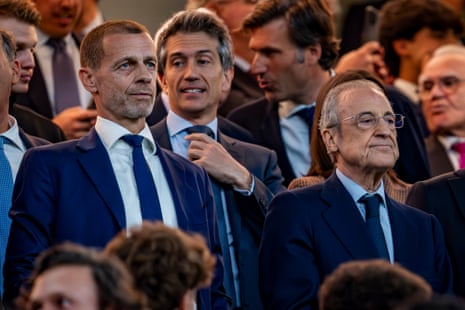
KratosBeThyName asks: What’s next for Real Madrid? Arbeloa’s not gonna be there next season. Have you heard anything about who Pérez is targeting? (Not Klopp, I hope)
Sid:
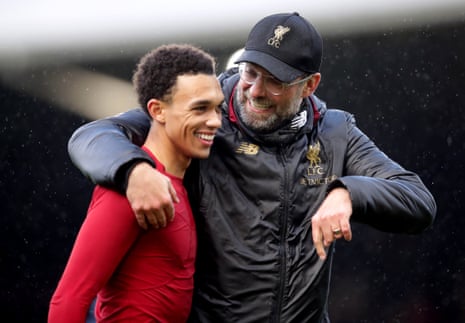
He would love it to be Jürgen Klopp … which doesn’t mean it will be. I’m intrigued by this situation. We could be in for a long few months. And endless names.
I also think it needs more than just the change of name, it’s also about culture and power at the club. And the perception of a need to change that was already there, which is why the sacking of Xabi Alonso doesn’t only feel like a pity but also a missed opportunity. There is, I think, an irritation at his sacking that is not just about him as a coach but what he symbolised, what he was supposed to bring, and the fact that it was undermined by his authority effectively being removed. As for a name, someone like Mauricio Pochettino wouldn’t surprise me.
What are this season's feelgood stories in Spain?
stooze asks: If you could choose one (or maybe two, three?) genuine feelgood stories from Spanish football this season – ones that virtually everyone in Spain would agree on – what would they be?
Sid:
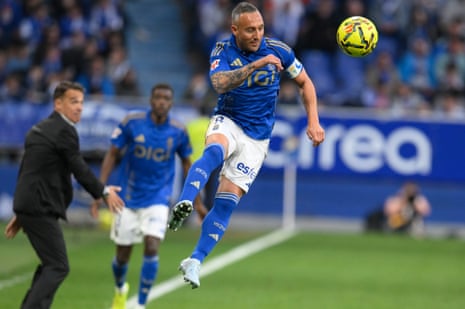
Santi Cazorla, of course. (But maybe that is more last season than this, what with things not going quite so well now … ). Watching him get an ovation at every ground is lovely.
Vedat Muriqi: my word, he’s amazing. And everyone loves him. Top character too. I’m very, very close to considering him player of the year.
I would love to say Lamine Yamal as this incredible kid who might well be the best in the world and lead Spain to the World Cup, but of course that has not been as clear as it felt at the Euros (and even then there were some who resisted), when he felt more like he was everyone’s …
Is the Spanish press harsh on Atlético’s playing style?
Goatse asks: Has there ever been such loud, blanket, across-the-board outrage at Atlético’s playing style from both the Spanish media and from Spanish fans as there has been around Arsenal from the English media and other clubs’ fans for the past few months?
Sid:
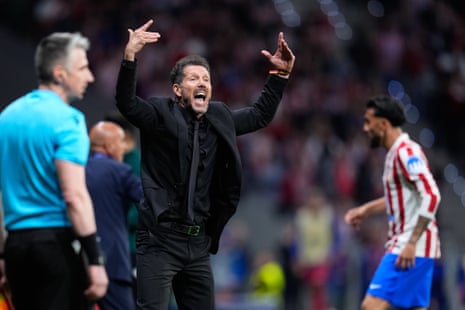
Difficult to answer this because to be honest I’m not entirely sure about the UK media/societal/fan response to Arsenal. But, not being RM or FCB, having a defensive identity (previously, but it lingers here too), having a coach like Simeone, I would say that Atlético fans will feel that they have felt the finger of accusation pointing at them often as well … I’m not sure I would call it outrage, or across the board, but the accusation of anti-football, boring, etc … all that is there I guess.
It’s not all cliche of course, and cliches and stereotypes are often rooted in some truth. I remember an opposition coach coming past me after a game at Atlético once, years ago in fairness, and saying “Christ, they’re a horrible team, aren’t they?”
How will Atlético fare against Arsenal in the Champions League semis?
cordelspo asks: Do you think Atlético will trouble Arsenal? They were hammered 4-0 in the group stages; has anything changed since then to make you think there will be a different outcome?
And, on a similar theme, benjvj asks: Good morning Sid, greetings from Valencia. What are Arsenal’s chances in Madrid? Will the atmosphere be as wild as against Barcelona?
Sid:
Atlético have changed a lot since then … or sort of. Their title challenge, insofar as there was ever one, was over by Christmas really and there have been evolutions, shifts, changes in form. I think there’s a momentum and a clarity about them now that wasn’t there before. An obvious, if simplistic example: Antoine Griezmann and Koke were supposed to be getting phased out but are among the best and will play now. Griezmann is sensational. Marcos Llorente has been full-back and midfielder, and is a freak of nature.
It feels like every year there’s this almost existential debate about what Atlético are and at some point along the way they sort of find themselves. What they are not, by the way, is what so many people seem to think they are. “We attack better than we defend,” Diego Simeone says and he is right. In terms of the last Arsenal game and this one, I guess there’s the change in Arsenal themselves and also the very basic thing which is that it is a different context now than in the league phase.
Not having seen enough of Arsenal I am unsure, but I would probably lean towards them as favourites, and I’m intrigued to see the approach. Atlético and Barcelona have played six times this season and all of the games have been different. The atmosphere should be great, although maybe not quite at the level of the Barcelona game.
How has Spanish football evolved during your career?
proevpete asks: Hi Sid. How has La Liga and Spanish football more broadly changed since you started your reporting career? And how has the actual reporting of it changed in that time as well?
Sid:
There are loads of elements to this, not least as it’s a long time, and there have definitely been big shifts economically and so on, and obviously a lot of it is societal, which is being played out everywhere not just here.
I think some parts remain the same, the quality of the football, the taste for technique (in very broad terms, as there are a million caveats), lots of players coming through … you can see shifts in the national team of course: they were like England, the “big” team that never won and that has changed. Obviously, I think the big difference between Spain and elsewhere (well, England in this case), is the dominance of two teams … and yet that does not entirely eclipse the other clubs, some of which are very big, and I’m always very conscious of giving space and proper attention to the “other 18”. They often feel abandoned by Spanish media/society, I think. In terms of reporting, that’s central to it.
There’s immediacy now of course; I’m not pre-internet, but it has changed completely, the platforms and tools, etc. The content shift, which has been played out everywhere I think, but is much more accentuated here than anywhere else, is the increase of the shouty-confrontational stuff, which I find utterly tedious to be honest.
How did you get into all things Spain?
tpth asks: Sid! I’m a massive fan of both your writing and the country about which you write. I’m wondering how you learned to speak Spanish/how you came to develop such an affinity for Spanish culture – I feel like I read you did an exchange year at some point?
Sid:
Thank you. And hello everyone. Tea made, so I’m ready. (Which, erm, maybe undermines this first question/answer a bit).
I suppose the simple answer is: people. And, in truth, while I do think Spain is special and there are lots of very good reasons to believe it’s different, who knows, it might have worked out the same way if somehow I had ended up in Italy or France or Germany or wherever. The practical answer, which takes in the language and, from there, I guess the affinity, is that I did Spanish at school (as well as French).
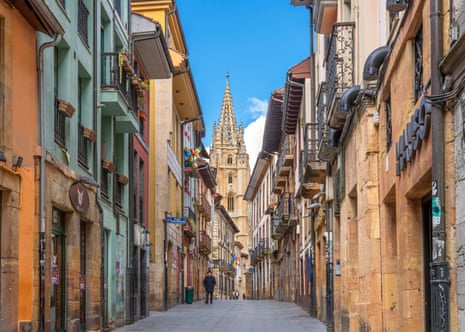
There was a school exchange to Lorca, in Murcia, of all places. Tiny little town. This is 1990, I think. And I turned up with no Spanish at all. But the family were lovely, all the kids on the trip (including the English ones) were great, and I found myself suddenly thinking actually this isn’t so hard. The language, I mean. I came back and really through myself into it, reading in Spanish (kids books, nothing clever) and translating and stuff … then, to give the brief version, GCSE, A-level and my degree was Spanish and history. The history was the part that really drew me in I think. Third year of University was Erasmus year in Oviedo, which is a step again. Studied there. “Studied”, ahem. Played football too, although I then broke my ankle. Which was all part of it.
Again: people. I did a Masters and PhD in Spanish political history which brought me back, this time to Madrid. I am, in part, an accidental journalist. And then I don’t know really, I guess it’s just being here and enjoying it, having an interest. In truth at times now, at my old age, busy with work and stuff, I sometimes feel like I don’t get as culturally engaged and immersed as I might/should, but it is true that the writing about football is always about society and people too for me and means engaging with all those kind of questions as well.
Welcome
Sid Lowe is the Guardian’s Spanish football correspondent, based in Madrid, and has been covering an increasingly busy beat for years. And after a busy week of action in the Champions League, La Liga and beyond, post your questions below the line; he’ll answer as many as he can from 12pm BST.
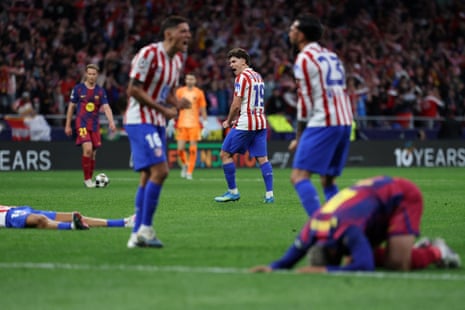
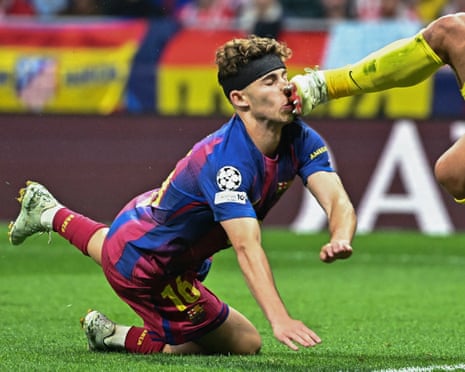
In the meantime, here’s his report from Madrid, where Atlético knocked Barcelona out of the quarter-finals, plus Andy Hunter’s dispatch from PSG’s win over Liverpool.
And after another dramatic night on Wednesday, here’s Nick Ames on a classic in Munich, where Bayern knocked out Real Madrid, plus Barney Ronay on Arsenal squeezing past Sporting.
Explore more on these topics