.png) 2 months ago
31
2 months ago
31
Yusra Cherbika was 12 when the Grenfell fire broke out, a stone’s throw from her home. She and her family were evacuated that night and spent over a year living in a hotel, where she had to continue studying and revising for her exams.
At school, she faced empty chairs for classmates who hadn’t returned after the fire – for weeks, no one knew if they were dead or alive. One of her friends never came back.
“We grew up with Grenfell; it was a huge part of our childhoods,” she said. “We were forced to grow up really quickly – we were still sitting the same GCSE exams as everyone else, but we were dealing with this at the same time.
“For many of us this was our first experience with death, and for it to be so traumatic, it’s completely shaped who we are now.”
Cherbika, now 21, is one of a growing number of young people affected by the Grenfell fire stepping up to fight for justice, and for a better understanding of how the trauma of the fatal fire affected young people who lived through it.
Through the local community hub The Space, they have created a youth-led support service to allow people to share their experiences and trauma without judgement. They have also launched a campaign – Hear Their Healing – calling for a parliamentary inquiry into the impact the fire had on children’s mental health.
A number of young people said the mental health support they had been given in the aftermath of the fire was woefully lacking, and mainly consisted of art therapy sessions, while some children were simply “written off” and excluded from school for bad behaviour.
“How can you exclude someone after they’ve gone through that?” said Cherbika. “There was this perception at the time that we were too young to understand, so let’s just put them in art therapy. I didn’t even know what therapy was.

“I’m sure for some kids it worked, but they never gave us any choice and they didn’t understand the context of where we live. I’m Muslim and one of the ways I healed was through a religious pathway but that was never an option, it wasn’t even spoken about.”
Rabab Chentoum, 20, who attended school underneath the tower, said she didn’t understand the full scale of the disaster at the time, or how it was caused by huge systemic failures – the mental health toll has come later, as she slowly realised the scale of negligence.
“Obviously at the age of 11, I’m not going to understand death as much adults, and our parents tried to protect us,” she said. “As I got older, I began to see how deep it actually was, how the government and council were at fault. I’ve become more exposed to the truth of everything and it has started to impact me more.”
Chentoum added that sending people from outside the area to run therapy sessions created backlash when emotions were running high, and when trust in authorities had been lost.
“Personally, I don’t think those in power care about us. We don’t really trust them or have respect towards them because of what happened,” she said.
Samia Badani, the chief executive of The Space, which she set up in the aftermath of the fire, said: “We need to learn from what happened after Grenfell, the fact there was no safe space for children and young people to even start expressing themselves.
“The government failed to do an impact assessment on the mental health of young people, and they consistently fail to include young people’s voices in policies or services.”
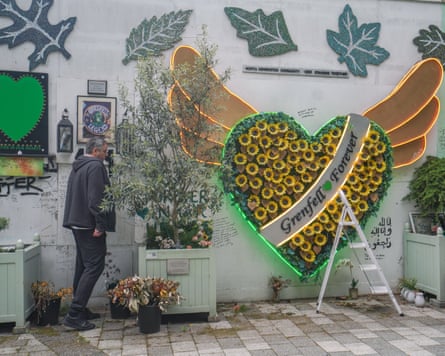
Joe Powell, the Labour MP for Kensington and Bayswater, where the tower sits, said young people across the area had been “profoundly affected” by the fire and “it’s right we listen to their voices on what they need.”
“Our community has some of the largest health inequalities in the country, so I expect the NHS and the government to take seriously the call for further investigation into what young people need to heal and thrive,” he said.
Nine years on from the fire, and still awaiting charges from the police investigation into the cause of the blaze that killed 72 people, young people are keen to take on the burden from older, longstanding campaigners who have been fighting for justice for years. Some of the oldest residents fear they may not see justice in their lifetime.
“We feel a sense of responsibility to carry on the legacy that older people started,” Cherbika said.
On the eve of the anniversary they run a Young People’s Remembrance Day to allow the younger generation to grieve and pay respects on their own terms, as well as running a wellbeing hub with qualified therapists on the day of the anniversary itself.
“Being 12 when the fire happened, I feel a sense of responsibility to give people who are 12 now the voice we weren’t given when we were younger,” said Cherbika.
Badani said she was proud to have watched young people in the area flourish and embrace new opportunities, despite the trauma they had lived through.
Cherbika is about to start working as a primary school teacher, hoping to pass on everything she has learned from her own experience to help the next cohort of young people.
“We realised on the night of the fire the authorities weren’t around, we couldn’t wait for someone to help, we needed to create the change. And young people are doing it even better than us,” said Badani. “Their energy has been really uplifting in the community.”