.png) 2 hours ago
7
2 hours ago
7
It was the summer of 1984 and things weren’t going well for Paul Simon. The year prior, a blockbuster Simon and Garfunkel tour ended in bickering. Meanwhile, even though the 1980 single Late in the Evening reached the US Top 10, Simon’s last two albums had not sold very well, and his marriage to Carrie Fisher was starting to unravel. In the midst of all that the 43-year-old folk icon was steadily working on building a beach home out on the far end of Long Island.
Many of Simon’s pilgrimages from Manhattan out to Montauk were soundtracked by a bootleg tape of accordion-heavy mbaqanga, a South African music style with jazz rhythms and bright guitar chords, he had received from a friend. It was on those drives that the seeds of Graceland, the crown jewel of Simon’s discography, were planted. “Many of us, in that day and age, found a moment of self-reflection – of being able to go deep inside ourselves – when we were in the car on these road trips,” said Ashley Kahn, whose new book, Days of Miracle and Wonder, follows the gestation process of Graceland. “If it wasn’t the radio, it was cassettes.”
Forty years on, Graceland remains the most nimble, ecstatic album that Simon’s hands have touched. It’s constructed around contributions from South African musicians whose “township jive” reminded Simon of the early rock and doowop records he heard as a kid in Queens. There’s musical detours of all kinds – a trip to Louisiana inspired Simon to record with zydeco group Rockin’ Dopsie and the Zydeco Twisters, while the song All Around the World or the Myth of Fingerprints features Los Lobos’ fusion of norteño and rock. Simon is at his best when among resonant rhythms from Johannesburg.
Inspired by the bootleg, Simon booked jam sessions in Johannesburg with different bands – General MD Shirinda and the Gaza Sisters, Tao Ea Matsekha, the Boyoyo Boys – where he developed melodies and scribbled down lyrics as engineer Roy Halee tracked the group’s grooves. Some of the songs that ended up on Graceland were assembled on top of these groups’ already-finished songs, such as Gumboots, a thrilling pop confection that Simon initially heard as an instrumental on that tape. For Simon, whose process often started with an acoustic guitar, it was a profound shift in how he approached his craft. “He’s finding a way of building from the rhythm up; that, for him, was profoundly new,” said Kahn, who compared Simon’s then-newfound process with hip-hop: “Start with the beat and match the words to the beat.”
In these February 1985 sessions, Simon had found a surge of inspiration, but the harsh realities of South African apartheid loomed outside the studio doors. After dark, the Black musicians weren’t allowed on the streets of Johannesburg, nor were they allowed to use public transportation. As a result, a day of recording would reach an “uncomfortable time when the players couldn’t concentrate until they knew there might be a car to take them home”, Simon told Rolling Stone in 1986. In a foreshadowing of the backlash Graceland would go on to receive, the manager of the Soul Brothers told Simon he believed recording in South Africa constituted a violation of the United Nations’ 1980 boycott, which was passed to prevent the South African government from using culture as propaganda for apartheid.
Kahn believes that Simon had the musicians’ labor rights in mind. “He wanted to have them participate, he wanted them to be credited and he wanted them to be compensated,” said Kahn, emphatically noting that Simon paid the South African musicians triple the daily rate of musicians in American unions. “Did he do it perfectly? No. But there wasn’t a set formula of how to approach this.” Simon has still faced backlash over the years about Graceland’s songwriting credits from several musicians who appeared on the album, including Los Lobos, Rockin’ Dopsie and the Zydeco Twisters, and even guitarist Ray Phiri, who helped construct the album’s title track. Against charges of cultural appropriation, Graceland advocates have suggested that Simon’s work in South Africa helped bring these bands, such as Ladysmith Black Mambazo, who round out the starry-eyed Diamonds on the Souls of Her Shoes, to a larger audience.
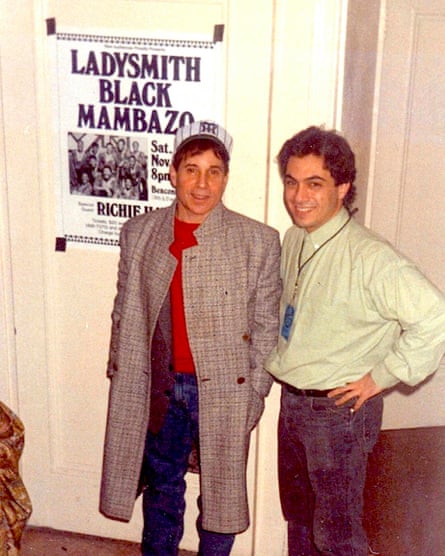
Before the first sessions at Ovation Studios in Johannesburg, Simon spoke with calypso legend Harry Belafonte, who had suggested that he reach out to the African National Congress. Believing that the power of art trumped laws, Simon resisted Belafonte’s recommendation. Months after the release of Graceland, the UN’s special committee against apartheid censured Simon and planned to add him to the list of performers who violated the boycott. “They were looking for a coordinated message, coordinated push, hence the issue with the boycott,” Kahn added. The UN’s decision was reversed months later when Simon wrote a letter to the committee noting that he had understood the ban focused on performing, not recording, and he had no intentions of performing in South Africa.
A career-long tug-of-war between Simon’s cerebral and conversational language courses through Graceland. He eschewed overt anti-apartheid protest songs, but the anxieties of his experience in South Africa seep into Homeless and The Boy in the Bubble, which opens on an image of “the soldiers by the side of the road” while the interplay between famo-style accordion and bass suggests something threatening up ahead. But Simon’s qualms and anxieties – his failed marriage, his feelings about being washed up, his anxieties related to the information age – are what he fleshes out on Graceland, often through dizzying images (“lasers in the jungle”) or larger-then-life characters (“Fat Charlie the Archangel”).
“One of the images that always comes to me is Paul in a room with a rubber ball – bouncing it, bouncing it, bouncing it – to get into a Zen-like state where lyrics start to come,” Kahn said. “He’s already thinking about songwriting. The lyrics are there. He just needs to silence all the other shit that’s in one’s mind.”
Graceland’s steady stream of longing, sometimes offered through simple lines such as “You don’t feel you could love me but I feel you could,” contained unexpected emotional wallops. On the album’s very best songs, there’s an impressionistic flow of feeling in Simon’s lyrics. Nowhere is that clearer than in the title track, where the word Graceland had initially been written down as a placeholder. It eventually evolved into a figurative destination for Simon as he tried to mend his broken heart after his marriage to Fisher. “If I miss in the direction of head, I risk being obscure or pretentious,” Simon said in 1986. “If I miss in the direction of heart, I risk being sentimental. I dread both. I dance in the penumbra. That’s the thrill. When it’s right, I can feel it.”
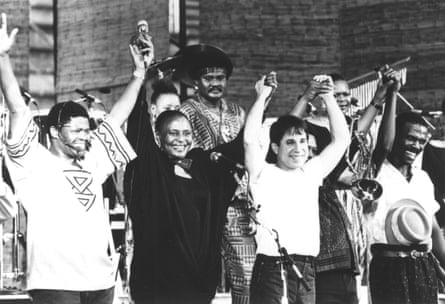
Many revisions and additions happened stateside, including the guitar-synth textures from Adrian Belew and Steve Gadd’s AMS reverb-drenched drums on All Around the World. For another set of sessions, including the one in which they rerecorded You Can Call Me Al, Simon flew Phiri, Bakithi Kumalo – whose restless fretless bass is now synonymous with the Graceland album – and drummer Isaac Mtshali to New York, where Simon also shared his progress with David Byrne, Cyndi Lauper and Phillip Glass. He would turn on a tape of an instrument track, get close to their ears and sing the melodies or lyrics he’d crafted. “The fact that Paul was open to sharing the process with a lot of people goes to show a certain strength, as well as an openness to saying, ‘I could be wrong,’ or, ‘I could be better,’” Kahn says.
Graceland’s influence as a genre-defying, cross-pollinated album has spread far and wide, informing brilliant artists such as Vampire Weekend and Lorde, plus with one particular viral parody of Simon’s approach. For almost as long as the album has been in stores, a healthy dose of criticism has followed: two decades before he would produce for Beyoncé and Eminem, a young Mark Batson asked Simon how he could justify “taking over this music”, before discussing how Black art has been “stolen” by white artists time and time again during a Q&A at Howard University. It’s a testament to the life-affirming melodies and jubilant grooves of Graceland that it hasn’t been consigned to the dust bin of history of an embarrassment – and that these conversations endure. “All these questions about appropriation, about systemic racist, about the entitled versus the non-entitled – that’s never going away,” Kahn says. “What Graceland did was show us a way to talk about it.”
It’s hard to imagine when Graceland arrived in stores towards the end of August 1986 that it wasn’t an overnight sensation. Support from music critics, performances on Saturday Night Live and eventually Grammy wins helped it find an audience. (It entered the Billboard 200 album chart at No 94 in September 1986, before eventually peaking at No 3 next April, just over a month after the Grammys ceremony.) The final piece of the puzzle was pop radio programmers, who didn’t understand the stylistic jumps taking place across Graceland. The spring after the album’s release, radio honchos latched onto its lead single, You Can Call Me Al, with its attempts to find salvation in the “angels in the architectures”. It was a classic case of better late than never: “It was a damn unicorn,” Kahn says. “In the zoo of music, they had no idea which cage to put it in.”
-
Days of Miracle and Wonder: Paul Simon and the Trials and Triumphs of Graceland by Ashley Kahn is out now