.png) 1 month ago
21
1 month ago
21
Algiers, 1969. What had, for seven years, been the metropolis of a newly independent country became, over the course of 12 days in July, the cosmopolitan centre of an entire continent. That summer, Algeria played host to the first Pan-African Cultural festival (Panaf) and the capital’s streets were transformed into a vista of energising performers, flanked by placards announcing each country’s delegation: Ethiopia, Liberia, Mali.
Picture an Olympics-style opening ceremony, then discard it, for the images captured in William Klein’s documentary of the event, The Pan-African Festival of Algiers, hint at the very dissolving of barriers between spectacle and spectator – an act that brings to life a quote, shown on screen, from Guinea’s first president Sékou Touré: “We must make this revolution with the people … and the songs will come.”
Far from an abstraction, as a cinematic accompaniment to the Barbican’s ongoing Project a Black Planet exhibition, the film programme opened with that footage and, across the next three months, will bring together an array of works showcasing how the project of pan-Africanism affected the lives of African and African-descended people.
Some, including Roy Guerra’s 1979 feature Mueda, Memória e Massacre from Mozambique, address the legacies of colonial crimes such as the 1960 Mueda massacre by Portuguese forces, and how the act of remembering becomes a part of the struggle for liberation. Others, such as Timité Bassori’s The Woman with the Knife (1969) and Djibril Diop Mambéty’s Hyenas (1992), reflect on the postcolonial condition through psychoanalysis and satire.
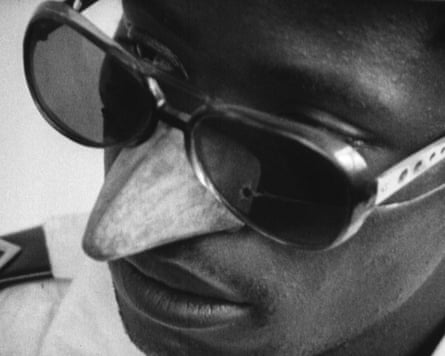
For the programme’s curator, Matthew Barrington, the “inherently populist” medium of film is one way to show the extent to which pan-Africanism “manifests in the way of people and how they interact”, with the aim being that the selections are “all in a dialogue” with each other.
He invites people of various backgrounds and generations to “come to the space, see some of these films” and draw out the connections between them, while finding new entry points into the subject matter, through music, panel discussions and performance lectures designed to prompt “different ways of thinking about these films”. Alongside the screenings, recitals from the poets Linton Kwesi Johnson and Sarah Lasoye will take place, as well as a set from DJ Coby Sey.
The chosen films also seek to take inspiration from the classic works of African cinema without being overly reliant on a canon that risks centring on a select number of male auteurs. Since Project a Black Planet’s first edition in Chicago, the works of Sarah Maldoror have accompanied the touring exhibition and will do so again at the Barbican, in the guise of Fogo, l’île de feu – released in the same year as Guerra’s Mueda – which takes Cape Verde as its setting to meditate on land and labour after the dawn of independence.
Annouchka de Andrade, the founder of the Association of Friends of Sarah Maldoror and Mario de Andrade, has spent several years working to secure the rights of, restore and distribute her mother’s cinematography, while putting together a film and book project about her life.
In the case of Sambizanga, perhaps Maldoror’s most well-known work, de Andrade noted that “it was kept by a producer for 40 years … and she didn’t have any copy” with Maldoror having to challenge the industry’s racism and sexism as a Black woman. It was a fight compounded by the lack of financial resources afforded to her, such that more than 50 of her planned projects were left unrealised.
Although Maldoror was credited as an assistant in Klein’s endeavour to film Panaf – a production often betrayed by an overbearing male gaze and described in Elaine Mokhtefi’s autobiography Algiers, Third World Capital as “beyond Klein’s organisational skills” – the risk of her marginalisation from mainstream narratives of pan-Africanism is an all too familiar case.
De Andrade highlighted that “her first three movies were dedicated to the struggle in Angola and Guinea-Bissau, but she was not part of the male discourse, and when you see the picture of all the people at the first Congress of Black Artists and Writers, you have only one woman [but] Sarah was in the room”, not to mention the involvement of writers such as Suzanne Césaire, a leading intellectual of the négritude movement.
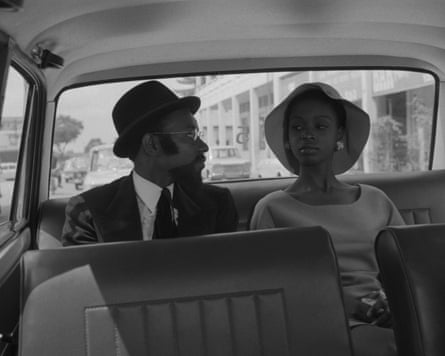
Négritude is plainly a point of contention at Panaf, something of a cultural proxy for political disagreements between an Algerian government seeking to take on the mantel of “third worldism” against conservative regimes exemplified by Léopold Senghor’s Senegal, which had hosted the first World Festival of Black Arts (Fesman) three years earlier.
Some of these nuances emerge in the season’s Ambiguous Encounters strand, curated by Abiba Coulibaly, marking 60 years this September since Fesman and the Tricontinental conference in Cuba took place.
Inspired by her curatorial work at Brixton Community Cinema and academic background in geography, Coulibaly shines a spotlight on the African cities of Dakar, Algiers and Lagos (which was the venue for the second edition of the World Festival of Black Arts in 1977) without aiming to deconstruct pan-Africanism, but rather “to sit with all of the discomfort and contradictions within it”.
Aside from its limits, the season explores the borderless expanses of pan-Africanism to include the influence of Havana and diasporic cinema such as Ola Balogun’s Nigerian-Brazilian collaboration, Black Goddess.
How, then, to understand pan-Africanism? That is a question posed by Kodwo Eshun, a co-founder of the Otolith group whose films In the Year of the Quiet Sun and Nucleus of the Great Union will also be shown during the season and “speak directly” to this. Eshun said that while the term has many definitions, the group’s argument is that “pan-Africanism is the transformation of the continent, which implies the transformation of the planet … if pan-Africanism was a dream, why did Belgium, USA and Britain go to the lengths they did to assassinate Lumumba? It wasn’t a dream, it was a threat.”
On the eve of Panaf, while Africa’s eyes were fixed on Algiers, another event was taking place, albeit not on Earth – July 1969 was also the month of Apollo 11’s mission to the moon. Decades on, in an era that looks again to the skies for distraction from the planet, the groundings of pan-Africanism’s transformative vision makes for compelling viewing.