.png) 3 months ago
90
3 months ago
90
Her ordeal began with stomach cramps; 19 years old and training to be a nurse, she knew something was wrong. At the hospital she waited for hours in the emergency department. She had suffered an obstetric emergency.
Under El Salvador’s legal framework, emergencies including miscarriages and stillbirths, place women under criminal suspicion. She lost the baby and doctors alerted the police. She was arrested and handcuffed.
“She couldn’t understand what happened,” says a lawyer in El Salvador, speaking anonymously for fear of political reprisals. “She went to hospital with a stomach ache, not knowing she was pregnant, and had an emergency.
“Then she was taken to prison, and faced a prosecution asking for a 50-year sentence. She was in complete shock,” the lawyer says.
El Salvador has some of the most restrictive reproductive laws in the world. Since 1998, abortion has been banned under all circumstances – including rape, incest and risk to the mother’s life – and in 1999 a constitutional amendment enshrined the protection of life from conception. In practice, women accused of terminating a pregnancy have been charged with aggravated homicide – a crime that carries a sentence of up to 50 years in prison.
Women who have had obstetric emergencies are often reported by hospital staff and even imprisoned under charges including negligent homicide.
In recent years, there had been fragile and hard-won signs of change.
The law itself has remained in place, but sustained advocacy by women’s rights groups, combined with international pressure, led to a shift in how it was applied. Between 2009 and 2023, campaigners secured the release of dozens of women imprisoned for abortion-related charges, miscarriages, stillbirths and obstetric emergencies.
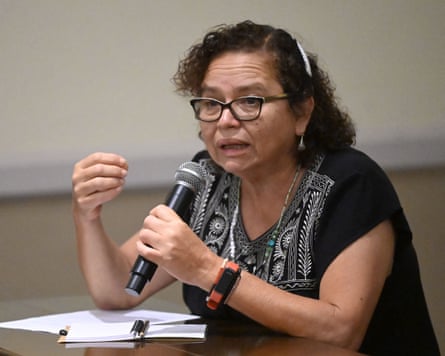
Morena Herrera, a reproductive rights advocate in El Salvador, helped lead the fightback. “By [2023] we had managed to get them all out of prison,” Herrera says. In total, 81 women were freed from 2009, many from decades-long sentences for aggravated homicide.
But now, under the country’s state of emergency, progress is unravelling.
In March 2022, President Nayib Bukele – a populist who described himself as the “world’s coolest dictator” – assumed emergency powers and suspended civil rights in a move known as the “state of exception”. Framed as a temporary response to combat rampant gang violence, the crackdown has had far-reaching consequences for human rights and the justice system. Due process has been suspended, and about one in 50 adults imprisoned.
Advocates say those emergency powers have quietly expanded into hospitals, ensnaring women who suffer miscarriages, stillbirths and other obstetric emergencies. “We are experiencing a new spiral of criminalisation against women,” says Herrera, who is the former president of Citizens’ Group for the Decriminalisation of Abortion.
In a further sign of the increasingly restrictive environment, the group, which was the only organisation in El Salvador campaigning for the decriminalisation of abortion, announced its legal dissolution on Monday, saying the political climate had become “incompatible” with its work.
According to a team of lawyers in El Salvador, at least 29 women have faced investigations since 2022, with several currently behind bars.
“Women go to hospitals seeking medical help, are identified as suspected of having induced an abortion and prosecuted. They are accused of aggravated homicide and face sentences of 30, 40 and 50 years in prison,” Herrera says.
She describes a recent case of a woman being prosecuted after her baby died during a breech delivery. In another, a woman was charged with attempted aggravated homicide after giving birth alone in a toilet, even though the baby survived.
Behind this regression in human rights is Bukele’s “state of exception”. Under his regime, constitutional protections have been suspended or undermined, such as access to a lawyer and the presumption of innocence.
Administrative detention, once limited to 72 hours, has been extended to up to 15 days before an initial hearing. During that period, detainees may have no contact with legal counsel or family members, making it harder for defence lawyers to gather evidence or challenge prosecutions. Juanita Goebertus, Americas director at Human Rights Watch, says that after the initial hearing, most of the women are now placed in pre-trial detention, where they “spend months or years without effective access to legal counsel or contact with their families”.
The Salvadorian lawyer says Bukele’s emergency powers have fundamentally altered the legal landscape.
In the case of the 19-year-old trainee nurse, none of her testimony was heard, despite repeated requests from her defence team. Prosecutors sought a 50-year sentence, but the court handed down a three-year sentence for negligent homicide, later converting it to 144 days of community service. The prosecutor’s office said it would appeal.
“There was some form of progress with the women being released in the campaign,” the lawyer says. “But now, again, we see ourselves in this wave of criminalisation.”
Paula Ávila-Guillén, director of the Washington-based Women’s Equality Center, says that before the state of emergency was imposed, informal legal networks had been created to help protect women from immediate arrest. “We created a system with lawyers on the ground. Hospitals, instead of immediately calling the police, would call up the legal defenders, to allow us to defend the women properly.”
That system, she says, did not change the law, but it meant the lawyers were able to keep women out of prison. “These women were given the right to defend themselves,” she says. “They were actually presumed innocent instead of presumed guilty.”
“Now it is detention first, investigation later, often without meaningful access to legal defence,” Ávila-Guillén says. “These women are not accused of gang activity or organised crime, yet they are prosecuted under emergency rules designed for security threats.”
She says the resultant climate of fear has deterred medical professionals and lawyers alike from intervening: “Because of the fear these rules have created, there is a fear from both doctors, nurses and even from legal defenders to take these cases.”
Hospital staff have been compelled to report patients to authorities. Healthcare professionals who perform abortions – or are suspected of doing so – can face sentences of up to 12 years in prison. Around two years ago, authorities installed cameras in hospitals, claims a Salvadoran healthcare professional who no longer works in the state hospital system. “They put cameras inside the ORs [operating rooms], inside the emergency consultation rooms, inside the pharmacies,” they say. “They are watching you all the time. Imagine that you are a patient and you are without your clothes inside an OR, and there’s a camera there.”
Herrera says women are also too frightened to speak up. “Most don’t want to talk. They’re afraid,” she says. “It makes it harder to defend them now.”
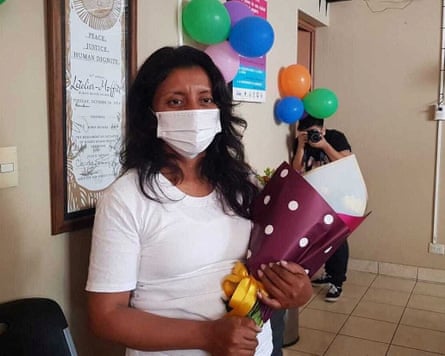
Ávila-Guillén cautions that while the impact on women may be an “unintended consequence” of the state of emergency, it is not an unforeseen one.
Authoritarian governments, she says, treat such outcomes as incidental damage. “Strongman leaders believe this is the cost of doing business,” she says. “If you want a ‘safe’ country, then some people will pay the price.”
The re-criminalisation of women in El Salvador comes amid a broader erosion of women’s rights across Latin America. In Argentina, President Javier Milei has in effect curtailed access to abortion and restricted the distribution of contraceptives through sweeping funding cuts.
In Chile, the president-elect, José Antonio Kast, has appointed a vocal opponent of abortion, the evangelical far-right Christian Judith Marín, as minister for gender equality, while in Ecuador the courts have moved to ban the morning-after pill.
Bukele is one of Donald Trump’s closest allies in Latin America, and advocates say there is little international political will to address these women’s rights abuses. “This government is aligning itself with the most conservative positions of other governments internationally,” says Herrera.