.png) 4 hours ago
7
4 hours ago
7
Julián Alvarez entered a long, dark tunnel on his own. “We’re stronger together,” Giuliano Simeone said but that wasn’t the way it went. At the end of their first home game of the season, a 2-2 draw with Villarreal, all of Atlético Madrid’s players gathered by the centre circle, shook hands with their opponents and each other, then headed towards the south end of the Metropolitano. Almost all of them did, anyway: one was left behind. Somebody in a suit had a quiet word then the press officer came, pointing in the other direction. So, while his teammates turned to the supporters who had turned on him, the man wearing No 19 went west, to the exit.
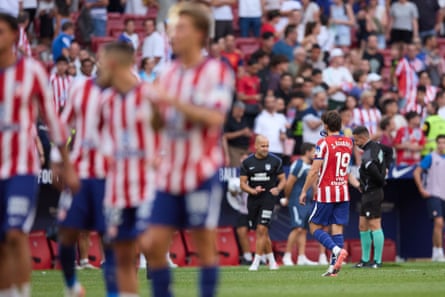
Alvarez walked alone. Head down in silence, as he had been all afternoon and beyond, he set off slowly across the pitch accompanied only by his thoughts and the whistles that followed him. Not offered a hand to shake or a nod of acknowledgment, he stepped past the Atlético badge on the touchline where the mouth of the tunnel opens. Either side, supporters hung over the void, whistling and shouting. Way off to his left, Atlético’s other players paused, seemingly waiting for him to slip out of sight before approaching the stand, but none turned back. A scarf was thrown, landing at Alvarez’s feet and left lying there. And then he disappeared into the dark, a portrait of the place he is in.
No one was waiting for him on the other side. Alvarez went up the stairs, past a couple of security guards and turned left to an empty dressing room, not lifting his gaze and not invited to either. Four minutes would pass before his teammates came up the stairs together. But at least it was quiet now, for a little while. The noise had been loud; no one could recall supporters turning on their own player quite like this. Atlético’s fans, still his fans, had whistled him when his name was read out, whistled him when he had warmed up, whistled him when he came on wearing red and white there for the first time since April and since he declared it his “dream” to leave, and they had whistled him out of there too, for good.
Good? “Unhappily, this situation isn’t comfortable for anyone,” Jan Oblak said, and amid the damage done, the mutual accusations, the hurt pride and spited faces, nor is it easy to see a solution. The situation, in short, is this: Julián Alvarez wants to leave for Barcelona. Barcelona want to sign him. But he has a contract until June 2030, a €500m buyout clause, and Atlético won’t sell him. And definitely not to them. And so, here they are. Stuck.
The first time Alvarez hinted he may not continue was after facing Tottenham in the Champions League last March. The timing seemed odd then: it hadn’t been an easy season, the feeling that something was wrong growing and about to be confirmed, but he had just scored twice and Atlético had won 5-2. It seemed odder still when he chose the moments after Argentina beat Austria at the World Cup to announce he wanted to go. “It’s not the time to talk about this but nor can I hide,” he said. “I spoke with the people I needed to [at Atlético] and the best thing for everyone is a transfer. I want to fulfil my dream.”
There had been a “bid” that wasn’t really a bid at all from Real Madrid but the dream was Barcelona and they were the ones who had been speaking to Alvarez, planning how to make it happen. Which was one of the reasons why Atlético were so determined it wouldn’t, deciding to take a stand instead, make this a cause. This was not about him wanting to go, or not only, but about the way it had been done.
From New York, Joan Laporta claimed that Barcelona had made an “important” offer. “If Atlético are prepared to accept, fantastic,” he said, but they weren’t and they didn’t think much of the offer either. Atlético’s chief executive, Miguel Ángel Gil Marín, insisted they would not sell at any price: they had told Alvarez, his agent and Barcelona that. “I know Joan: he’s always acting up for the media, fans, his own personal circus,” Gil Marín said. “I told him: ‘Leave it, please. We don’t want to sell and won’t sell, stop insisting’. He loves to play the part but he knows perfectly well that Julián won’t play for Barcelona next season.”
Barcelona insisted that they had approached a potential transfer the right way, with “respect”, but Atlético reported them to the RFEF (Spanish Football Federation) and refused to budge, a statement made, territory defended. This had become a point of principle, examples to be made of them. The noise though refused to go away. When Alvarez arrived for pre-season, still wanting out, he cut an isolated figure. If every silence and furrowed brow was analysed to death, it was true that there was an absence about him. This weekend Jorge Valdano took a line from Julio Cortázar to explain it: “When someone says they’re going, they’re already gone.”
Even if they’re not going. While Atlético quietly investigated other options, Gil Marín gave a statement again insisting that Alvarez was staying. “We can’t allow other clubs and media to dictate our policy and disrespect us,” he said. “We have values.” He attacked Alvarez’s agent too, saying that Alvarez had been poorly advised. To which Fernando Hidalgo – whose version has Atlético promising that if Alvarez publicly said he wanted to go, taking responsibility, they would allow him to – replied with a post: “Never ask a liar to explain why he lied; he would only have to lie again.”
As for the coach, watching his superiors take the lead, he was ready to put Alvarez back in the team. “You can’t be clearer than the club’s been. It’s like when the judge says: ‘Denied!’,” Simeone said. As if it was that simple, the case so easily dismissed. While Atlético said they would “look after” him, while accusing Barcelona and Hidalgo lifted some blame from his shoulders, Alvarez’s return instead underlined that coming back from this might be even harder than anticipated, redemption more of a reach than imagined.
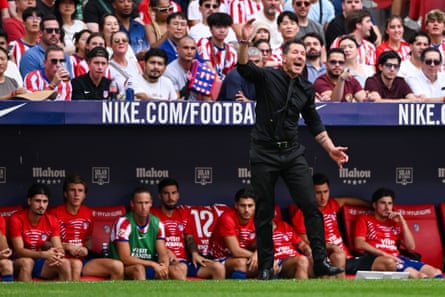
Sunday did not suggest a solution, a moment for the healing to start. Instead, it felt unsustainable, the case eclipsing all else, pressure building to find a proper conclusion. This was a fun match, but it was all about one man, the bad guy, and the verdict against him – and that affects everyone, maybe no winners any more. After the game there was a moment when, hands raised in front of him, the press officer asked journalists if there were any more questions, pausing to add … about the game … and the hands went down again. Before it, every photographer gathered in front of the bench as Alvarez took up his place to the left of Juan Musso and José María Gimenez, staring at the floor, the only movement his clenching jaw, while 60,000 people whistled his name. That, it turned out, was just the beginning.
La Liga results
ShowRayo Vallecano 1-1 Alavés, Real Betis 1-0 Real Sociedad, Espanyol 1-2 Real Madrid, Valencia 0-0 Celta Vigo, Athletic Club 1-3 Sevilla, Elche 0-5 Barcelona, Getafe 1-0 Racing de Santander, Atlético Madrid 2-2 Villarreal
When he went to warm up on 51 minutes, they whistled again. From the south end, there were chants of “Fuck Barcelona! Fuck Catalonia!” They sang: “We are Atlético”. And “Atlético yes, mercenaries no!” Another one ran: “Tell him to go, once and for fucking all!” (To which Alvarez might have thought: yeah, that’s what I’m trying to do). As Atlético’s players came to the touchline after their first goal, the fitness coach said Alvarez was about to go on. “Careful, eh,” Marc Pubill replied. The noise when he did was deafening and didn’t relent. There weren’t many touches but with every one the angry volume rose, the rejection not receding all the way to the final whistle, which was not the final whistle at all: that too was for Alvarez. With eight days left in the window, it could still have been a good riddance, but … if it’s not?
“Julián is with us in the team and for as long as he is, we’re going to support him,” Oblak said. “All I know is that if Atlético want to win titles we have to be together, we need strikers and we need important strikers,” Simeone noted, admitting he had apologised to Ademola Lookman for making him play there in the absence of Alvarez and the injured Alex Sørloth. They do have strikers, the coach said the second time he turned to that line, but they would have to “take care” of them, the coach confirming that the club had told him it was their decision that he shouldn’t greet the fans, not Julián’s.
Yet if it had been designed to protect Alvarez and if this statement had too, absolving him of having chosen to turn his back on them, it also exposed him. Leaving first without the others, none joining him, served as an expression of his isolation, his othering, of how broken the situation had become. “Together we’re stronger, that’s always characterised us, made Atlético Madrid different. He is our player so we will die for him on the pitch,” Giuliano said, but when the time came, Alvarez went alone.