.png) 2 months ago
38
2 months ago
38
It was a glorious balmy night, and I was walking home from dinner. I’d just eaten fried red mullet from the Black Sea on a pavement terrace, listening to the cries of the last swifts as darkness crept over the city. A couple of blocks from where I was staying, there was a curious sight: a couple and their dog were standing over a hedgehog, which was standing seemingly irresolute in the road. I wasn’t sure the couple were doing the right thing by shining their phone torches at the poor creature, but their intentions were clear enough: they were trying to protect it and chivvy it out of the way of the traffic. As a car bore down, I flung myself into the street, like a latter-day Roberta from The Railway Children, and waved my arms to get the driver to stop. At the same time, the couple’s dog gave an encouraging bark to the tiny animal, which scuttled across to the opposite pavement, and into the safety of a yard.
Everything always feels heightened in Kyiv, and I was apt to overthink into this moment many metaphors of escape, protection and destruction. Hedgehogs, by the way, are a surprisingly common sight in Kyiv. So too are the “hedgehogs” made from metal beams welded together in a three-dimensional star-shape, a highly effective obstruction for tanks. (The other favoured tank obstructors are known as “dragon’s teeth”, because of their resemblance to monstrous molars rising from the ground.)
After this small drama had concluded, I realised two things: that I had really, really needed the creature to survive, and that it was perhaps odd that strangers in the street should have found it necessary, in the middle of a horrific war, to band together in unspoken defence of a hedgehog.
Later that night, the Russian military unleashed a long-expected combined missile attack on the city. I woke up with a start around 2.30am, my heart racing. It took a moment for my ear to tune into the sound: was it outgoing, or incoming? Yes: outgoing – air defence. Later came Shahed drones, which sound like airborne lawnmowers, punctuated by the small-arms fire of the Ukrainians. The sonic landscape of missile, while now familiar to my Ukrainian friends, is so remarkable to me that I can never stop myself recording it on my phone.
The next morning, my brilliant colleague, the photographer Julia Kochetova, and I went out to report on the damage in two areas nearby: one, a fancy new development where the large glazed windows of almost every apartment had been blown out, and another in a much less prosperous part of the city, where ordinary Soviet-era blocks had been badly affected. Seven people were killed in that night’s attacks, 90 injured and an unknown number left with a now-ordinary set of problems to deal with, on a sliding scale scale from smashed up home to shattered car windscreen.
How do you live like this, with the knowledge that it might be your turn tonight for death, injury, or a destroyed apartment? When Julia and I visited the modern development, we spotted the young woman pictured above sitting by a huge, now glassless, window, with a beautifully made caffe latte in her hand. She gave us a quick wry smile.
The art of war
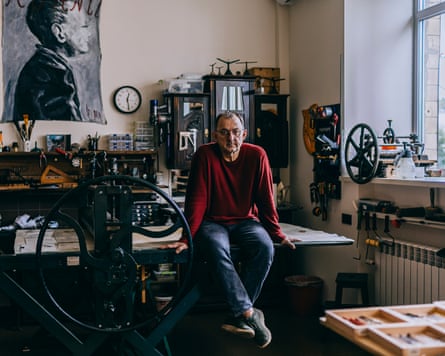
When I am in Ukraine, I write about culture, not politicians. I write about the artists who are documenting the conflict – transforming the raw and tender material of life lived in wartime into poetry, or plays, or music, or artworks that that can express what is, in normal discourse, unsayable. I’ve expanded this work into a new book, Ukrainian Lessons: Art in a Time of War, which is out in August. (You can preorder it here at the Guardian Bookshop).
The doings of Volodymyr Zelenskyy always seem very far from this world – as they also seem, on the whole, from my conversations with Ukrainian friends. It’s true that there is optimism about the frontline, though not in every direction. Places Julia and I visited last year, such as the beautiful monastery town of Sviatohirsk, are now in the kill zone, exposed to direct fire, no longer on the list of possibilities for a behind-the-lines reporter like me.
While politicians and diplomats talk, and optimistic headlines are written, I see my friends dealing with the messed-up day-to-day of a steady, relentless, and cruel campaign of air attacks that is taking lives and homes, and painfully eroding Kyiv’s urban fabric. It’s a violence and terror that people in Ukraine have been obliged to absorb into their lives, at who-knows what psychological cost.
And every time it happens, there it is: on the streets you see the quiet, stolid work of rescuing and evacuating, of sweeping and cleaning, of replacing and mending. On it goes, the work of reopening, improvising and endlessly, ceaselessly adapting.